



By Scott Hamilton
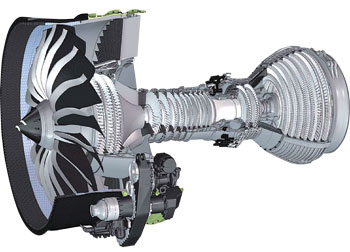
CFM LEAP engine. GE Aerospace says MRO expansion and other factors will reduce the turnaround time. Credit: GE Aerospace.
June 2, 2026, © Leeham News: Engines from all three commercial aviation manufacturers have caused trouble for owners and operators. Airbus A320neos are powered by the CFM LEAP-1A and Pratt & Whitney GTF. The Airbus A350-1000s are powered by the Rolls-Royce Trent XWB-97. Boeing’s 787 is powered by the GE Aerospace GEnx and RR Trent 1000. The Boeing 737 MAX is powered by the LEAP-1B.
All these engines suffered various technical problems of varying magnitude, and all have had shorter on-wing time (durability).
At a media briefing on May 19, GE indicated that the durability of the GEnx and LEAP has been improving as advances, design tweaks, and in-flight experience are integrated into new engines and retrofitted into in-service ones. Mohamed Ali, CEO of the Commercial and Engine Services unit, says LEAP engines shipped today will have durability comparable to the CFM56, and GEnx engines will achieve durability comparable to the CF6 and GE90 engines of years past.
Durability shortfalls led to early visits to GE-owned and independent Maintenance, Repair, and Overhaul facilities. Some within the airline and lessor community fear that a bow wave of LEAPs is about to hit, which will back up MRO across the LEAP sector and, by extension, into the widebody engine sector. It’s not an unreasonable fear. Rolls-Royce and PW are experiencing an overload of unresolved engine repairs.
Ali and others at GE believe the company’s recent MRO expansion plans and new authorized repair centers will meet demand.
Predictive maintenance

Mohmed Ali, president of GE Aerospace’s Commercial and Engine Services division. Credit: Leeham News.
“This concern is not new, and it’s not actually just LEAP,” Ali said in response to LNA’s query. “We had the same concerns about GE90, [that] when we expand the time on-wing, you’re going to get a big bow wave that’s going to be coming and hitting you. The key thing here is just to address the problem. “Number one is [to] predict it.”
GE strives to predict the exact time on-wing for each customer. “[We need to] predict the material stream that’s needed to support these shop visits as early as possible. You [want to] give sufficient lead time for the suppliers to do it. Then [you] work with the suppliers who cannot meet that collaboratively in order to meet that material stream. Finally, you accelerate repairs and limit extension, so you reduce the need for new materials continuously.”
Ali said that GE is addressing each one of these leading parameters. GE gets live data from its customers. “We also are using our models to predict what materials will be needed by when, and we can predict that years in advance. The longer we have that horizon, the better lead time we are giving for the supply chain and the repair of our network to be able to be ready for that.”
Billion-dollar expansion
GE previously announced a billion-dollar program to expand its own facilities, create new ones, and authorize third parties to provide MRO across its commercial engine line.
A program to collaborate with GE’s supply chain to ensure capacity, expansion, quality, and on-time delivery of parts and components is well underway. GE increased its own engine output by 25% of LEAP engines in 2025 vs 2024. There has been a 40% increase in the number of supplies received YOY. Turnaround times have been reduced by 25% to 50%, depending on the location.
Related
