



Two French Air and Space Force Rafale B fighters scrambled from Šiauliai Air Base in Lithuania on April 8, 2026, following a NATO Alpha Scramble alert, in the French detachment’s first interception since assuming the Baltic Air Policing mission one week ago.
The crew identified and safely escorted a Russian Ilyushin IL-20 reconnaissance aircraft flying over the southern Baltic region, the French Air and Space Force announced. No airspace violation was reported.
Two @Armee_de_lair 🇫🇷 Rafale B launched from Šiauliai 🇱🇹 today following a @NATO Alpha Scramble.
The crews identified and safely escorted a 🇷🇺 IL-20 reconnaissance aircraft flying over the southern Baltic region, along 🇱🇹 🇱🇻 🇪🇪 airspace.
This was the first interception by the… pic.twitter.com/HP2sdwc3ra
— NATO Air Command (@NATO_AIRCOM) April 8, 2026
The intercept came two days after a separate Alpha Scramble on April 6, 2026, when Portuguese Air Force F-16s deployed to Ämari Air Base in Estonia were scrambled to identify a Russian Ilyushin IL-76 Candid flying close to NATO airspace, itself the first intercept for the Portuguese detachment since taking over the enhanced Air Policing mission at Ämari on March 31, 2026, from the Italian Air Force.
Yesterday @fap_pt 🇵🇹 F-16s scrambled to identify a 🇷🇺 Ilyushin Il-76 Candid flying close to NATO airspace.
This marked the first Alpha Scramble for the 🇵🇹 detachment since taking over the NATO enhanced Air Policing mission at Ämari Air Base in 🇪🇪 from @ItalianAirForce 🇮🇹 pic.twitter.com/C0xTSrZ8e7
— NATO Air Command (@NATO_AIRCOM) April 7, 2026
An Alpha Scramble is a NATO procedure for intercepting an unidentified aircraft that does not pose an immediate threat but requires visual identification. It is distinct from a Tango Scramble, which is used for hostile or potentially hostile aircraft.
A familiar target
The Il-20 is a long-range signals intelligence platform derived from the Soviet-era Il-18 airliner. Its value lies in its ability to operate near NATO borders while collecting data on radar activity, radio communications, air defense procedures, and the response behavior of quick reaction alert forces.
Russian Il-20 activity over the Baltic has been sustained in recent months: Polish MiG-29s intercepted and escorted an IL-20 over the Baltic Sea on March 13, after the aircraft was detected flying without a flight plan and with its transponder switched off, its ninth reconnaissance mission of 2026 in international airspace.
Nuclear strike unit deployed to NATO’s eastern flank
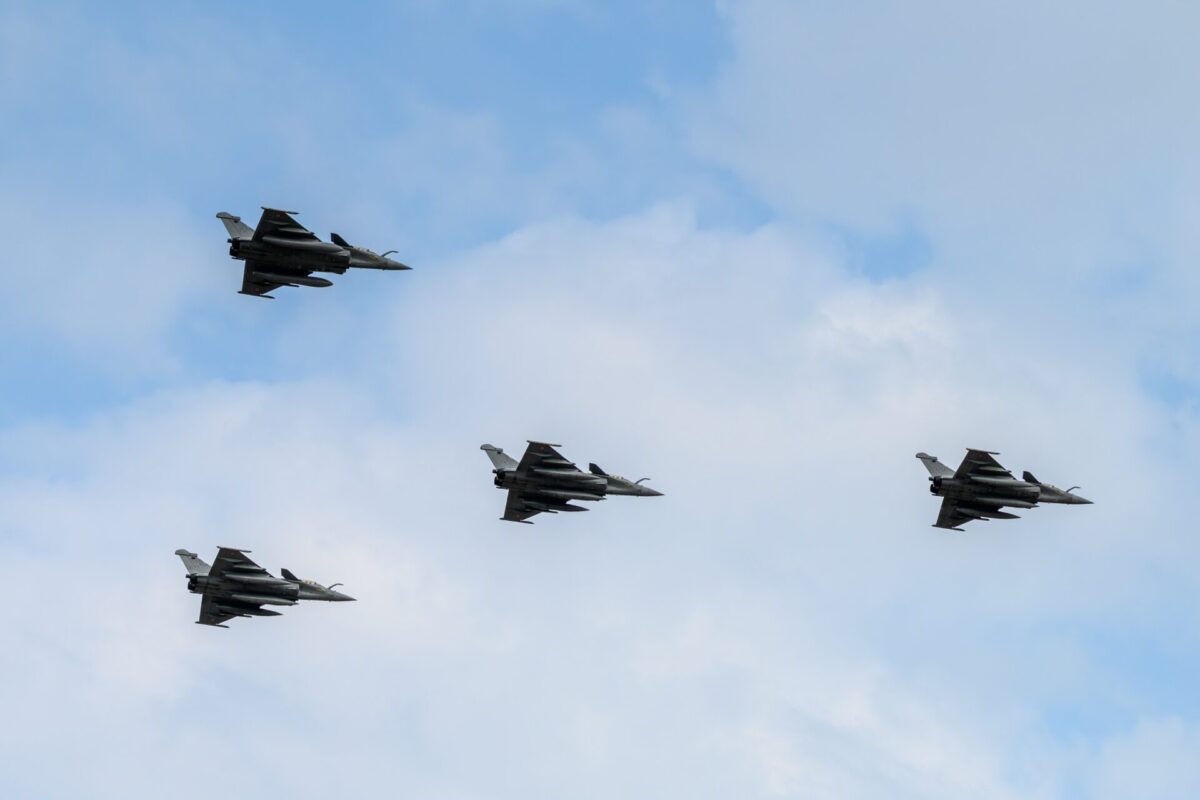
France formally took over the lead of the NATO Air Policing mission in the Baltic states at a ceremony in Šiauliai on March 31, 2026, replacing the Spanish Air Force contingent after eight months of duty. The French detachment, operating four Rafale fighter aircraft under NATO’s Integrated Air and Missile Defence system, maintains Quick Reaction Alert to safeguard NATO airspace over the Baltic region. A Romanian Air Force contingent flying F-16s is also deployed to Šiauliai for the same rotation.
Lieutenant Colonel Alexandre, chief of the French detachment, said on taking over the mission that deploying to Lithuania was “both a responsibility and a privilege,” adding: “Different aircraft, different nations, but one mission: to ensure the security of the Alliance.”
The deployment is notable for the unit involved. The 4th Fighter Wing, based at BA 113 Saint-Dizier, is the primary wing of France’s Strategic Air Forces (Forces Aériennes Stratégiques, FAS) and the operator of the nuclear-capable Rafale B. Its assignment to the Baltic Air Policing rotation, rather than the single-seat Rafale C units that led previous French rotations at Šiauliai, brings a platform central to France’s airborne nuclear deterrent to NATO’s northeastern flank.
The symbolic move comes in the context of President Emmanuel Macron’s forward deterrence doctrine, announced in March 2026, which envisions a more dispersed and forward-deployed posture for French air power across Europe.
