

Emirates, the Dubai-based carrier, has made it clear that it wants larger planes. At the  Dubai Airshow 2025 the airline even asked
  Boeing to conduct a feasibility study for a potential larger member of the 777X family, the 777-10. It has also been reported that Emirates is asking Airbus to make a larger A350.
Of course, there is seemingly a simple and immediate solution. Tens of Airbus A380s are in storage around the world, with many being lined up to be scrapped. On the sidelines of the Dubai Airshow,  Emirates’ CEO, Sheikh Ahmed bin Saeed Al Maktoum, told Simple Flying that his airline has no interest in flying second-hand Airbus A380s, and explained the reasons why.
No Second-Hand Airbus A380s Needed

Speaking to Simple Flying at the Dubai Airshow, Sheikh Ahmed revealed that Emirates wants far more high-capacity aircraft. However, according to him, this doesn’t mean that second-hand Airbus A380s would ever be considered by the airline.
The reason that Emirates is not interested in second-hand Airbus A380s seems to revolve around a level of uncertainty knowing exactly how those aircraft have been cared for, both by their former operators and while in storage for extended periods of time.
Sheikh Ahmed remarked,
“No. We’re not taking any [second-hand A380s] because we don’t want to bring an older aircraft. At least we know that those aircraft which we have today are well maintained, have been refurbished, and all of that. Of course, we will always be there seeing if any manufacturers will build something that will be a similar size or even bigger.”
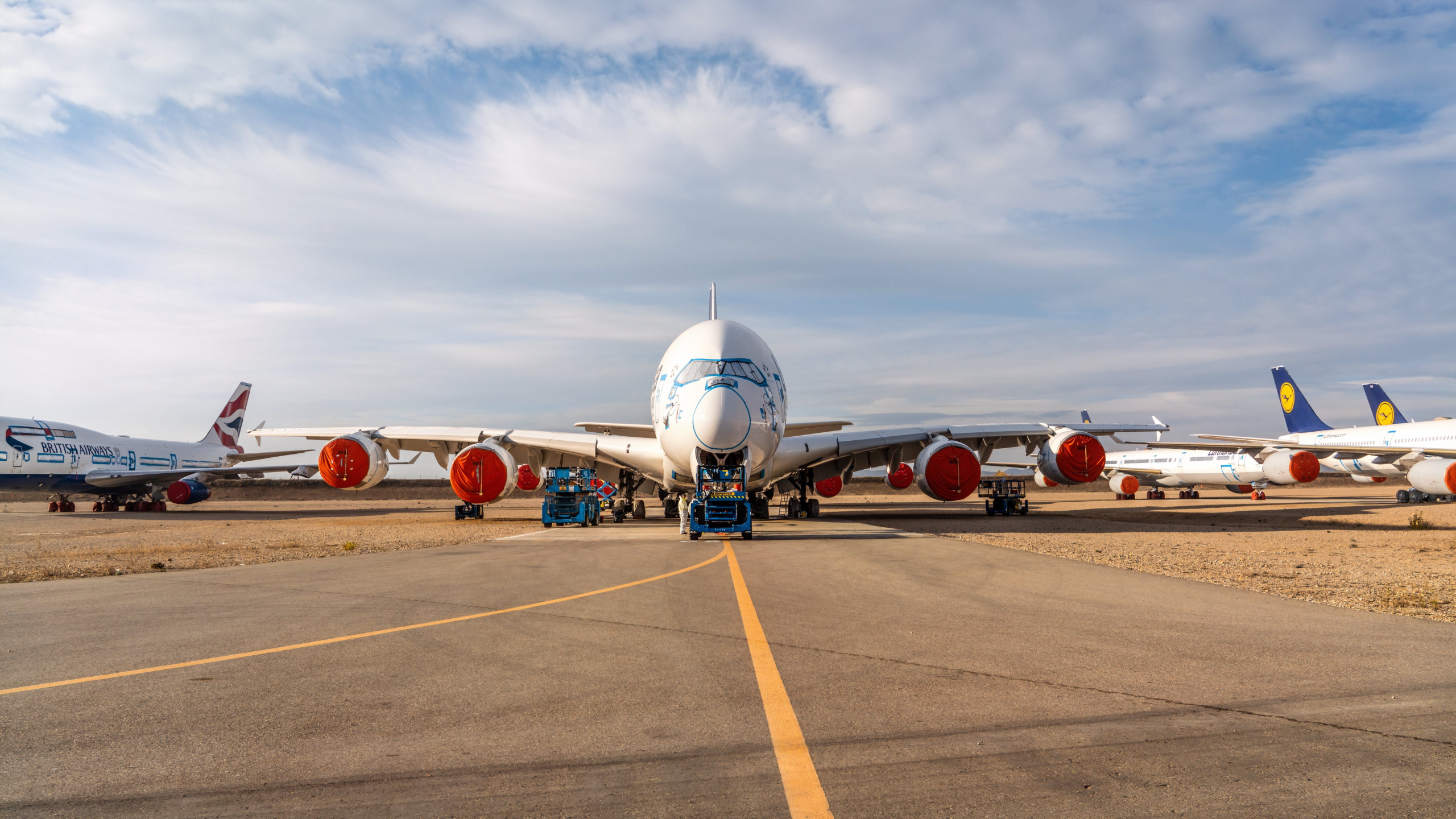
Emirates Still Has Its Own Airbus A380s In Storage

Before considering new A380s, it would naturally make sense for Emirates to look to reactivate the few A380s that it still has in storage. According to data from ch-aviation, Emirates still has eight A380s that have been in storage for more than a year ranging from MSN 9 with an age of 19.25 years to MSN 90 with an age of 14.38. These aircraft are as follows,
|
Aircraft |
MSN |
Age (years) |
Stored Since |
|---|---|---|---|
|
A6-EDE |
17 |
17.16 |
March 9th, 2020 |
|
A6-EDI |
28 |
16.12 |
March 17th, 2020 |
|
A6-EDT |
90 |
14.38 |
March 18th, 2020 |
|
A6-EDP |
77 |
14.7 |
March 22nd, 2020 |
|
A6-EDJ |
9 |
19.26 |
March 23rd, 2020 |
|
A6-EDR |
83 |
14.5 |
March 23rd 2020 |
|
A6-EDL |
46 |
15.83 |
March 24, 2020 |
|
A6-EDC |
16 |
17.5 |
March 24th, 2022 |
As all but one of these aircraft haven’t flown for several years, reactivating them is not a simple process. Lots of maintenance will be needed to bring them back into an airworthy condition, and it may simply be more cost-efficient to scrap them for spare parts despite Emirates’ desire for larger aircraft.
Talking about the difficulty of reactivating these A380, Chris Welham, Senior Manager Base Heavy Maintenance, Emirates, told Simple Flying on the sidelines of the show,
“They’ve built up an enormous maintenance burden now. By the time we would be planning to bring the last one back, it would have been parked [at Dubai World Central] for seven years, because this is from COVID. And then you start to look at the financials of it. Is it possible to bring it back? Is it possible to get that aircraft compliant again? In some cases, no.”
How Many Airbus A380s Aren’t Flying

Airbus built 254 Airbus A380s during the program’s lifetime. Of these Emirates received 123, or just under half of all built. Three were test aircraft, and the remaining 128 were split between 13 customers from ANA to Singapore Airlines.
According to ch-aviation, just 160 Airbus A380s are currently listed as “active”. 31 planes are listed as “scrapped” or “on display”. This surprisingly leaves a further 63 aircraft. Of these remaining aircraft, 24 are retired, 23 are in maintenance, and the final 16 are in storage.
There have been two attempts at flying second-hand Airbus A380s to date. Hi Fly tried operating a former Singapore Airlines A380 as a wet-lease aircraft, but couldn’t find sufficient demand for the plane. Meanwhile, Global Airlines has ambitions to launch Airbus A380 services, but their aircraft has been parked since two test flights in May despite the carrier denying that it was going to storage.
source
