


Asia-Pacific is emerging as one of aviation’s fastest-growing markets, prompting aircraft manufacturers to rethink how they support operators across the region’s diverse geography.
For Embraer, the answer has been building what executives call a comprehensive “ecosystem” approach, with Singapore at the center of operations spanning from Japan to New Zealand.
The Brazilian aircraft manufacturer has spent 25 years establishing regional infrastructure designed around proximity. This approach keeps parts, training and technical expertise close to operators rather than managing everything from distant headquarters. With roughly 320 aircraft operating across the region, the company believes its localized approach provides competitive advantage in markets where service quality increasingly differentiates manufacturers.
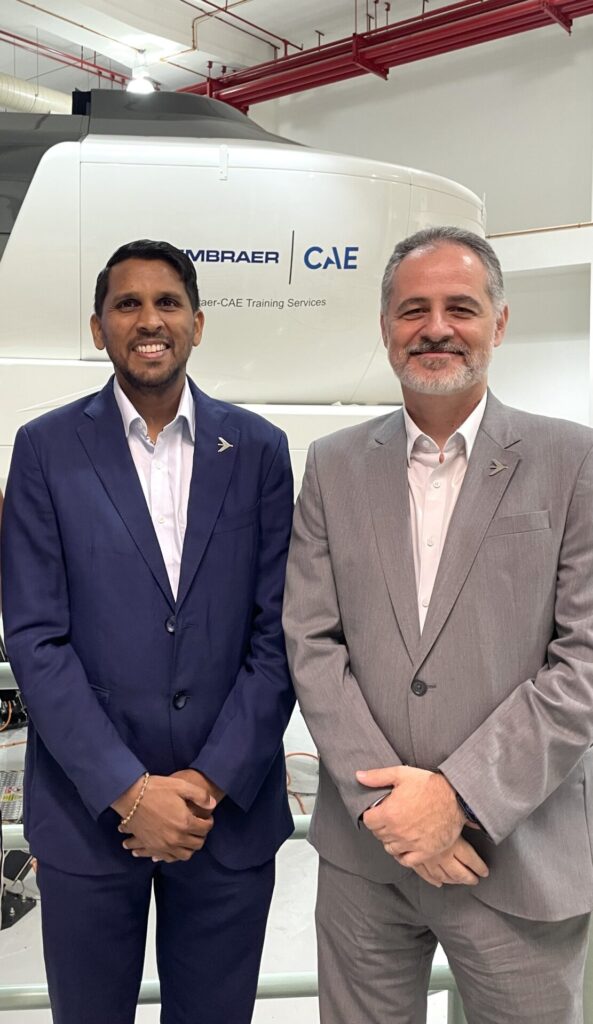
AeroTime spoke exclusively with Carlos Naufel, President and CEO of Embraer Services and Support, and Ganesh Gopalakrishnan, Head of Services and Support for Commercial Aviation in the Asia Pacific region at Embraer, about the company’s regional strategy and recent infrastructure investments.
Training facility exceeds expectations
The Singapore training facility has become a cornerstone of Embraer’s regional presence since opening two years ago. Naufel described the momentum as “a success”.
“We inaugurated the training center here in February 2024, and it’s becoming a huge success,” he said. “We’re seeing lots of customers coming here more and more.”
While Embraer has maintained a Singapore office for more than two decades, the addition of the full-flight simulator has transformed the company’s regional positioning. The facility has already trained more than 200 pilots from operators including Scoot, Virgin Australia, and Hunnu Air, with All Nippon Airways expected to join following its recent E190-E2 order.
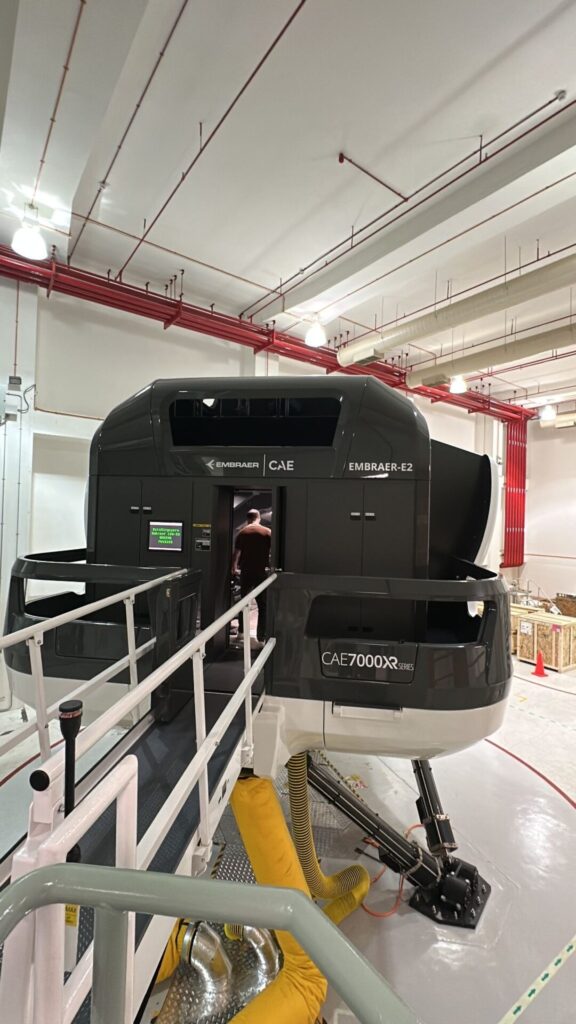
The training programs balance efficiency with thoroughness. Gopalakrishnan explained the standard approach: “It’s a 20-day program: eight days in the classroom, three days in what we call an FTD [Flight Training Device], then eight days on the simulator, followed by a final check.”
For airlines transitioning between Embraer aircraft variants, the process becomes significantly streamlined. Naufel noted that pilots moving from older E-Jet Series to the E2 family require only two days of training, reflecting the design commonality between the aircraft generations.
The partnership with CAE is also expanding into new aviation segments. At Singapore Airshow 2026, CAE announced that Embraer-CAE Training Services has purchased its first full-flight simulator dedicated to training pilots for Eve Air Mobility’s eVTOL aircraft. The simulator will support Eve’s certification process and prepare pilots for commercial urban air mobility operations, demonstrating how the joint venture is positioning itself for emerging aviation markets beyond traditional aircraft training.
Philippine partnership marks decade milestone
The relationship with SIA Engineering Philippines exemplifies Embraer’s long-term approach to regional partnerships.
“We entered into an authorized service center agreement with SIA Engineering Philippines in Clark in 2016, so this year we celebrate our 10-year anniversary,” Gopalakrishnan explained. “They’ve been doing E1 aircraft for the past 10 years.”
The partnership recently expanded when SIA Engineering Philippines gained authorization for E2 maintenance in 2024, completing what Gopalakrishnan called “a complete ecosystem” that combines Singapore’s parts warehouse, training facility, and Philippine maintenance capabilities.
Comprehensive regional vision
The infrastructure investments reflect Embraer’s belief that regional presence drives commercial success. Naufel emphasized the breadth of the approach.
“As you can see, we’ve built out an ecosystem that’s not just training. It’s training, maintenance, parts, technical support with field representatives and account managers. All the infrastructure is here because it’s a very important region and it’s growing a lot.”
Infrastructure supporting the strategy
This executive vision is backed by substantial infrastructure investments across the region. At the center sits a Singapore warehouse holding more than $100 million in parts inventory, functioning as one of seven global distribution centers designed to deliver components within hours rather than days.
Embraer operates a hybrid maintenance model combining 15 company-owned facilities globally with more than 70 authorized partners. In Asia-Pacific, this includes partnerships with Fokker Services Asia in Singapore for older E-Jet Series aircraft alongside the Philippine operations for both aircraft families.
The company has also shifted toward outcome-based service contracts, with all E2 operators worldwide participating in parts pool programs. Under these arrangements, Embraer manages component availability and repairs in exchange for hourly payments, shifting inventory management from airlines to the manufacturer while providing cost predictability.
The executives’ confidence reflects broader industry optimism about Asia-Pacific aviation growth, though Embraer’s regional success ultimately depends on continuing to win orders in markets where competitors like Airbus and Boeing remain dominant.
For now, the company appears committed to the proximity strategy, betting that local presence translates to stronger customer relationships and, eventually, more aircraft sales.
source
