

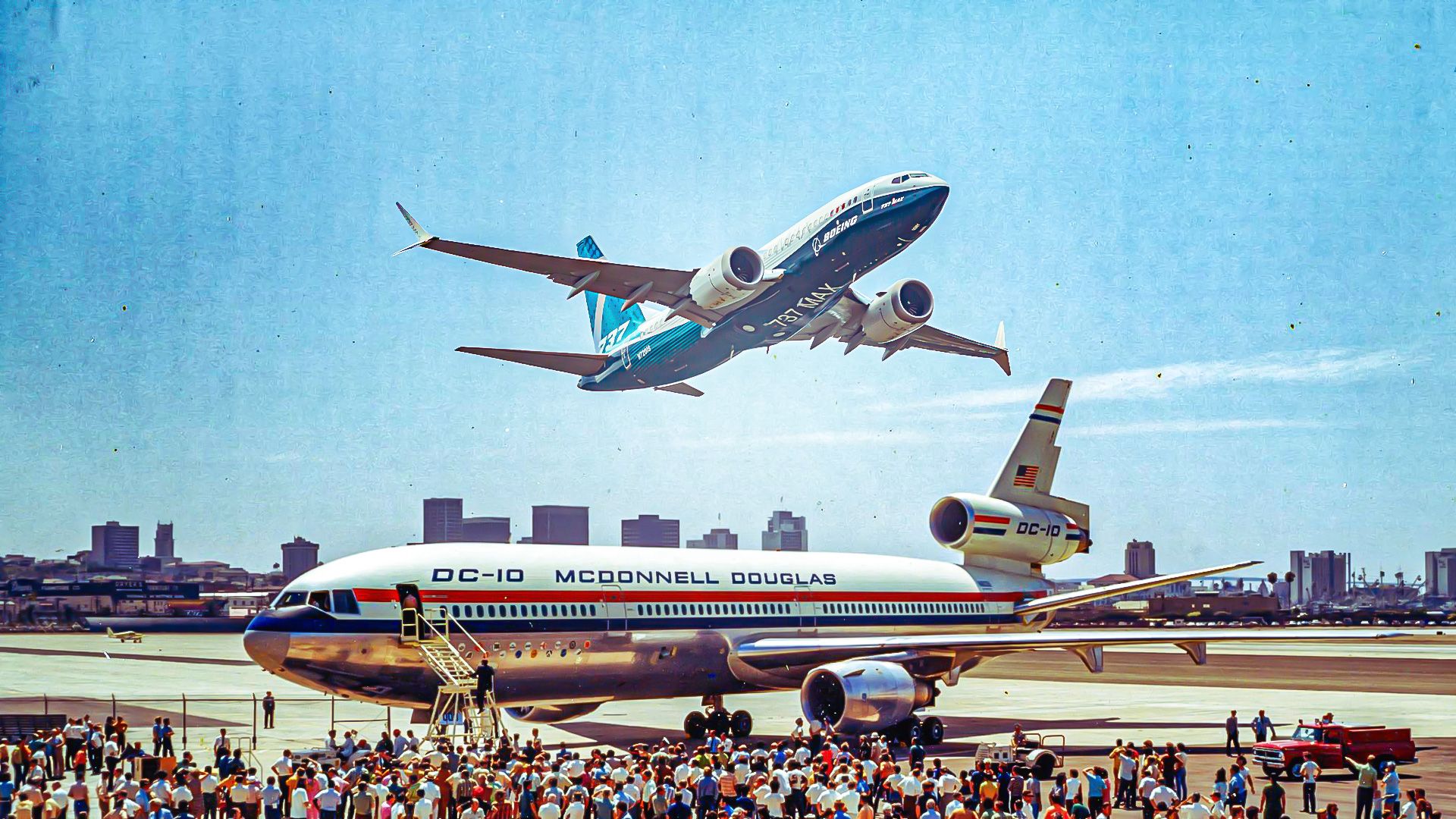
In August 1997, the world of commercial aviation changed forever when legacy aerospace manufacturer  Boeing merged with McDonnell Douglas, the only company that provided it with any legitimate competition in the domestic aviation market. In the United States, there was now just one major aircraft manufacturer, one player that could control prices, supply, development, and overall market presence. Legacy airlines were excited by the move, as it would streamline supply and, if you took the word of the two companies that were merging, would lower overall costs for operators. Nevertheless, there were some negative things to come out of this merger, some of which often go underdiscussed.
The merger highlighted a major shift in Boeing’s history away from a customer and safety-oriented culture, which had once made it one of the most respected aircraft manufacturers globally. Today, a customer-oriented safety culture is a phrase seldom affiliated with Boeing outside of investor relations presentations. Boeing, as a company, fundamentally changed over the course of the 21st century, and almost all of its shifts can be tracked back to that specific inflection point, which occurred at the end of the 1990s. We analyze the merger between Boeing and McDonnell Douglas, exploring the ripple effects that this merger deal had on the company and its future.
A Brief Overview Of The Boeing-McDonnell Douglas Merger

The merger between Boeing and McDonnell Douglas was announced on December 15, 1996, as an all-stock deal that was initially valued at around $13.3 billion. This ultimately created the world’s largest aerospace company, and the deal closed on August 1, 1997, at roughly $16.3 billion as Boeing’s share prices continued to rise. From a strategic perspective, Boeing absorbed McDonnell Douglas’s defense franchises, including fighters, missiles, and space vehicles, while also rationalizing overlapping commercial aircraft lines. This also allowed the manufacturer to pivot towards the continued development of the Boeing 737 and the Boeing 777, and incorporate a large amount of McDonnell Douglas resources.
This deal allowed the manufacturer to pursue scale in procurement and research and development, ultimately deepening the manufacturer’s exposure to government and defense-sector clients. This also gave the manufacturer strong competitive pressure against Airbus. Antitrust reviews of the merger were quite extensive, with the US Federal Trade Commission (FTC) clearing the merger on July 1, 1997. The European Commission ultimately pushed for some competitive concessions from Boeing, but ultimately cleared the deal as well.
|
Merger Benefits |
Merger Downsides |
|---|---|
|
|
The deal was one of the highest-profile mergers and acquisitions (M&A) deals of the 20th century for the aerospace and defense industry, and it is consistently examined and scrutinized as a case study in many management and economics courses. The deal itself was advised on by multiple of the world’s leading investment banks. Credit Suisse served as Boeing’s principal financial advisor and delivered a fairness opinion to the board. JP Morgan advised McDonnell Douglas and issued its own fairness opinion to the company’s board, according to The Wall Street Journal.
What Did Boeing Do After The Merger?

In the years following the merger, Boeing folded McDonnell Douglas into a wholly-owned subsidiary and reorganized the manufacturer around three pillars, including Commercial Airplanes, Defense & Space, and Shared Services. Early synergies quickly came from increased supplier leverage, rationalized facility reshuffling (most notably in Long Beach), common avionics, bulk procurement, and a unified financing arm. In terms of product strategy, Boeing quickly retired or wound down overlapping commercial lines, including the MD-11 passenger aircraft, the MD-80 and MD-90 models, and the Boeing 717, which lingered briefly. This further concentrated investment in the development of multiple Boeing families before the launch of the Boeing 787.
From McDonnell Douglas, Boeing quickly inherited several durable defense franchises, including the F-15 Eagle and the F/A-18E/F Hornet. This diversified the company’s overall production backlog. From a financial perspective, this allowed the manufacturer to expand its bargaining power with suppliers and lessors, and it smoothed out earnings volatility. This integration process sparked a long debate, and critics say that McDonnell Douglas’ cost-and-schedule ethos ultimately diluted Boeing’s engineering-led culture.
This ultimately led Boeing to shift some decisions, most notably the choice to outsource the production of components for many of its core aircraft programs, most notably that of the Boeing 787. Defenders of the program will ultimately argue that the scale and capital discipline were essential to creating a US manufacturer that could both compete with Airbus and survive international financial downturns.
How Did This Merger Change Boeing’s Mindset Towards Safety?

The 1997 merger between Boeing and McDonnell Douglas accelerated a shift from Boeing’s engineering-first culture towards a business centered on financial metrics, cost control, and managing schedule pressures. Former McDonnell Douglas leader Harry Stonecipher, who became Boeing’s CEO, said the aim was ultimately to change the company’s culture so that Boeing could be run by a business as opposed to a great engineering firm. In the following years, leadership emphasized affordability, outsourcing, and rapid certification, balancing production goals and engineering caution.
Investigations after the Boeing 737 MAX incidents documented a process of continued cultural failures dating all the way back to the merger itself. Congressional investigations described a culture of concealment and undue pressure that was placed on employees, while the Federal Aviation Administration (FAA)’s chartered Joint Authorities Technical Review urged for broader, system-level safety assessments and stronger oversight of delegated work. Subsequent reviews ultimately found a disconnect between senior management and factory-level employees, especially in terms of safety and quality.
None of this means that Boeing has abandoned safety as a key objective. Rather, this merger helped catalyze a governance model that privileged financial targets and efficiency, ultimately making it easier for production schedules and market commitments to dominate over risk signals. The company now says it is rebuilding an open, metrics-driven safety culture, but trust is set to hinge on execution.
Is There An Argument To Be Made That This Merger Led To The MAX Crashes?

Yes, there is an industry argument that the 1997 Boeing-McDonnell Douglas merger helped set the conditions that ultimately contributed to the MAX crashes. Post-merger leadership, specifically that of Harry Stonecipher, has specifically pointed to Boeing shifting how it sees its role within the market. Once a company that thought it was at the forefront of engineering and safety prowess, the manufacturer soon shifted towards profits being its principal priority.
This shift ultimately showed up later in a number of choices made surrounding the Boeing 737 MAX. Specifically, it showcased the maneuvering characteristics augmentation system (MCAS), as a tweak to existing systems in order to minimize training burdens. Independent regulators later found broad system-level safety issues associated with the system that ultimately caused the string of deadly crashes.
An extensive congressional investigation into the matter later discussed a culture of concealment and undue production pressures at Boeing that ultimately compounded lapses in Federal Aviation Administration (FAA) oversight. None of this, however, proves that there is a single, linear cause of the incidents and there is no statistical or empirical way to prove that the merger was directly behind it. Nonetheless, merger-era cultural reorientation is widely cited as a major upstream factor.
What Has Boeing Done To Improve The Safety Culture Since The Crashes Took Place?

Boeing has elected to pursue a multi-year reset of its safety culture in the wake of the deadly Boeing 737 MAX incidents and subsequent safety issues. A number of governance changes are currently in the works, including a board-level Aerospace Safety Committee in 2019 and a standing Chief Aerospace Safety Officer with an annual safety report.
The manufacturer has also encouraged a “Speak Up” culture surrounding safety, and has indicated that reports rose around 220% in 2024. This indicated greater employee voice in safety-related issues. A company-wide Safety Management System, which was FAA-approved in 2020 and then further expanded after the 2024 Alaska Airlines door plug blowout incident, has become a key part of Boeing’s culture.
From an external perspective, the Federal Aviation Administration has heightened oversight of Boeing and implemented production caps for the Boeing 737 family. More recently, the agency has begun to restore limited certification authority to the manufacturer while maintaining broader production surveillance, pressures that reinforce internal reforms.
What’s The Bottom Line?

At the end of the day, the merger between Boeing and McDonnell Douglas highlighted the end of an era of free competition in the United States commercial aviation industry. Since the two companies were brought together, the manufacturing of commercial aircraft has been controlled by just one company in the United States.
However, this did not simply have a competitive impact on the industry. Boeing, a company that had once been focused on excellence in engineering and safety, quickly shifted its tone and strategy to prioritize profits over pretty much everything else. The manufacturer, which had decades of experience in engineering, has since prioritized profits almost exclusively.
While the FAA’s lack of oversight did have some role to play in the Boeing crashes, there is an argument to be made that the chain reaction which led to the disasters began long prior. There are some who will continue to point to this merger as the key starting point for Boeing’s inevitable cascade.
source
