

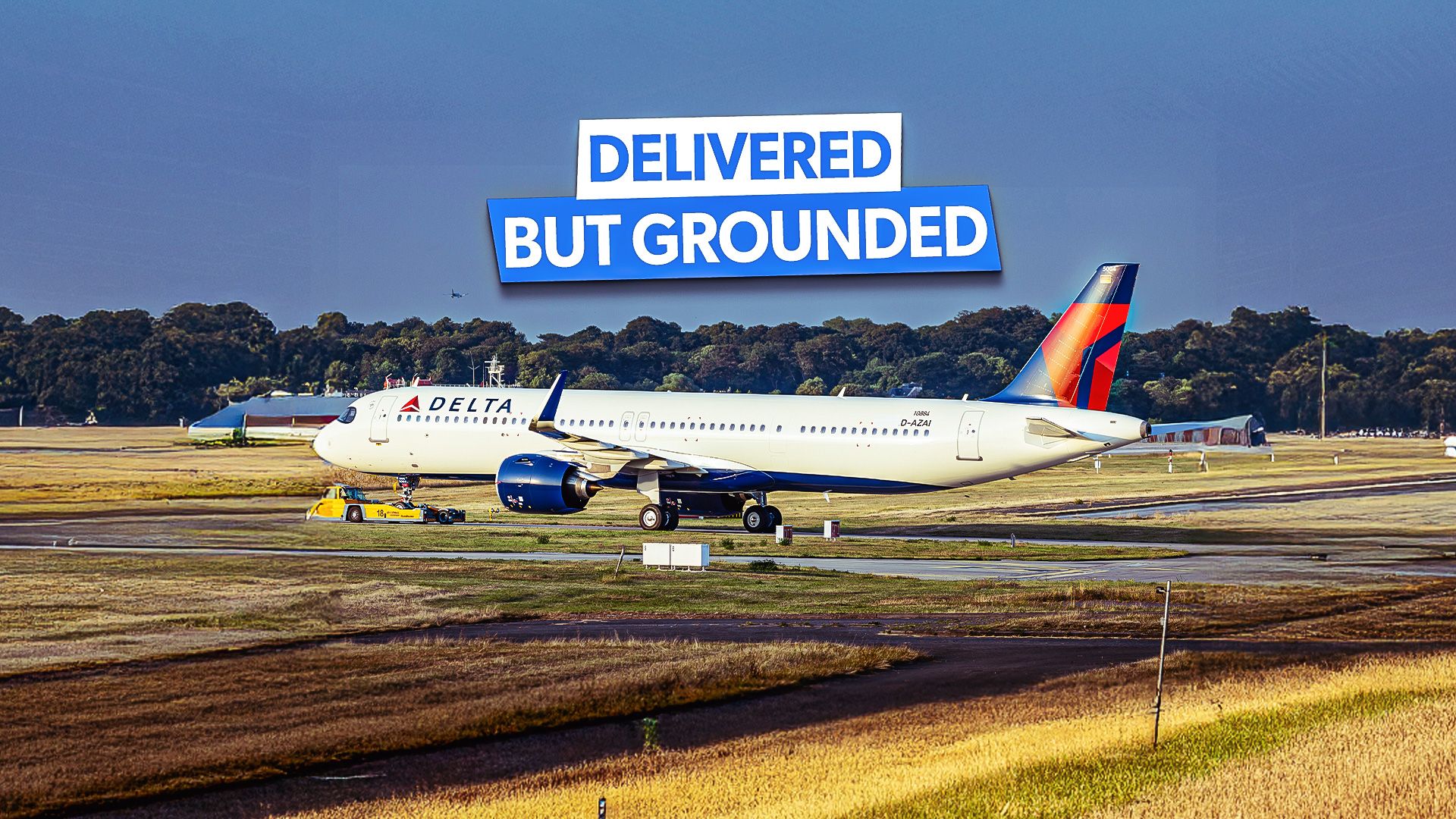
Delta Air Lines is doing something rather unusual with its new Airbus A321neos. Whereas all of its A321neos have been configured with 20 first class seats so far, it will soon be introducing a new subfleet that will include 44 first class seats, more than double the number. It’s not a move pushed through by strategy either; rather, it’s Delta being pragmatic, presented with lemons, but no sugar and making the lemonade anyway.
This new configuration will be exclusive to the Airbus A321neo, the latest evolution of the Airbus A321 family. These aircraft feature new engines (the Pratt & Whitney PW1100G in the case of Delta’s fleet) along with standard sharklets, new exit configuration options, and an updated interior on the latest examples. It’s now the best-selling jet-powered airliner variant of all time, gaining popularity with airlines virtually everywhere. Here’s the latest with Delta’s super-premium A321neo fleet.
Overview Of The Delta A321neo Fleet

 Delta Air Lines currently has 79 Airbus A321neos in service, along with another 71 on order. Furthermore, five aircraft have been in storage since delivery. In total, this makes 155 combined A321neos. The majority of these planes are configured with 194 seats, including 20 Delta First seats, 60 Delta Comfort seats, and 114 Delta Main seats. This is a standard configuration for an A321neo operated by a legacy US airline.
American Airlines and United Airlines both installed 20 first class seats on their A321neos. American has two extra economy seats, while United has six. For Delta, these aircraft are comparable to its domestic Boeing 757-200 fleet, although the carrier is primarily replacing its aging A320-200 fleet as it looks to upgauge throughout its network. Delta equips the A321neo with the PW1100G, and it configures these planes with four exit doors and four overwing exits, one of multiple exit configuration options.
With 155 A321neos total and 127 young Airbus A321-200s, the Airbus A321 family is the future of Delta’s narrowbody fleet. With 100 Boeing 737 MAX 10 aircraft on order, it’s also clear that Delta is committed to making large narrowbodies the future of its fleet. All of these aircraft have or will have 20 Delta First seats, and the only aircraft with more is the Boeing 757-300 which has 24 Delta First seats. What, then, is the motivation for this new A321neo subfleet with 44 Delta First seats?
Seat Certification Issues

Of the 155 Airbus A321neos in service and on order, 134 are set to feature the standard layout with 20 Delta First seats. The remaining 21 are to be configured in a three-class (four if you count Delta Comfort separately) configuration for transcontinental flights. Data from aeroLOPA shows that these planes will have 16 DeltaOne suites, 12 Delta Premium Select seats, 54 Delta Comfort seats, and only 66 Delta Main seats for a total of 148 seats.
While not all A321neos are replacing the Boeing 757, these planes are direct replacements for the carrier’s “75S” fleet, which features 16 DeltaOne seats for transcontinental flights. These details were first shown in a leaked seat map in 2022, and since then, five aircraft in the “3NF” fleet have already been delivered (the standard A321neos are coded as “3NE“). These five aircraft are important because they are the five A321neos that have been stored after completion.
The new “3NF” A321neos will feature new reverse herringbone seats with doors for DeltaOne. These seats are reported to be the Safran Vue. However, Delta has reportedly been facing certification issues with the new seats, and while the certification efforts continue, the five planes sit in storage, with no DeltaOne seats installed, incurring costs while generating no revenue. Therefore, the solution is to install Delta First seats in place of the DeltaOne seats.
What To Expect From The New 44F A321neos

The Premium Select seats on these new A321neos are the same Recaro CL4710 seats that are used for Delta First on the 3NE fleet. These seats are already certified and flying. Additionally, it’s not unusual for airlines to market domestic first class as premium economy;  United Airlines sells its first class seats as Premium Plus on its transatlantic Boeing 737 MAX flights. As such, Delta is hardly doing anything unusual here.
The 3NF configuration features 12 Premium Select seats behind the DeltaOne cabin, meaning that Delta will be removing the bulkhead divider between DeltaOne and Premium Select, then installing 32 Premium Select/Delta First seats in the space originally occupied by DeltaOne. Combined, you get 44 Delta First seats. The economy cabin behind Premium Select/Delta First will remain unchanged, with 54 Delta Comfort seats and 66 Delta Main seats. Combined, you get 164 seats.
It’s an unorthodox layout, but Delta is paying for these five A321neos regardless of whether they fly, and it has to pay additional storage costs. By installing 32 additional CL4710s and rebranding the whole cabin Delta First, Delta is making lemonade even though it hasn’t gotten sugar yet. The five A321neos that have already been delivered will receive the new layout, and reportedly, two more A321neos are expected to be delivered with the new layout.
The Long-Term Viability Of The 44F Subfleet

The name of the game in the United States today is “premium,” and no airline is more about premium than Delta Air Lines. 44 Delta First seats, however, is an extraordinary amount of premium capacity on a single narrowbody, and installing 164 seats on an A321neo trashes the jet’s per-seat economics. This only works if you can maintain high fares for all of those premium seats, and Delta likely wouldn’t be flying A321neos with 20 Delta First seats if the concept were truly sound.
This is a pragmatic decision by Delta to earn money with planes that are currently grounded. If the carrier sees high demand for 44 Delta First seats on a single narrowbody, then the subfleet will stick around, but this is not the intention as of now. Delta is spending money to install additional CL4710s, so the subfleet will likely stick around even once the DeltaOne seats are certified. What will likely happen is that these seven planes will be retrofitted after the remaining 3NF A321neos are delivered.
With only seven planes, this fleet will likely be consolidated to a single hub that has significant business demand. The 3NFs will fly out of New York-JFK, Los Angeles, and Boston, but Boston is a smaller hub for Delta than New York, and Los Angeles has more premium demand. As such, it’s unlikely that Delta will base these new planes there. Instead, it will either be JFK, LAX, or Atlanta that sees these new planes, given how much demand and connecting feed the carrier has there.
Seat Certification Challenges Industrywide

Seat certification delays are unfortunately common in the aviation industry today. Delta has faced significant delays and had to make adjustments to its plans as a result, but  American Airlines has also faced similar challenges. It recently began taking deliveries of new Boeing 787-9s with the Adient Ascent for “Flagship Suites”, but certification delays led to introductions of these planes being pushed back.
 Lufthansa, meanwhile, has been severely burned by certification challenges. It began rolling out its new Allegris cabins on the Airbus A350-900 in 2024, with the Boeing 787-9 next in line. However, Lufthansa uses a different supplier for the 787 (Collins Aerospace versus Stelia Aerospace for the A350), and the Allegris cabins feature up to five different seat types in business class: Suites, Privacy, Extra Space, Extra Long Bed, and Classic.
Not only do the seats on the Boeing 787 need separate certification, but each variant of the seat needs to be certified, too. As such, Boeing 787s are being built for the German flag carrier that is currently unable to fly. Lufthansa has only been able to certify the front row “Suites” seats, and it’s now deciding to fly the planes anyway. It will sell the four “Suites” seats on the 787-9s, and the rest of the seats will have to be blocked until certification is finally obtained.
Rundown Of The New Delta A321neo Subfleet

Certification is causing major delays and headaches for airlines and suppliers industrywide. In today’s environment of increased regulatory scrutiny, it’s becoming harder to install new cabins on airliners in a timely manner, and airlines are having to figure out solutions. For Delta, this involves extending the Premium Select cabin and calling it Delta First until the DeltaOne suites are certified. Once they are, and the remaining 3NF planes are delivered, these seven planes will join them.
You’ll likely find these planes on the carrier’s highest-demand routes, such as Atlanta to Los Angeles or Atlanta to New York City. It’s a lot of first class capacity to add, but it’s better than paying for planes that are sitting on the ground. The benefit for passengers, meanwhile, is that upgrade opportunities are sure to be plentiful. If they’re not and Delta can fill these seats at high fares, then the fleet may stick around longer than expected.
source
