

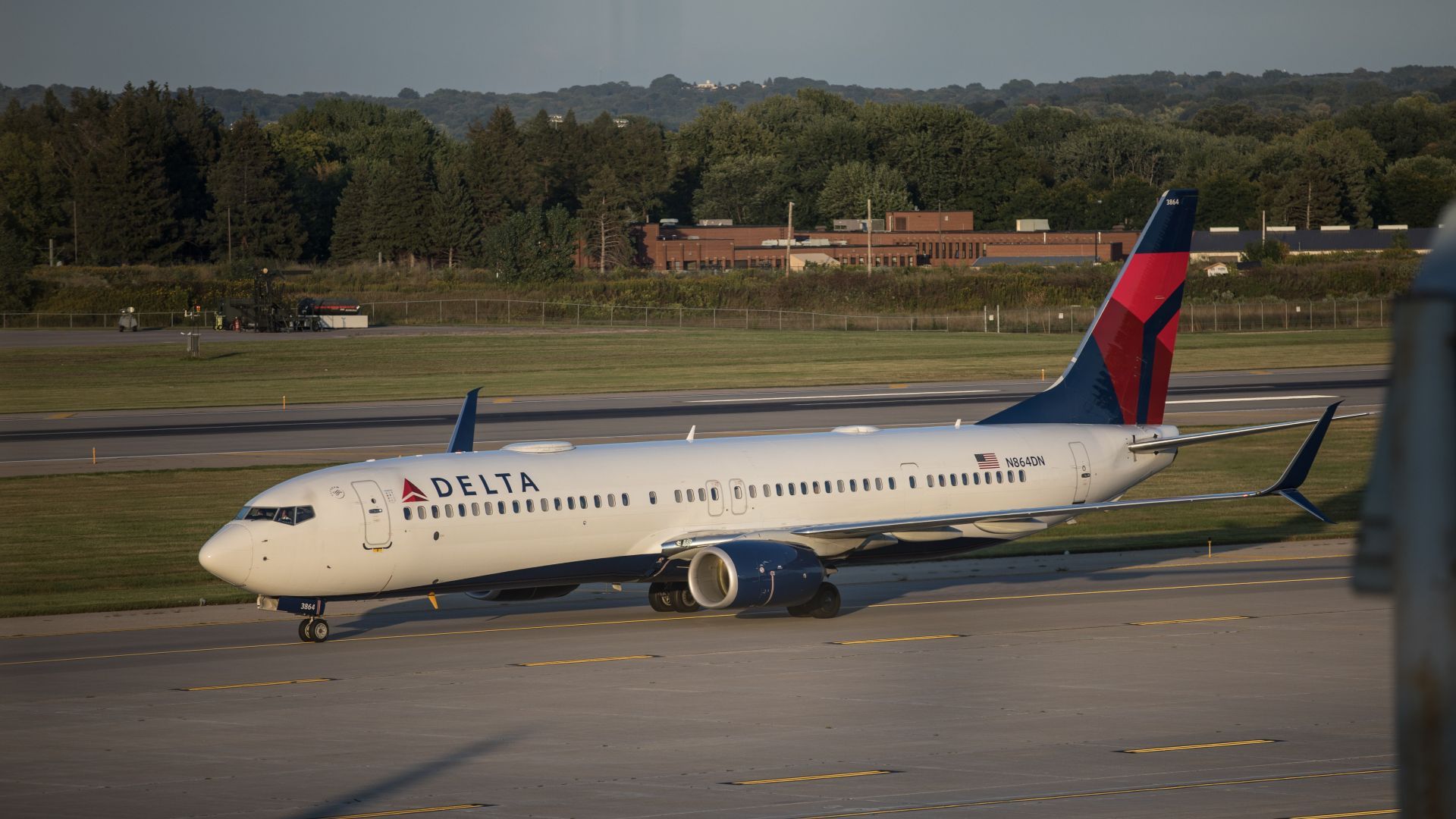
A Delta Air Lines Boeing 737-900ER performed a rejected takeoff at Minneapolis-St. Paul International Airport on October 23, 2025. As reported by The Aviation Herald, the aircraft had suffered an engine failure, and the crew had to perform a high-speed rejected takeoff before returning to the gate. Passengers were moved to another aircraft, while the 737 in question remains grounded.
The aircraft in question was a 737-900ER carrying 187 people from Minneapolis to Portland on the evening of the 23rd. Passengers experienced a roughly two and a half hour delay, while the crew were likely reassigned to another flight or had the rest of the day off. This was the plane’s most recent attempted flight, and it has been sitting for repairs since.
An Engine Failure At Minneapolis

Delta DL1661 is a daily flight that  Delta Air Lines operates from Minneapolis-St. Paul International Airport to Portland International Airport. On October 23, the flight was scheduled to depart at 15:50 and taxiied on time to Runway 30L. From there, the crew began their takeoff roll, but received an indication of a failure in the Number 2 (right-hand) engine.
The aircraft involved, N829DN, was traveling at 135 knots when the crew decided to abort the takeoff, making this a high-speed rejected takeoff. Subsequently, the pilots turned the aircraft onto Runway 22 before taxiing to a new gate. Immediate inspections were performed to check the status of the plane’s brakes and tires, given the speed at which the takeoff roll was rejected.
Passengers and crew disembarked the aircraft and had to wait well over two hours for their replacement Boeing 737, N836DN, to arrive. Due to duty time regulations and the need to file reports, a replacement crew was also assigned to operate this leg. As per Flightradar24, DL1661 is meant to depart at 15:50 for an arrival in Portland at 17:27, but instead, passengers arrived in Portland at 19:59.
Overview Of The Aircraft

N829DN is a Boeing 737-900ER that was first delivered to Delta Air Lines in 2014, as per Planespotters.net. It is one of 163 737-900ERs in Delta’s fleet, which is the world’s largest operator of the type. It is part of the carrier’s standard 737-900ER subfleet (739), and it retains Delta’s standard interiors along with configuration, unlike the ex-Lion Air and Malindo Air 737-900ERs that Delta acquired after the COVID-19 pandemic.
Data from aeroLOPA shows that Delta configures its 737-900ERs with 180 seats total. This is broken down into 20 Delta First seats, 27 Delta Comfort seats, and 133 Delta Main seats. It’s been reported that there were 187 occupants in total. A 737-900ER requires two pilots and four flight attendants for a total of six crew members, meaning that this was a full flight with all 180 passengers, as well as either a jumpseater or an FAA-certified line check airman in the cockpit.
The 737NG (the family that the 737-900ER is part of) exclusively uses the CFM56-7B, a variant of the legendary CFM56 high-bypass turbofan. The CFM56 is renowned as one of the most reliable turbofan jet engines ever produced. While investigators will look into whether there is a new issue with the CFM56-7B as a whole, what’s far more likely is that this was a one-off event.
What Will Happen Next

Investigators will explore whether a design or maintenance flaw caused the engine failure. Delta itself operates 163 of the 505 737-900ERs produced, and there are thousands of CFM56 engines in service on the Boeing 737NG (CFM56-7B) along with the Airbus A320 family (CFM56-5B). Furthermore, the CFM56 remains in service on the KC-135 as the CFM56-2 and the Airbus A340-300 as the CFM56-5C.
The CFM56 is the most successful turbofan jet engine program of all time, and part of this is due to its reliability. As such, while investigators will surely examine the CFM56-7B’s design, they’ll likely give more importance to Delta’s maintenance procedures and will explore any unique faults with the engine that failed.
|
Series |
Main Variants |
Applictioms |
|---|---|---|
|
CFM56-2 |
CFM56-2A, CFM56-2B |
Boeing E-3 Sentry, Boeing E-6 Mercury, Boeing KC-135R Stratotanker, Boeing RC-135 |
|
CFM56-2C |
McDonnell Douglas DC-8 Super 70 |
|
|
CFM56-3 |
CFM56-3B, CFM56-3C |
Boeing 737-300, Boeing 737-400, Boeing 737-500 |
|
CFM56-5 |
CFM56-5A |
Airbus A319, Airbus A320 |
|
CFM56-5B |
Airbus A318, Airbus A319, Airbus A320, Airbus A321 |
|
|
CFM56-5C |
Airbus A340-200, Airbus A340-300 |
|
|
CFM56-7 |
CFM56-7B |
Boeing 737-600, Boeing 737-700, Boeing 737-800, Boeing 737-900, Boeing 737-900ER |
N829DN has been grounded in Minneapolis ever since the incident. Minneapolis is home to a large Delta TechOps operation, and as such, it’s an ideal location to perform such investigations as well as make repairs to bring the 737 back into service. While the incident may have alarmed passengers and required extra caution, it ended with no injuries and minimal additional aircraft damage.
source
