


Dassault Aviation and German space prime OHB announced on May 11, 2026, that they will jointly propose the VORTEX-S reusable spaceplane to the European Space Agency (ESA), formalizing an industrial team for a Franco-German entry into Europe’s emerging low Earth orbit cargo competition.
Under the partnership, Dassault Aviation will act as prime architect and global integrator of the spaceplane, while OHB will architect and integrate the service module. Both companies said discussions are underway with other European space companies to expand the consortium.
A second-stage entry in the VORTEX roadmap
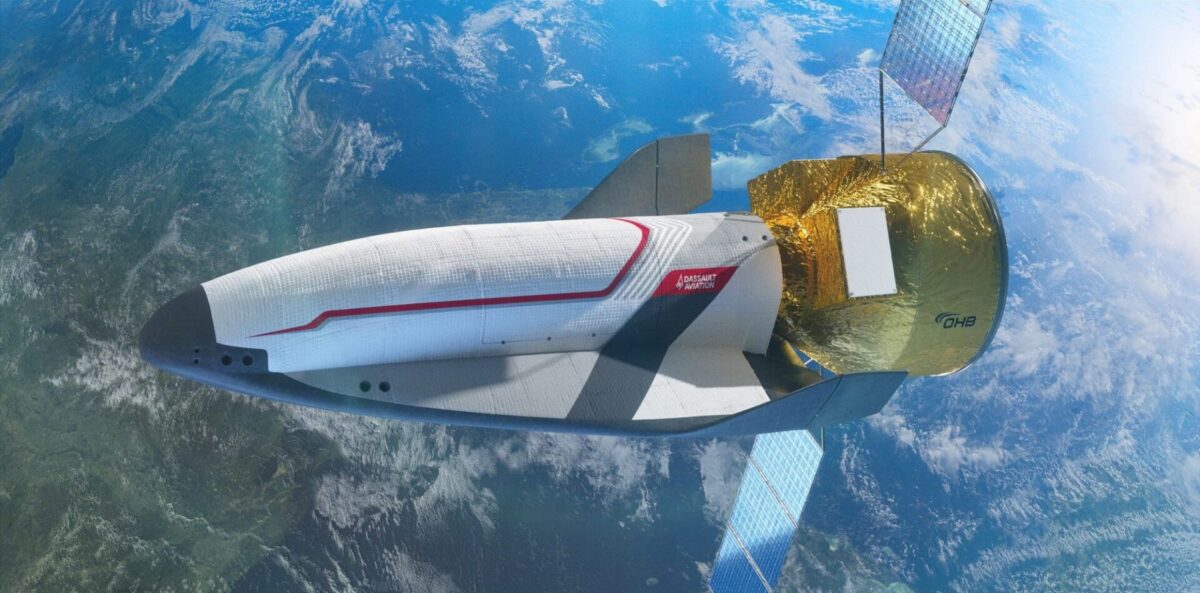
VORTEX-S is the second milestone in the four-step roadmap that Dassault Aviation unveiled at the 2025 Paris Air Show. The full family runs from VORTEX-D, a 1:3-scale flight demonstrator targeted for a first flight in 2028, to VORTEX-S, a 2:3-scale “Smart Free Flyer,” then VORTEX-C, a full-scale cargo version, and ultimately VORTEX-M, a crewed configuration.
According to the press release, VORTEX-S would be capable of round-trip transport to orbital stations and autonomous orbital free-flyer missions, in which the vehicle remains in orbit for extended periods to perform tasks such as in-orbit servicing or payload hosting. That dual envelope is central to how the team is positioning the proposal.
The VORTEX program is backed by an initial €30 million (around $33.7 million) from the French Direction générale de l’armement (DGA) and the Centre national d’études spatiales (CNES), committed after the 2025 Paris Air Show reveal.
Dassault Aviation has since selected Spanish startup Arkadia Space in April 2026 to develop the propulsion system for the VORTEX-D demonstrator.
Aimed at ESA’s reshaped cargo competition
Although the partnership announcement does not name the specific ESA tender, the round-trip-to-stations function lines VORTEX-S up with ESA’s LEO Cargo Return Service initiative, which the agency restructured in early 2026 under the name ALADDIN (Autonomous LEO Accelerated Demo Docking to ISS Node).
ESA published its Phase 2 call for proposals on January 8, 2026, with bid evaluations expected by mid-2026. Phase 1 contracts, each worth 25 million euros, were awarded in May 2024 to capsule-based concepts from The Exploration Company and Thales Alenia Space.
Phase 2 is open to all bidders, not just the two Phase 1 awardees, providing a window through which the Dassault-OHB team is positioning its winged, runway-landing concept.
A “family-owned” pitch
Both Dassault Aviation and OHB are family-controlled industrial groups, and both leaned on that shared identity in announcing the deal.
“With the Vortex-S proposal to ESA, we aim to strengthen Europe’s space capabilities,” said Éric Trappier, chairman and CEO of Dassault Aviation. “Our German friends at OHB are natural partners to participate in this project, bringing their remarkable expertise.”
Speaking before the French National Assembly’s Defense Committee on April 9, 2025, the Dassault CEO publicly lamented the absence of a European spaceplane program, telling lawmakers that he had “the idea” and “the will” but that no one appeared interested.
Marco Fuchs, CEO of OHB, framed the partnership as a complementary match.
“The partnership with Dassault Aviation is a perfect match: as family-owned high-tech companies, we share the same vision and bring complementary strengths to the development of a reusable spaceplane, Dassault Aviation as aircraft manufacturer, and OHB as space company,” Fuchs said.
OHB employs around 4,000 people and is one of ESA’s principal German industrial counterparts, notably on Galileo navigation satellites and Germany’s SARah radar reconnaissance constellation.
source
