


The U.S. Navy’s MQ-25 Stingray has completed its first flight, marking a key step toward carrier-based unmanned aerial refueling.
The U.S. Navy’s production representative MQ-25 Stingray unmanned aerial refueling aircraft has successfully completed its first flight on Apr. 25, 2026. The flight, initially planned by the end of 2025, marks a major milestone in the service’s effort to field the first operational carrier-based unmanned aircraft.
The MQ-25 took off from MidAmerica St. Louis Airport, Missouri, home of Boeing’s production facilities, accompanied by a company-owned TA-4J Skyhawk and a U.S. Navy UC-12M Huron as chase aircraft. Our friend and aviation photographer Jerry McGrath was able to capture some photos of the event, which you can see here in this article.
The maiden flight was first attempted on Apr. 22, although the takeoff was aborted for unknown reasons.
The first flight of the production representative MQ-25 comes almost seven years after the first flight of the T1 test asset on Sept. 19, 2019. The new aircraft features some modifications compared to T1, including a retractable electro-optical/infrared (EO/IR) turret.
Earlier this year, in January, Boeing and the U.S. Navy’s Naval Air Systems Command (NAVAIR) announced that the production representative prototype was undergoing taxi trials. The development followed the confirmation by senior officials that the first flight, described as a pivotal milestone for the future of unmanned carrier aviation, slipped to early 2026.
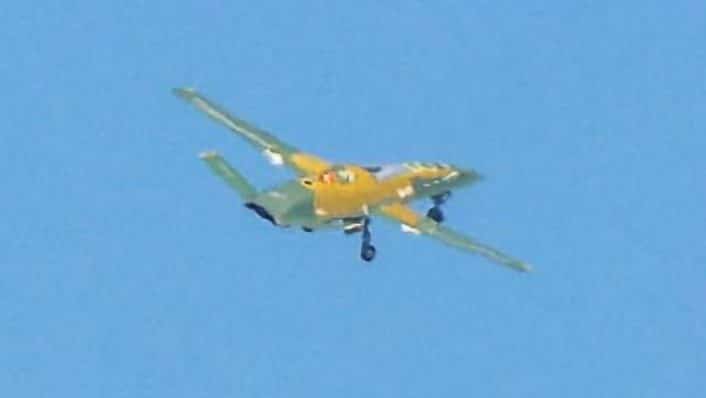
With the maiden flight, the program now transitions from ground testing into full flight test operations. The service envisions an Initial Operational Capability (IOC) in FY2027, and a total of nine aircraft are being built to conduct the required testing in support of that timeline.
The taxi trials were conducted by the Navy’s Air Test and Evaluation Squadron 23 (VX-23) and Air Test & Evaluation Squadron Two Four (UX-24), with the latter specializing in the developmental testing of unmanned aerial systems. The two units will continue to work together for the flight test campaign.
A Long-Awaited First Flight
The first flight is the culmination of an extensive series of ground tests, including autonomous taxi trials at low and high speed, as well as system integration and verification checks. These activities were essential to validate the aircraft’s ability to operate safely both on the ground and in the air.
While the earlier T1 demonstrator had already proven the concept of unmanned aerial refueling, new tests will likely be conducted to certify the capability with the MQ-25’s new configuration. The data collected during the testing will be used to better prepare for the introduction in the fleet.
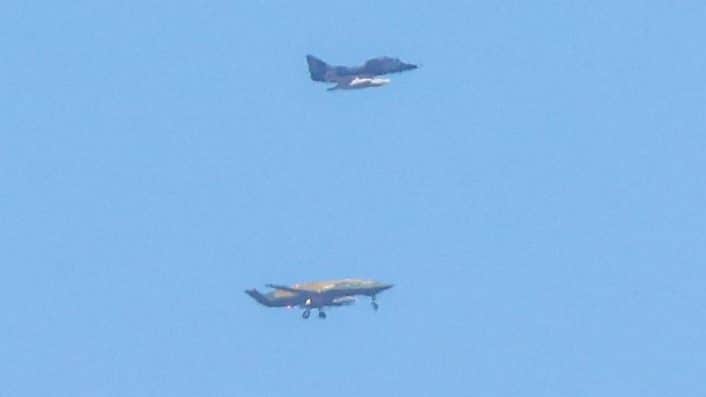
Once initial flight testing is complete, the Navy is expected to conduct envelope expansion flights, in preparation for the beginning of flight testing from an aircraft carrier. In the past, an MQ-25 was tested in a carrier environment, focusing on suitability testing and deck handling, without flying.
The MQ-25’s Role
The significance of the MQ-25’s first flight extends far beyond the flight itself. Navy officials have long described the Stingray as a “trailblazer” for integrating unmanned aircraft into carrier operations at scale.
Vice Adm. Daniel Cheever, commander of Naval Air Forces, has repeatedly emphasized that the MQ-25 is the system that “unlocks the future for manned-unmanned teaming on the aircraft carrier,” enabling a future carrier air wing built around collaborative combat aircraft (CCA) concepts. In fact, the Navy intends to use the MQ-25 to work on the introduction of unmanned aircraft in the carrier air wing, among all things.
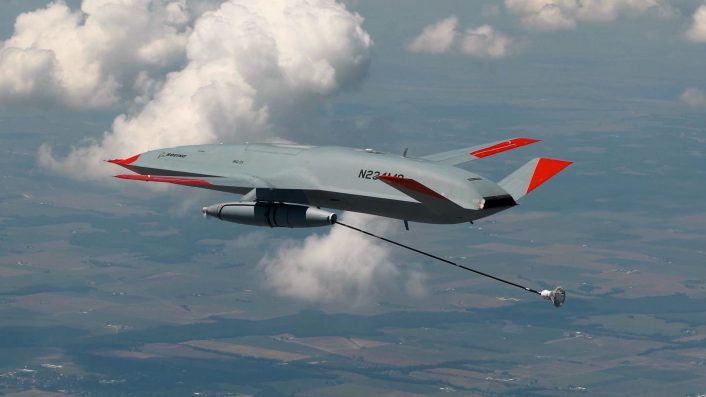
The Stingray’s primary mission is aerial refueling, relieving the F/A-18E/F Super Hornet fleet from tanker duty. This is expected to be the drone’s most urgent task, as that accounts for up to a third of Super Hornet sorties, according to Navy figures, allowing to free up the crewed aircraft for other missions.
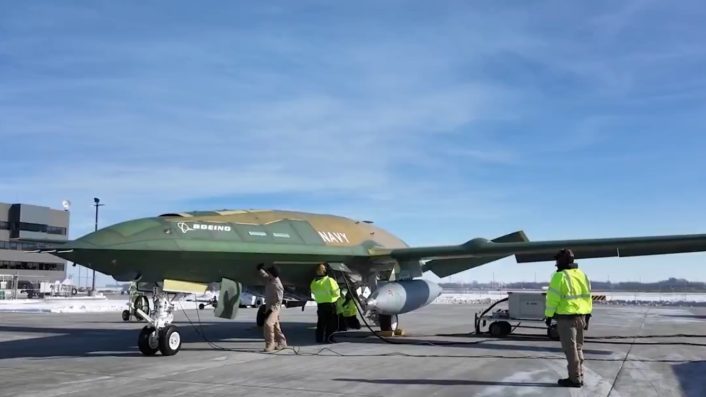
By carrying the same Cobham ARS pod already used by the F/A-18, the MQ-25 is expected to deliver up to 14,000–16,000 lb of fuel at 500 nautical miles, the Navy told Congress in an August 2025 report. This will increase both the range and availability of strike fighters aboard Nimitz- and Ford-class carriers.
Secondary Intelligence, Surveillance and Reconnaissance (ISR) roles are also planned, with the Stingray providing organic surveillance and recovery tanking during carrier operations with the retractable sensor turret. In the early days of the MQ-25 program, the aircraft was described as capable of performing ISR via the installation of SIGINT (Signals Intelligence), AIS (Automatic Identification System), and EO/IR (Electro-Optical/InfraRed) equipment.
Slipping Schedule
The MQ-25 has already faced multiple schedule adjustments. According to the Pentagon’s Selected Acquisition Reports and GAO assessments cited in the August 2025 report to the U.S. Congress, major program milestones – including the first EMD aircraft flight and initial operational capability (IOC) – have slipped by approximately two years over the past development cycles.
GAO also warned of cost risks if low-rate initial production begins before sufficient testing is completed. The Navy’s FY2026 budget request included $1.04B for procurement and RDT&E, covering the first three LRIP aircraft and continued development of the UMCS.
Current planning envisions IOC as late as FY2027. To stay on schedule, Boeing opened a $200-million production facility at MidAmerica Airport, Illinois, in 2024 to support future low-rate production, and Congress has been closely monitoring program costs and risk assessments.
Additionally, the Navy has been working with Lockheed Martin to continue the maturation of the UMCS. In 2024 and 2025, UMCS installations were completed aboard USS George H.W. Bush (CVN 77) and at shore sites, and Navy Air Vehicle Pilots demonstrated the system’s ability to command not only the MQ-25 but also unmanned aircraft such as the MQ-20 Avenger.
As we previously reported here at The Aviationist, Boeing also demonstrated manned-unmanned teaming technologies allowing F/A-18 pilots to control an MQ-25 during refueling operations.
Thanks to Jerry McGrath for the photos he sent us. Make sure to follow him on Instagram for more!
source
