

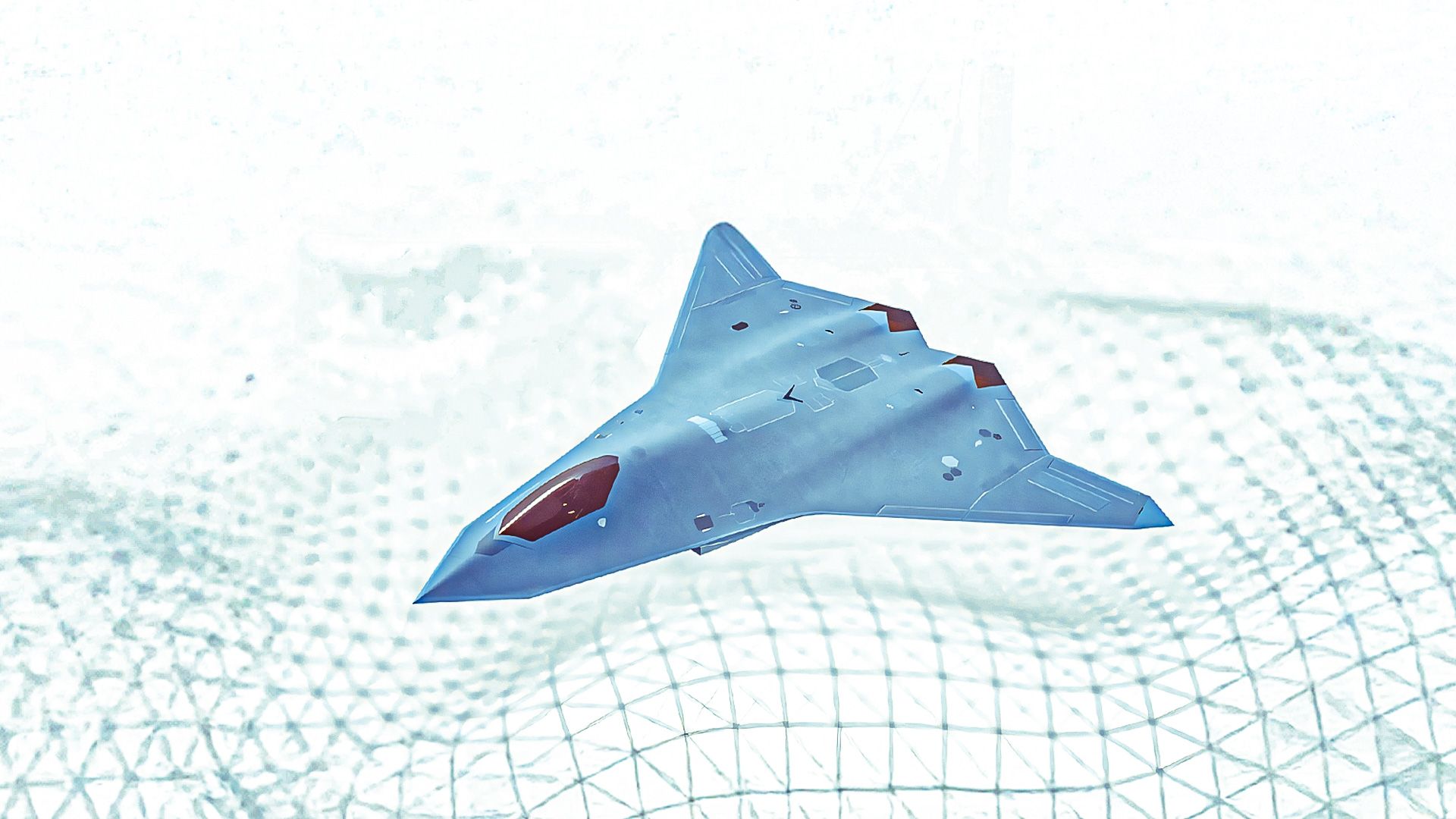
The Boeing F-47 emerged as the winner from the manned component for the United States Air Force’s Next Generation Air Dominance program (NGAD). The NGAD program also includes Collaborative Combat Aircraft (CCAs), known as loyal wingman drones. After a prolonged period of uncertainty that culminated in the Air Force putting the fighter jet on hold pending the incoming Trump Administration’s decision, the Air Force is now rapidly developing the jet as quickly as possible.
It should be stressed that the F-47 is an extremely secretive program, and little is known about it or its capabilities. In a rather interesting development, the public is becoming increasingly aware of China’s next-generation programs, such as the so-called J-36. This is because over the last year, the Chinese have been flaunting their new prototypes by flying them in public, while no reliable rendering yet exists for the F-47 or even a picture of the demonstrator.
First Prototype Under Construction

The first sixth-generation demonstrators for the NGAD program flew in 2020 and included competing designs from Lockheed Martin and Northrop Grumman. After the Air Force selected Boeing as the winner in early 2025, all efforts are being made to develop the jet as fast as possible. The first representative prototype is currently under construction, and the Air Force wants the first aircraft to be flying by 2028.
Air Force Chief of Staff Gen. David Allvin offered a very brief update on the F-47 fighter jet in September, saying, “In the few short months since we made the announcement, they [Boeing] are already beginning to manufacture the first article. We’re ready to go fast. We have to go fast.” Allvin was referring to China’s next-generation aircraft rapidly emerging and set to erode much of the qualitative edge the US enjoys with its advanced fifth-generation F-22 Raptors and F-35 Lightning IIs.
It is possible the aircraft could start to enter service in 2029. This partly depends on what sort of prototypes are being constructed. Historically, fighter jet prototypes were only used for development and were never intended for combat. The Air Force would need to wait for representative serial production examples. However, the B-21 bomber’s prototypes are known to be more or less representative of their future serial production counterparts. While the B-21 is on track to enter service in 2027, it could be rushed into service in 2026 if the urgent need arose.
Don’t Know What The F-47 Looks Like

While there have been plenty of renders of the F-47 flying online, only two partial renders have been officially released. It is also believed that these renders purposefully incorporate misdirections. Secretary of the Air Force Troy Meink hinted at this. According to The War Zone, he stated while speaking during his own keynote at a conference in September, “Just love looking at this picture,” referring to the F-47.
Meink then added, “I expect some of the Chinese Intel analysts are spending a lot of time looking at this picture. Good luck trying to dig something out of there. Pretty careful about that.” In short, no one in the public actually knows what the aircraft looks like. The aircraft is shown in the renderings with canards, but it may or may not actually have canards. The implication is that the public now knows more about the massive next-generation Chinese J-36 fighter jet, as China has purposefully flown it around for the world to see.
|
Select sixth-generation programs |
Country/countries |
Planned in service date |
|---|---|---|
|
F-47 |
US |
Approx. 2029/2030 |
|
F/A-XX |
US |
2035 |
|
J-36 (so-called) |
China |
Unknown, perhaps 2030 |
|
GCAP/Tempest |
UK/Italy/Japan |
2035 |
|
FCAS |
France/Germany/Spain |
2040+ |
The Chinese J-36 is tailless and has three engines. Most assumptions of the F-47 are that it too will be tailless, be twin-engined, and have all-aspect stealth. But this is not true of all next-generation jets; the UK/Italian/Japanese GCAP/Tempest sixth-generation does have large vertical tails. The GCAP is known from renderings and mockups consistently showing tails. Separately, the first GCAP/Tempest demonstrator is also under construction by BAE Systems in the United Kingdom.
The Fuzziness Of “Sixth Gen” Designations

There is no such thing as discreet “generations” of fighter jet aircraft. The concept first emerged in the early 1990s and was popularized as a way to describe the Air Force project that would produce the F-22 Raptor. It became a way to describe just how much more advanced the F-22 was over the older F-15 and why the aircraft was so expensive. Since then, it has become a favorite for clickbait headlines, an easy way to conceptualize aircraft, and a marketing ploy.
There is no universal definition of what counts as each generation. Making matters worse is that an aircraft considered “fifth” generation is not necessarily more capable than an upgraded “fourth” generation fighter. The “fifth” generation Russian Su-57 is not necessarily more capable in its air-to-air role than the upgraded “fourth” generation F-15EX, Rafale, or Eurofighter Typhoon jets. Much comes down to their networking, computing power, and other internal systems, and not their ability to supercruise or how much they look like the F-35.
|
Boeing F-47 timeline |
|
|---|---|
|
2020 |
First demonstrator flights |
|
March 2025 |
Boeing announced the winner |
|
August 2025 |
Prototype reported being built |
|
2027 |
First representative flights |
|
2029-early 2030s |
Expected in service |
The F-47 is designed to be a generational leap over the air dominance F-22 Raptor, ensuring the US Air Force retains a silver bullet and trump card in the air dominance role for decades to come. Comparing it with other sixth-generation fighter jets and assuming they represent a similar set of capabilities is problematic. One thing is for sure: the F-47 will represent the cutting edge of US defense and aerospace engineering.
Question Of Numbers & F-22 Raptor

The US Air Force originally planned to purchase 750 F-22 Raptors (although it actually purchased 187) and currently has a program of record to purchase 1,763 F-35 Lightning II fighter jets. In the past, it purchased thousands of F-15 and F-16 fighter jets. But those days are gone. Next-generation fighter jets are now so complex, complicated, capable, and expensive, it is not feasible to produce them in large numbers.
The Air Force has previously indicated it is considering purchasing 185+ F-47s. The F-47 has been touted as a successor to the F-22 as the Air Force’s air dominance platform. 185 F-47s would allow the Air Force to replace the Raptors on a one-for-one basis. However, in 2024, the Air Force stated the F-47 is no replacement for the F-22 and suggested the F-22 would remain in service.
The Air Force is currently embarking on a significant series of programs to overhaul and upgrade its 142 combat-coded F-22s to keep them at the cutting edge well into the 2030s. It is also considering upgrading its older 35 Block 20 training variant F-22s that are not currently combat-coded. How many F-47s the US Air Force will eventually purchase is an open question hinging on factors like the fate of the F-22s, competition with China, financing, alternative autonomous systems, and more.
Part Of A Much Larger System

Advanced datalinks, longer-ranged missiles, lasers, advanced jet engines, battle management capabilities, advanced sensor fusion, and more are just some of the aircraft’s next-generation capabilities. It is expected to have a combat radius of over 1,000 nautical miles, which would be around 25% more than today’s jets. It is likely to reach speeds above Mach 2 and incorporate ‘broadband’ low-observability (advanced stealth).
The manned F-47 fighter jet should not be seen in isolation. It is just one piece in a much larger ecosystem of cooperating systems that includes cooperating with fourth and fifth-generation fighters. Most obvious is the loyal wingman drones (CCAs) that are being developed to serve alongside the aircraft. Anduril’s YFQ-44 and General Atomic’s YFQ-42 have been selected for Increment 1 of the CCA program. Their development is now rapidly progressing. General Atomics flew its first representative example in August, while Andruil flew its first representative example in late October.
The F-47 is specially designed to operate with loyal wingman drones. That said, the F-22 Raptor will be the first to receive loyal wingman drones by the end of the decade. Another program in development is the Next Generation Aerial Refueling System, or NGAS. This may be a stealthy autonomous tanker, although the program is troubled by the Air Force’s lack of funds. Aerial refueling is one of the major weaknesses of any fighter jet, which have limited range in combat conditions with a full payload, and their tankers are vulnerable to systems like the J-20.
Classified, Opaque, But A Priority

The Boeing F-47 remains heavily classified, and what it looks like is still unknown. However, it will be the cutting edge of American engineering, designed for an air dominance role as a system of systems functioning as a sort of command center. It will be a huge fighter jet designed to be the tip of the spear, penetrating into defended enemy airspace where it can kick in the door and allow fifth and fourth-generation fighters to operate.
The F-47 has emerged as such a pressing priority that the White House and others in Washington tried to put the Navy’s sixth-generation counterpart, the F/A-XX, on ice. They argued that the US defense aerospace base is not big enough to simultaneously develop two next-generation fighter jets. They said it would delay the F-47.
However, the Navy insisted it needed the F/A-XX, and Congress has provided the funds, seemingly allowing the project to progress. It is unclear if any country, other than the US and China, can feasibly develop a next-generation fighter jet alone. That said, Russia is ostensibly developing its own next-generation fighter, while France is threatening to go it alone as it has major disagreements with Germany over the joint FCAS program. For now, it seems the F-47 will be the first sixth-generation fighter to enter service at the end of the decade, while noting China’s jets are also progressing extremely quickly.
source
