

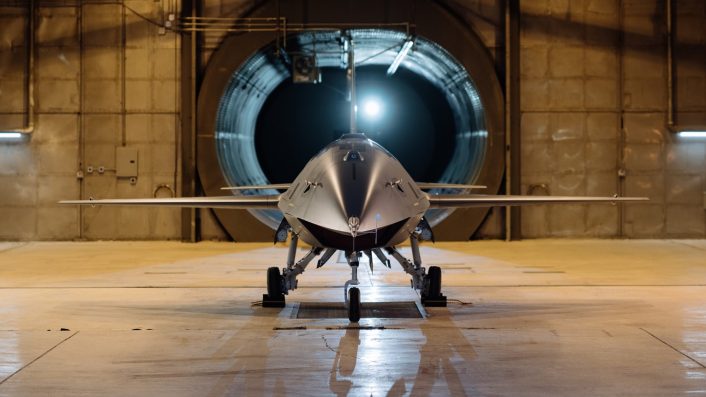
With the YFQ-44 now flying, both of the U.S. Air Force’s new Collaborative Combat Aircraft are in flight testing.
The YFQ-44A Collaborative Combat Aircraft (CCA) developed by Anduril has conducted its first flight on Oct. 31, 2025. Following this milestone, both of the U.S. Air Force’s new uncrewed fighters are now in flight testing as part of the Increment 1 of the CCA program.
https://t.co/FBV38llbvd pic.twitter.com/SmffBOzurP
— TaskForce23 (@Task_Force23) October 31, 2025
The YFQ-44’s first flight follows the one of the YFQ-42A by General Atomics Aeronautical Systems in August 2025. Both unmanned aircraft were initially expected to enter flight testing by the end of the summer.
“This milestone demonstrates how competition drives innovation and accelerates delivery. These flights are giving us the hard data we need to shape requirements, reduce risk, and ensure the CCA program delivers combat capability on a pace and scale that keeps us ahead of the threat.”
— Troy Meink, Secretary of the U.S. Air Force
Today, the @usairforce made continued progress in our CCA program with the first flight of the YFQ-44A developed by @anduriltech. This milestone shows how competition drives innovation & accelerates delivery. (1/2) pic.twitter.com/MlxyJ85WvF
— Office of the Secretary of the Air Force (@SecAFOfficial) October 31, 2025
The company says the YFQ-44A went “from clean-sheet design to wheels-up in just 556 days,” and it flew semi-autonomously, instead of being remotely piloted. Additionally, Anduril says it is “building and testing a new type of production system for YFQ-44A, and it will be the first program to be introduced at the new Arsenal-1 production facility in Columbus, Ohio, in the first half of 2026.
The YFQ-44
The YFQ-44 was first unveiled in May 2025, after the announcement of the beginning of ground testing. Earlier, the aircraft was only shown in renderings.
Since it has been described as a production representative test vehicle, the aircraft might have only minor modifications such as instrumentation to record test data. One of these is the flight-test data probe installed on the nose of the aircraft, commonly seen on aircraft which are undergoing the initial phases of flight testing.
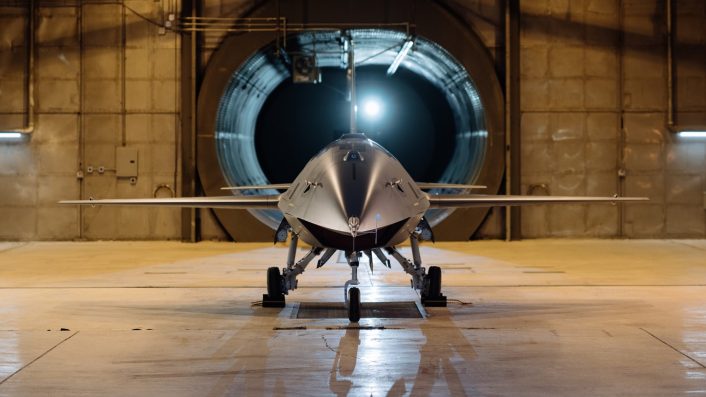
A difference that immediately catches the eye, compared to the renderings previously released, is what appears to be a forward-facing camera installed on top of the nose. This might be intended to provide pilots with visual cues either for control or situational awareness, although it is unknown if this will be also a feature of the final aircraft.
Another likely option, which would make sense given the air-to-air mission of the first CCAs, would be an InfraRed Search and Track (IRST) sensor, such as the one unveiled by Anduril in 2024, named Iris and marketed as a low-cost option for both manned and unmanned aircraft. The fairing installed on the YFQ-44 also appears similar to the one shown in the Iris’ photos released by the company.
Collaborative Combat Aircraft
The development of the autonomous systems has advanced more rapidly than expected, leading some to suggest that NGAD’s crewed fighter might not be as essential as initially planned. The combination of CCAs with manned platforms like the F-35 and F-15EX could provide a more affordable and flexible solution to achieving air superiority.
The rise of CCAs reflects the Air Force’s shifting priorities, where a system-of-systems approach may take precedence over a singular focus on a high-cost manned fighter. The combination of manned and unmanned systems also allows for greater flexibility and the potential to deploy assets in more distributed and resilient ways.
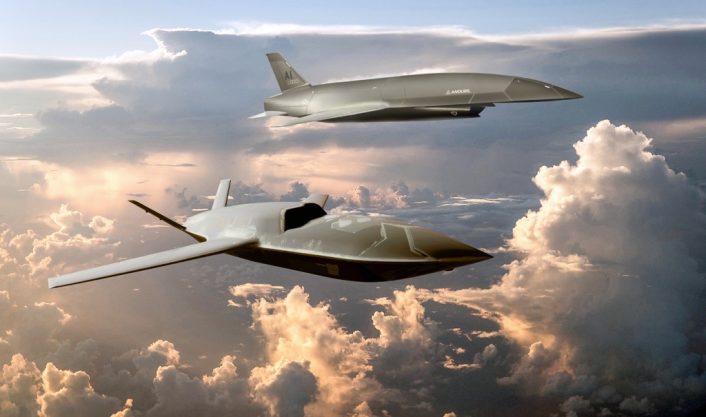
The Air Force is rapidly advancing the development of CCAs, with plans to begin deploying over 150 units in the next five years. These autonomous systems could take on a range of missions, from surveillance to direct combat, working as force multipliers in collaboration with manned platforms and taking on high-risk missions traditionally performed by manned fighters.
Unlike legacy fighters, CCAs feature modular designs, enabling rapid upgrades and streamlined maintenance. The modular design and open architecture, the latter becoming a staple in the design of modern military aircraft, allows to introduce new capabilities as they become available, allowing in turn to always field the latest technologies to keep an edge over rapidly evolving battlefields.
In early 2024, Anduril Industries and General Atomics were awarded contracts to design and test production-ready CCAs, marking a pivotal step in the program. Both companies are developing these unmanned aircraft to support both the upcoming NGAD fighters, as well as current F-35s and other manned aircraft, by sharing sensor data, executing coordinated maneuvers, and potentially carrying out combat roles.
In early 2025, U.S. Air Force’s Chief of Staff, General David Allvin, announced the official designation of the first two CCAs. The two aircraft by General Atomics and Anduril have been named YFQ-42A and YFQ-44A, respectively, marking the first use of the ‘Unmanned Fighter’ designation by the USAF.
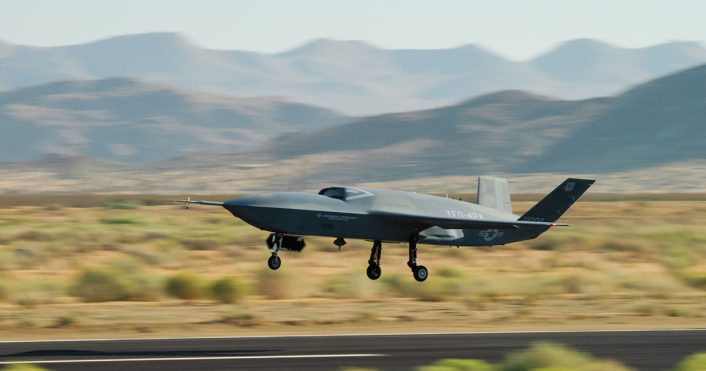
“We have two prototypes of Collaborative Combat Aircraft that were on paper less than a couple of years ago,” Allvin said. “For the first time in our history, we have a fighter designation in the YFQ-42 Alpha and the YFQ-44 Alpha – maybe just symbolic, but it’s telling the world that we are leaning into a new chapter of aerial warfare.”
The Air Force is planning to field a diverse fleet of over 1,000 CCAs, designed with modular configurations for weaponry, sensor capabilities, and rapid adaptability to mission needs. One notable advancement in 2024 was the first flight of the XQ-67A, a low-cost drone designed by General Atomics under the Off-Board Sensing Station (OBSS) program, which occurred in February 2024.
This platform, along with the earlier XQ-58A Valkyrie, demonstrates a “common chassis” concept—using shared components for various drone models to streamline production and reduce costs. This approach aims to provide a scalable, cost-effective solution for enhancing combat capacity without relying on high-cost crewed jets, which is essential given the Air Force’s budget constraints and strategic emphasis on distributed, resilient forces.
“A competitive Increment 1 production decision is expected in fiscal year 2026,” says the Air Force, “with development for Increment 2 beginning that same year to expand mission applications and integrate emerging technologies.”
source
