



Subscription Required
Open to All Readers
By Scott Hamilton
Background
May 21, 2026, © Leeham News: We completed a multi-part series last month on Boeing’s 30-Year March to a New Airplane. Now, it’s Airbus’s turn.
It will be around 27 years between new airplane program launches, based on some moving targets.
The A350 was Airbus’ last all-new airplane design. (The A220 doesn’t count; this program was purchased from Bombardier.)
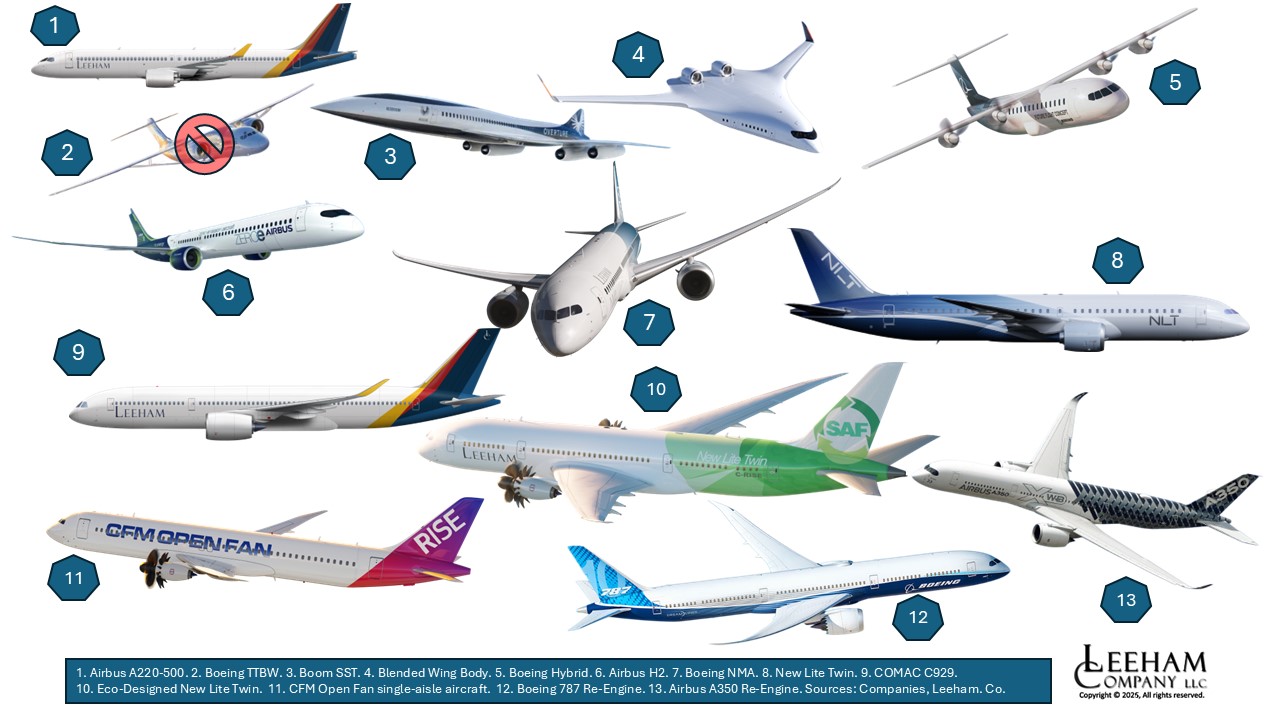
Figure 1. There is a plethora of new aircraft concepts and derivatives being discussed by various companies over the coming decade. Airbus has key decisions to make. Source: Leeham News.
In 2004, Airbus launched what would become the first version of the A350. It was an extreme makeover of the A330. Rolls-Royce Trent engines developed for the Boeing 787 were chosen for the new A350. A new composite wing replaced the A330’s metal wing. A few dozen A350s were sold, but it wasn’t long before Airbus realized this was going to be a loser.
After more false starts, Airbus launched the revamped A350 in 2006, called the XWB, for Xtra Wide Body. Since the A350 was Airbus’ response to the 787, the final version was slightly wider (hence the “Xtra Wide Body”), but narrower than the 777 fuselage. Airbus tried to straddle the 777 and 787 lines. The design was a compromise. LNA will discuss this further in our new series.
Airbus CEO Guillaume Faury previously said he expected to launch a new airplane program in 2030. This would follow about two years of testing the CFM RISE Open Fan engine, designed for the single-aisle replacements of the A320 and Boeing’s 737.
Engine testing was to begin in 2027. It now isn’t slated to begin until 2029. This means that a program launch is unlikely before 2031. That’s 27 years after the launch of the original A350. Whether 2004 or 2006 is the appropriate launch date, and if 2031 is good or a launch comes later, it’s still a long time between new airplane programs.
LNA’s new product tracking at Airbus
Just as LNA spent three years tracking Boeing’s path to a new airplane, we’ve tracked Airbus’ activities. As with Boeing, executives and officers have made plenty of public statements. Airbus has frequently showcased new aircraft concepts and discussed alternative clean-energy ideas. It’s been open about its Wing of Tomorrow project.

Figure 2. An early concept of hydrogen-powered airplanes by Airbus. The turboprop is now a four-engine concept. Source: Airbus.
As with LNA’s tracking of Boeing, we’ve talked with the supply chain, well-placed sources within Airbus, others, and we know where to look in the public domain on the Internet for key information.
Like Boeing, Airbus declined to make anyone available for interviews. Unlike Boeing, which didn’t cooperate with LNA at all (in fact, Boeing reneged on an interview it had agreed to), Airbus answered questions and provided information via its corporate communications department.
Choices

One concept for the Airbus Wing of Tomorrow. Credit: GKN, Airbus.
In recent years, Airbus floated the concepts of a stretched A220, commonly referred to as the A220-500. Internally, Airbus calls the concept the A220S for Stretch.
There’s also been a hydrogen-powered four-engine turboprop, Blended Wing Body, and tube-and-wing aircraft illustrated.
But the big decision to come is when to replace the A320neo family—and with what engine. Christian Scherer, a lifer at Airbus who served as chief strategist, chief salesman, and, most recently, CEO of Airbus Commercial Aircraft, has been a strong proponent of the CFM RISE Open Fan engine. He was also the leading proponent of the A220S.
But Scherer retired on Dec. 31. His successor, Lars Wagner, appears to favor proceeding with the A220S. An announcement might come as early as this year.
But he joined Airbus from his position as CEO of MTU’s engine unit. MTU is a big contractor to Pratt & Whitney on the Geared Turbo Fan. PW dismisses the Open Fan as a viable option for the next single-aisle airplane. Wagner’s position is unknown.
Hydrogen-powered airplanes, the first with a program entry-into-service goal of 2035, now appear to be on the back burner indefinitely.
LNA will take a deep dive into these choices. The Series begins on Thursday behind the paywall.
Lots of Caveats
- As with Boeing, there are many caveats to the conclusions LNA will draw in the coming series. Boeing has some caveats unique to it due to the prolonged 737 MAX crisis, delays, and agonizingly slow certification of the MAX 7 and MAX 10. But there are plenty of common caveats.
- Global or regional events, such as pandemics and conflicts that have global implications. The Iran War is an example of the latter, in which the full implications have yet to be understood.
- A global recession, such as the one beginning in 2008.
- What happens if Embraer forces Airbus’ hand prematurely by launching a new single-aisle airplane program?
- Engine development: new engines must achieve double-digit reductions in fuel consumption compared to today’s engines. They must demonstrate maturity to ensure reliable, durable in-service operations. An entirely new engine is needed for the MOM-category airplane. GE must satisfy the industry that its proposed RISE Open Fan engine isn’t a pipe dream. Pratt & Whitney must regain customers’ confidence that the decade-long debilitating problems with its GTF engine are over. Rolls-Royce must finance the development of not just one but possibly two new engines.
- What will Airbus’ response be if Boeing launches a New Midmarket Airplane (NMA) or similar New Lite Twin (NLT) first, as early as 2028? Boeing has the opportunity to reclaim the leadership in the Middle of the Market that has been eroded by the A321LR and A321XLR. An NLT/NMA freighter to replace the 767-300ERF might be a better option than a new-production 787-9F, which Boeing has already fundamentally designed.
Related
