


The U.S. Air Force released for the first time a short clip showing a B-1B Lancer bomber flying with an AGM-183 ARRW hypersonic weapon carried externally.
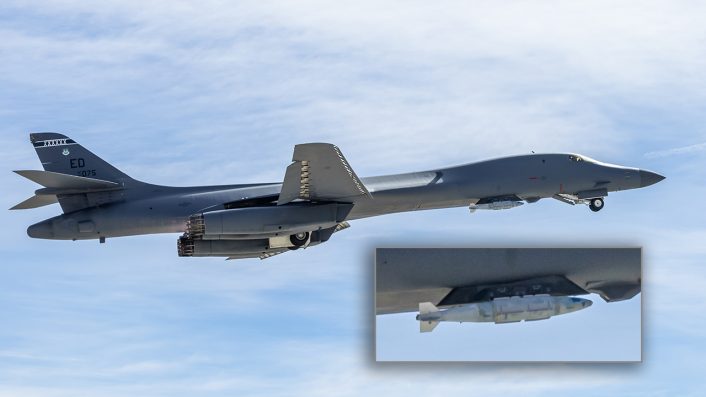
A U.S. Air Force B-1B Lancer bomber was shown for the first time while carrying an AGM-183A Air-Launched Rapid Response Weapon (ARRW). The hypersonic weapon was visible in a short 2-second clip which was part of a longer feature dedicated to maintainers and released on Edwards Air Force Base’s Instagram page on Apr. 29, 2026.
ARRW on B-1B
It is unclear when the test flight with the ARRW on the B-1B Lancer was conducted. The weapon is installed on an external pylon in the same position which was already used in the past to test the external carry of JDAM bombs and to carry operationally the Sniper targeting pod.
The service already mentioned years ago its intention of integrating the AGM-183 on the BONE (from “B-One”, as the aircraft is unofficially nicknamed). So far, however, the weapon was always seen on the B-52H Stratofortress, and the Air Force did not announce tests on the B-1B.
The integration on the B-1B was also mentioned in the recent Fiscal Year 2027 Research, Development, Test & Evaluation (RDT&E) budget request. Specifically, this appears to be part of the Hypersonic Integration Program, which the service explains it has “successfully demonstrated the B-1B’s ability to execute a captive carry of a 5,000-pound class store and the release of a proven weapon shape from a Load Adaptable Modular (LAM) pylon.”
This specific phrasing was also included in last year’s budget request, possibly referring to the testing of the 5,000-pound GBU-72/B Advanced 5K Penetrator, which was spotted on the BONE in 2024. The new pylons, whose procurement was similarly mentioned in last year’s budget request, are meant to allow the B-1B to carry externally a variety of weapons with fewer constraints compared to older systems.
Hypersonic Integration Program and Expanded Weapons Integration
The Air Force was initially looking to retire the B-1B by 2030, although it is now looking to extend the service life of the bomber to at least 2037. Meanwhile, the service has been looking to equip the BONE for stand-off attacks with larger volumes of weapons.
This is part of the Expanded Weapons Integration program, which is described as follows in the budget documentation:
“EXPANDED WEAPONS INTEGRATION: This funding supports the B-1B Expanded Weapons Integration (EWI) program, a Continuous Improvement Program (CIP) essential for maintaining the platform’s combat relevance against sophisticated adversaries, providing B-1B the ability to counter pacing and future threats. The primary objective of EWI is to advance the B-1B’s ability to deliver a diverse range of standoff munitions, a critical capability for executing missions in contested anti-access/area denial (A2/AD) environments. Current efforts focus on expanding the overall external carriage arsenal, including but not limited to: Guided Bomb Unit (GBU)-72, multiple Joint Air-to-Surface Standoff Missile (JASSM) and Long-Range Anti-Ship Missile (LRASM), Joint Direct Attack Munition (JDAM), Air Launched Rapid Response Weapon (ARRW) and Air to Ground Missile (AGM-183).
New Start FY 2027.
This program will integrate advanced weapon systems, including hypersonic missiles, by funding the requisite engineering, software development, and comprehensive testing to certify new weapon systems for safe carriage and employment. By expanding the B-1B’s payload and mission flexibility, this program significantly enhances its contribution to the nation’s long-range strike portfolio, ensures it remains a formidable asset capable of meeting future mission demands, and improves overall combat readiness.
New Start FY 2027.”
The new budget request notably shows that the Air Force intends to bring back the AGM-183 ARRW with a $345.7 million request for FY2027 and a total of $1.7 billion until FY2030. These funds would be used for both the ARRW’s Increment 2 program, which adds enhanced capabilities, and the new Air-Launched Ballistic Missile (ALBM).
The service previously said it did not intend to continue the program, which had its share of troubles with multiple test flights failed. However, the Air Force nonetheless completed the planned testing campaign, collecting data which would be used to further mature hypersonic technologies.
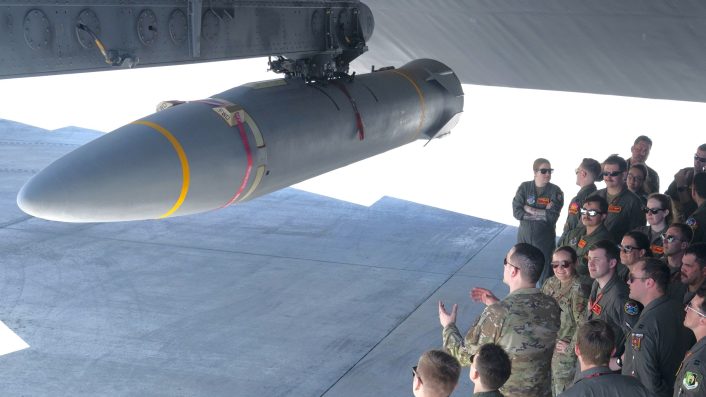
The FY2026 budget request already mentioned the Air Force’s intention to use the new Load Adaptable Modular (LAM) pylons to employ the B-1B as test bed for hypersonic weapons. Boeing, the manufacturer of the new pylons, similarly said the “Air Force intends to use the B-1 and pylons to test hypersonic weapons in the near term.”
Boeing explained the B-1 can accommodate six pylons, each capable of loading two 2,000-pound-class weapons or a 5,000-pound-plus-class future weapon. The pylons will be installed on the external hardpoints that were initially present on the B-1B and later removed.
The weight of the ARRW has not officially been confirmed, although it is estimated to be approximately 5,000 lb. This would mean that the B-1B could one day be cleared to carry up to six AGM-183 hypersonic weapons under its fuselage.
The service previously said that ARRW is meant to provide an offensive, high-speed strike capability to destroy high-value, time-sensitive, land-based targets in anti-access/area-denial environments.
source
