


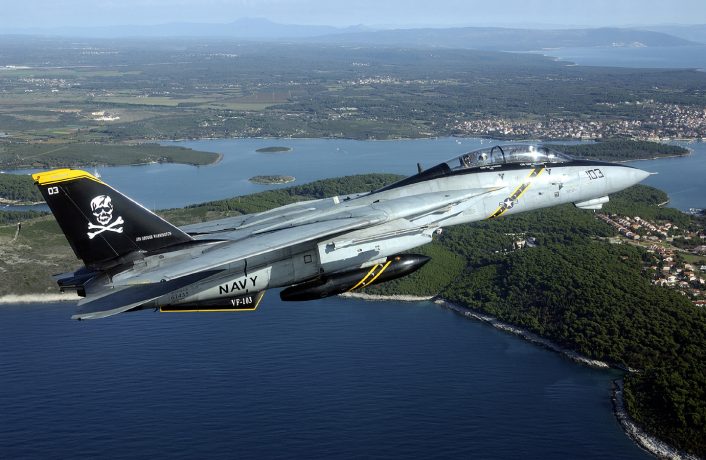
Three U.S. Navy F-14D Tomcats would be transferred to the U.S. Space and Rocket Center Commission in Huntsville, Alabama, and one might be made flyable again, following the approval of the “Maverick Act.”
The U.S. Congress is voting on a new bill which might see a F-14D Tomcat return to the skies 20 years after it was retired. The bill, notably called the “Maverick Act,” was introduced by Senator Tim Sheehy, co-sponsored by Sen. Mark Kelly, on Mar. 23, 2026.
Maverick Act
The bill passed Senate by Unanimous Consent on Apr. 28, 2026, and is now in line for voting at the House, with the latest update on May 4. Should the bill also pass the House, it would authorize the transfer by the Secretary of the Navy to the U.S. Space and Rocket Center Commission in Huntsville, Alabama, of three F-14D Tomcats.
https://t.co/ud4jZg86m5
The bill still needs to pass the house.
— OSINTtechnical (@Osinttechnical) May 7, 2026
The Commission directs the U.S. Space & Rocket Center, the space-dedicated museum established by the government of Alabama in 1970 and sometimes referred to “Earth’s largest space museum.” According to the text of the bill, it appears that the three aircraft have already been identified with the Bureau Numbers 164341, 164602, 159437.
The document specifies that the aircraft “do not have any capability for use as a platform for launching or releasing munitions or any other combat capability that it was designed to have.” A set of conditions is then listed, with the Secretary of the Navy not required to repair or alter the condition of the aircraft before conveying its ownership but providing any maintenance and operations manuals and excess spare parts.
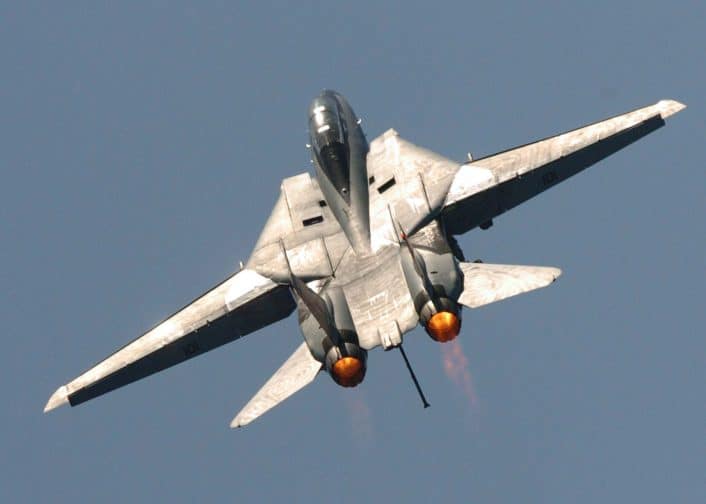
The latter is where things gets interesting, mentioning for the first time a possible return to the skies of the Tomcat:
“The Secretary shall provide excess spare parts to make one of the F–14D aircraft flyable or able to complete a static display, provided that any part transferred is from existing Navy stock, with no items being procured on behalf of the Commission.”
However, the activities required to make this happen will be the sole responsibility of the Commission:
“The Secretary will not be responsible for transferring any additional parts or providing any additional support beyond what is stated in this section, during or after the conveyance of the aircraft.”
The Commission will be able to obtain qualified support outside of the Department of the Navy, something similar to what the Collings Foundation did with the F-4D Phantom, the type’s only flying example in the U.S.:
“The Secretary may authorize the Commission to enter into agreements with qualified nonprofit organizations for the purpose of restoring and operating the aircraft transferred under subsection for public display, airshows, and commemorative events to preserve naval aviation heritage.”
The document also specifies that the transfer will be made at no cost to the government. “Any costs associated with such conveyance, costs of determining compliance with terms of the conveyance, and costs of operation and maintenance of the aircraft conveyed shall be borne by the Commission,” mentions the bill.
Feasibility
The U.S. has been historically extremely restrictive regarding the access to the retired F-14 airframes. In fact, access to spare parts was tightly controlled to avoid any possibility of smuggling toward Iran, which was the type’s only operator after the U.S. Navy retired its Tomcats in 2006.
Many parts were also destroyed, which would make difficult the procurement of the required components to make the aircraft flyable again. It should be noted that, upon retirement, many components were removed from the aircraft, before they were parked in the desert.
Before returning to flight, the F-14D would need deep inspections, both for the airframe’s structure and the systems. After that, work would be done in order to make the aircraft compliant with the requirements for the certification by the Federal Aviation Administration.
This process is expected to be highly expensive, mainly due to among of work after the aircraft sat in the desert for 20 years and the lack of supply chain. The Tomcat was also known for its high operating costs, which would make sustained airshow operations unlikely.
However, limited flight demonstrations and heritage events might be more likely. The timeline is another unknown aspect, and the possible return to flight might take years before materializing.
source
