

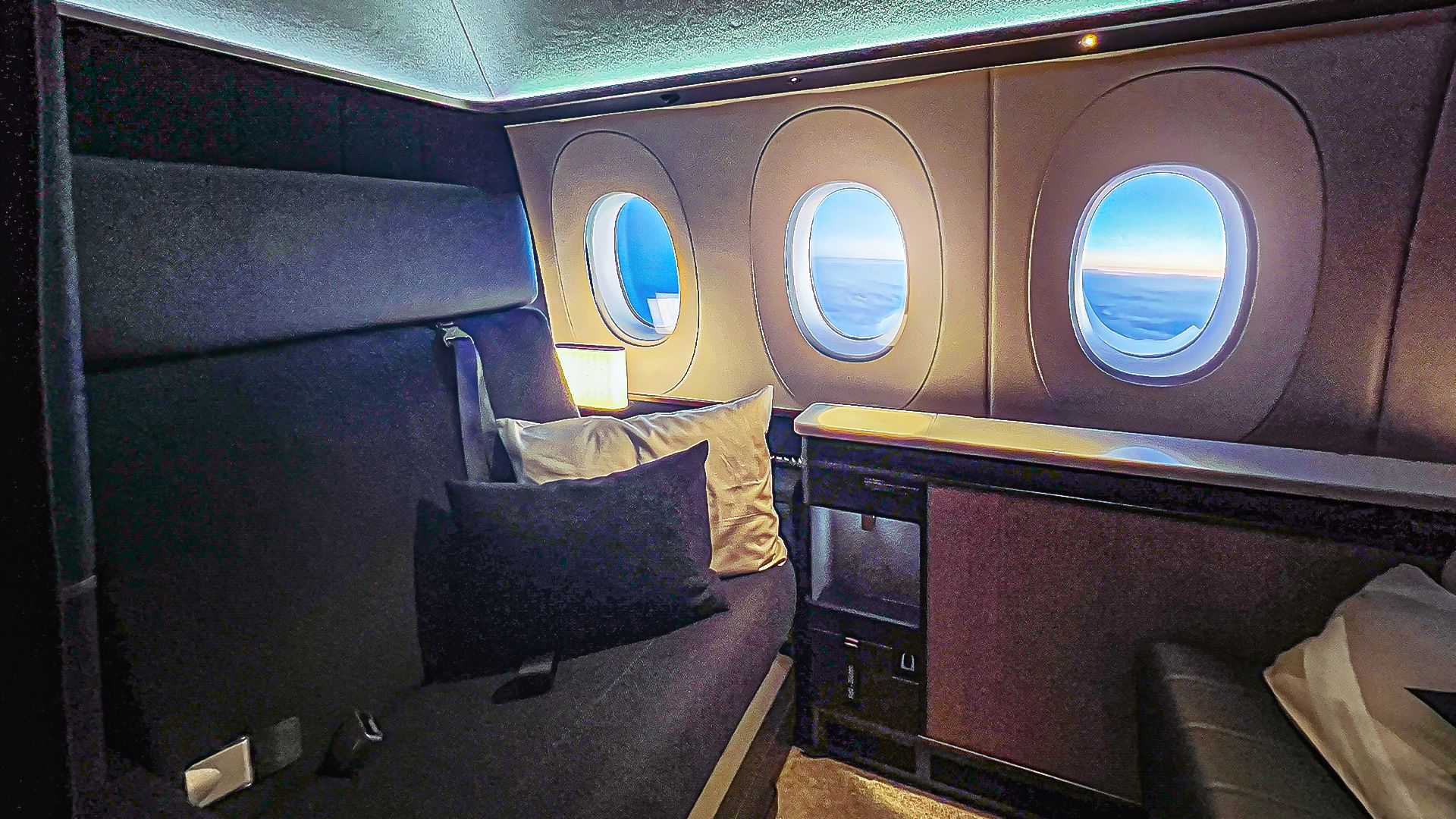
Allegris is Lufthansa’s all-new cabin interior layout featuring new premium seats. By 2025,  Lufthansa had invested some 2.5 billion Euros ($2.9 billion) in the program and is a part of a major effort to modernize the passenger experience for passengers and keep the airline one of Europe’s premier airlines. In 2024, Lufthansa got into the news for being unable to sell one row of seats on its new A350-900s. By 2025, it was being reported that Lufthansa was refusing delivery of its new Boeing 787-9s due to certification delays with Allegris’ business class seats.
As pressure to accept the aircraft grew, Lufthansa decided to accept the aircraft, unable to sell 85% of their business class seats. Here is what to know about Lufthansa’s Allegris roll-out debacle and whether it has been a profitable mess. This is only one issue facing Lufthansa as it launches more modernized widebody aircraft. Lufthansa is to be the launch customer of the upcoming Boeing 777X, but this jet has now been delayed again to 2027.
Lufthansa’s Allegris Premium Cabin

Lufthansa is a flag carrier providing premium seating options. At a time when many airlines are ditching first class, Lufthansa is introducing a new generation of first class seating options on select aircraft. But the main focus of Allegris is its business and premium economy seating options. Allegris also revamps economy seating.
Lufthansa is offering passengers a “completely new travel experience on long-haul flights” with Allegris. It first introduced Allegris on its new Airbus A350-900 airliners in May 2024. Now, Lufthansa has nine Airbus A350-900s equipped with Lufthansa Allegris, and these are available on flights from Munich to San Francisco, Shanghai, Bengaluru, Mumbai, Chicago, Beijing, and New York-JFK. Six of these aircraft also have first-class seating.
First class comes with “Suite Plus” featuring a separate double cabin with ceiling-high walls and a lockable door. Business class offers a suite with chest-high walls and sliding doors and a monitor up to 27 inches wide. Business class comes with five different seat types. The new premium economy seats offer a seat pitch of 39 inches, comfortable leg rests, a 15.6-inch monitor, and even high-quality noise-canceling headphones.
Delays With Airbus A350-900 Certifications

But Lufthansa has had trouble getting certain seats of its new Allegris certified. On the A350-900, Lufthansa was forced to physically block off row 19 as the certification for these economy seats remained pending after the aircraft were accepted into service. The issue was with the new seatbelt-integrated airbags needed due to a lack of a bulkhead and the high-back premium economy seats in front.
Progress is being made, and as of late 2025, row 19 is now available for booking. While the early issues were widely reported, the resolution of those issues was not. Since then, Lufthansa has continued to receive its A350-900s, and according to Planespotters.net, its most recent example (D-AIVE) was delivered in June 2025. While it may have been an embarrassing look for Lufthansa to have a row of economy seats physically taped off like a construction site, it was hardly that damaging to its bottom line.
The problem was the hard shells of the premium economy seats. FAA regulations require the first row of economy in that configuration to have an airbag or an acceptable restraint arrangement. The specific airbags Lufthansa was using did not yet have their regulatory certification by the time the airline started to receive its A350s.
Bigger Issues With Boeing 787 Dreamliners

A similar, but worse, situation arose for Lufthansa’s new Boeing 787 Dreamliners. At one point, around 15 Dreamliners were built and awaiting delivery, but were being refused due to Lufthansa’s inability to secure certification for some of its business-class seats. Starting in August 2025, Lufthansa started accepting the first 787-9s into service with business class seats blocked off.
In August, Lufthansa put out a press release announcing the arrival of the first Dreamliner with the Allegris cabin. It stated the aircraft would be used on flights from Frankfurt to Toronto starting in mid-October and says a total of nine more 787-9s are expected in 2025, or one every two weeks. It added that business, premium, and economy seats were already available for booking. Addressing the issue of Allegris certification, it only stated, “As soon as the certification process for Allegris Business Class for Boeing Dreamliners is complete, these seats will also be available for booking.”
|
Lufthansa Allegris certification issues |
|
|---|---|
|
Airbus A350-900 |
Row 19 blocked off |
|
Status |
Resolved |
|
Boeing 787-9 |
24 business class seats blocked off |
|
Status |
Remains blocked off |
While it didn’t give a number, for now, Boeing 787-9s will operate with most of their business class seats blocked off. It seems all business class seats that are behind the front row of Business Suites are not available. The Boeing 787-9 is configured with 28 business class seats, of which only four are bookable.
Loss Of Business Class Seats Is Painful

While the A350-900 seats may have been a nuisance for Lufthansa, it was not nearly as problematic as the Dreamliners. Lufthansa has paid a significant price for the holdup, although it’s impossible to put an exact number on it. One cost was the delayed acceptance of the 787-9s into service, which forced Lufthansa to rely on older, less efficient aircraft, burning more jet fuel.
It’s unclear if the delays impacted Lufthansa’s capacity, causing any impact on its routes. Perhaps most painful is operating the 787-9s while being unable to sell 85% of the business class seats. Being unable to sell a single row of economy class seats is completely different from being unable to sell 24 business class seats. Business class seats are far more profitable than economy seats.
|
Future Lufthansa widebody aircraft |
|
|---|---|
|
Airbus A350-900 |
14 remaining on order |
|
Airbus A350-1000 |
15 on order |
|
Boeing 787-9 |
27 remaining on order |
|
Boeing 777X |
20 on order |
A typical Lufthansa one-way business class fare costs upwards of $2,500, while a typical economy class fare is upwards of $500. As of the time of writing, flights from Munich to Chicago for December are listed as starting from over $2,000 for economy and over $8,500 for business. Taxes on business class seats are higher than economy class, but not excessively so. In all, premium classes drive around 50% of the aircraft’s revenue. Losing these business seats is very painful for the ability of the flight to turn a profit.
Trend To Premium Seating

Currently, there are two broad seating trends in the aviation industry. One trend is to low-cost and ultra-low-cost airlines around the world, with airlines like Allegiant and Ryanair. As a premium flag carrier, Lufthansa does not operate in this market. The other trend is to premium economy seating at the expense of economy seating and first class seating. Lufthansa is one of the comparatively few airlines retaining first class, although not in its new Boeing 787-9s and only four suites in its new A350-900s.
Long gone are the times when flying was an elite experience that only the well-to-do could afford and when strict dress standards were enforced by airlines. Today, flying is no longer much of a status symbol, and ultra-expensive first-class seats have fallen out of favor. With American Airlines now scraping first class, no mainline US-based airline will offer first class. First class has also been impacted by a rise in the quality of business class, which made first class seem unnecessary.
Passengers around the world are increasingly looking for either the cheapest option (low-cost carriers) or comfortable, but also affordable options with premium economy. The trend to premium economy seating has proven popular and profitable, and more airlines have introduced the class. Emirates is another major airline retrofitting most of its aircraft with substantial premium economy seats.
A Painful Hiccup Along The Way

Lufthansa’s Airbus A350 Allegris woes appear to be behind it, while it remains unclear when it will get its more serious issues with the Boeing 787-9s sorted. But it is reasonable to assume they will work out the issues in due course. It is common for airlines to have problems with new aircraft and products. Now, Lufthansa is able to offer an upgraded cabin experience for its passengers on a growing range of aircraft and routes.
Issues airlines face with new aircraft and products range from engine issues with IndiGo’s Airbus A320neos to legal disputes, such as those between Airbus and Qatar Airways over its Airbus A350s, which had the aircraft grounded for a while. Delta Air Lines is planning to introduce an Airbus A321neo with 44 premium seats because of issues with certification. The aircraft was meant to be configured with 164 seats made up of 44 premium seats and 120 economy seats. Delta has the option of either keeping its brand-new aircraft in storage as issues are resolved or getting some use out of them in the meantime.
Once Lufthansa fixes its Allegris certifications, it will benefit from a renewed and efficient fleet with refreshed cabin interiors. At that point, these teething Allegris issues will fade away into a footnote in Lufthansa’s history. After the seats get their type certificates and the layout matures, the issues are unlikely to repeat themselves in the future.
source
