




By Bjorn Fehrm
May 22, 2026, ©. Leeham News: We do a series on aircraft structures and how they have shaped the way our airliners transport us around the world today.
We start with the history of aircraft structures, as this is a good way to understand where we are today. Mankind has dreamt of flying like the birds. It was also the birds that inspired the first wing kits that were assembled by men like Otto Lilienthal. He put on bird-like wings and flew down a slope in Berlin in 1895, Figure 1.
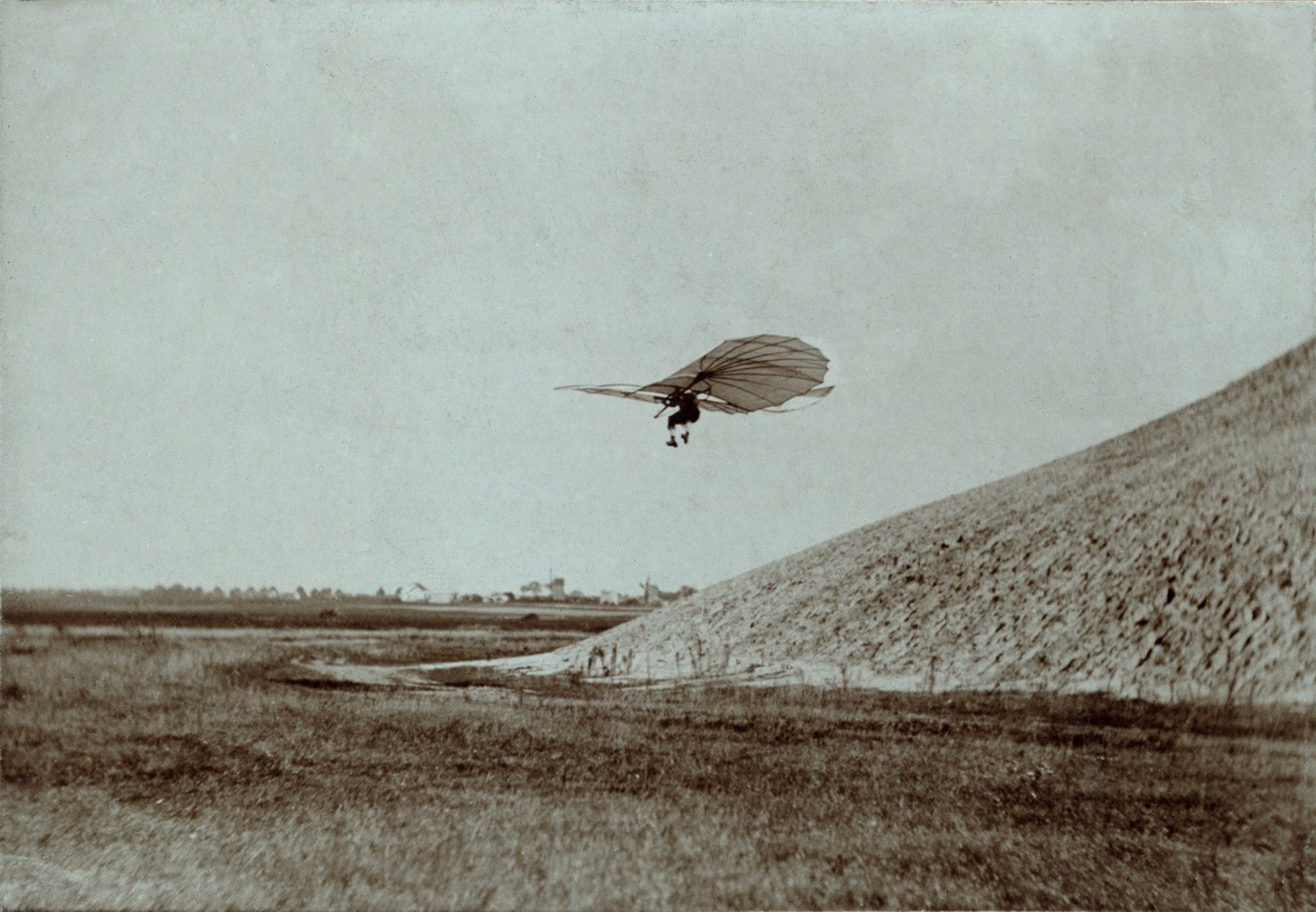
Figure 1. Ott Lilienthal with his glider wings in Berlin, 1895. Source: Wikipedia.
Lilienthal and other pioneers studied how the birds flew and took ideas on wings and tail from these. They covered a wooden structure, often made of bamboo, with cloth to give the wings an aerodynamic shape.
The development of aircraft structures is much about the materials
The initial structures were made of wood, using bamboo or spruce (which has good fiber orientation). Together with steel wires, the designers made box structures that were made sturdy by the addition of corner-to-corner crossing wires, Figure 2. (The illustration is from the practical book “Understanding Aircraft Structures” by John Cutler).

Figure 2. The Sopwith Camel structure. Source: Understanding Aircraft Structures by Cutler.
Observe that every wooden structural rectangle is braced with a wire cross: for the wing structure, the wing struts, the bracing of the wing laterally, and the X bracing of every part of the fuselage structure. Even the frames around the machine guns have wire cross-bracing.
The many braces and wires created drag. Gradually, after the First World War, aircraft needed higher speeds as they were used for military purposes or civil passenger service. To reduce drag and increase speed, the aircraft went from wire-braced double-deckers to monoplanes.
The change needed a design cleanup and an increase in the structure’s strength. Wood and wire cross-bracing was replaced by metal structures. The wooden fuselage longerons were replaced by steel tubes, and the wings’ spars and ribs were replaced by aluminum-based parts.
The invention of Duralumin
The progression from wooden structures to aluminum structures depended on the development of and commercialization of higher-strength aluminum alloys in Germany in the early 1900s.
Duralumin was the trade name for the copper-aluminum alloy invented by Alfred Wilm in Berlin in 1903. It was produced and marketed by the Dürener Metallwerke AG, which acquired Wilm’s patents and began commercializing the material in 2009.
Duralumin had the strength of six to eight times that of pure aluminum and a density one-third that of steel. It gradually became the material of choice once it was generally produced and available outside Germany after World War I. German aircraft builders began using Duraluminium during the war, with the first all-aluminum monoplane, the Junkers D.I, introduced at the end of the war in 1918, Figure 3.

Figure 3. The first all-metal fighter, the Junkers D.I, was made with Duralumin. Source: Wikipedia.
The copper-based Duralumin is found today in a series of Alu-based alloys called the 2000 series, designated through the international alloy designation system created in 1970 by the Aluminum Association.
Alloy 2024 is the most common alloy for aircraft general use and fuselage design because of its good strength and fatigue characteristics. Aluminum alloys derive their properties from their composition (e.g., Duralumin contains 3 to 5 wt% copper, 0.5 to 0.8 wt% manganese, and 0.5 wt% magnesium) and heat treatment. Duralumin was heat-treated at 450-500°C and then cooled fast (quenched). Today’s 2024 is available in different heat treatments called tempers. The untempered 2024-O has half the strength of the tempered 2024-T3.
In the interwar period, Wood was replaced by Duralumin
After WW I, duralumin and other aluminum manufacturers’ variations thereof became more widely available and known to aircraft manufacturers. By 1935, it had replaced wood as the construction material for military and commercial aircraft. Gradually, aircraft design began to use a monocoque or stressed-skin structural design (I prefer the stressed-skin label, as it better conveys what it’s all about).
A good exposé of the transition from a skeleton structure covered with fabric to a stressed-skin design is the story of the main British WW II fighters, the Hawker Hurricane and the Supermarine Spitfire.
The Hurricane was designed in the early 2030s as a progressive further development of Hawker fighters, using a skeleton-and-fabric fuselage and wing that went from a stressed-skin leading edge to gradually increased stressed-skin covers (Figure 4).

Figure 4. The Hawker Hurricane structure. Source: Understanding Aircraft Structures by Cutler.
The Supermarine Spitfire, like the Messerschmitt Me-109, was a stressed-skin design throughout, Figure 5.

Figure 5. The Supermarine Spitfire with its monocoque structure. Source: Wikipedia.
The well-established production methods for the Hurricane enabled Hawker to quickly increase production, and the Hurricane took the brunt of defense against the German bombers during the World War II London Blitz, whereas the more advanced structural design of the Spitfire allowed it to absorb a doubling of engine power as it was further developed during the war into faster and higher-flying versions.
Related
