


The B-1B is the Lancer 86-0115 “Rage” regenerated from the Boneyard to be returned to active service, during a post-depot functional check flight.
On Feb. 26, 2026, aviation photographer Ryan Rodriguez (@ryan_big_country_aviation) shot some really unique images: a “naked” B-1B Lancer, venting fuel at high altitude over Abilene, Texas.
Here’s how he recalled the sighting in a message sent to us:
“February 26th was just another normal day spotting at Dyess, whole lot of sitting, not much going on,” Rodriguez told us. “Waiting and listening to the ground chatter on the scanner, possible local Bone departure, I was just watching the radar as all the cool aircraft avoided our area like the plague. I noticed a hex taking off from Tinker, honestly thinking it was one of the Buffs in depot, so I figured I’d keep my eyes on it for the slightest chance of them shooting an approach here (wishful thinking 😅). Finally a few T-38s descended into the DYS pattern, so my focus turned to them. They leave, I get back on the radar to see the hex in west Oklahoma heading south towards Lancer MOA [Military Operations Area], which is normal. A little bit later I realized they were a lot lower than normal at 14k and climbing, but were south of the MOA and were beelining it my way. By the time they were about 10 miles away they were leveling off at 19k, thinking it’s a Buff I was thinking to myself that a Buff.”
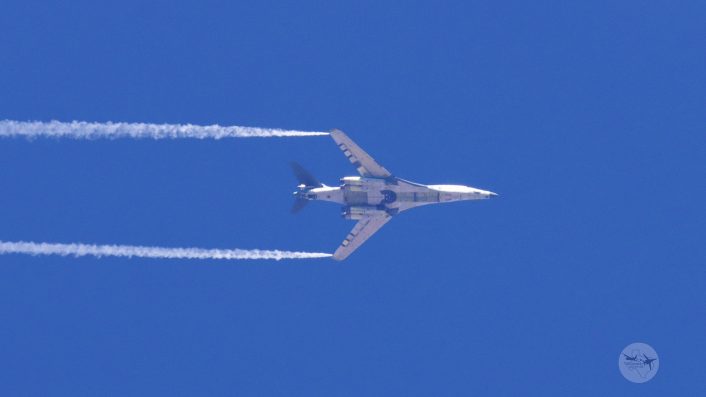
“At 19K would be so easy to see but I can’t see anything 👀 then I noticed something looks like it’s contrailing but not at 19k, so I knew something was different. Then I noticed it’s shiny 🤔 nothing at this point is clicking in my mind that I have my lens focused on a unicorn 😳 finally realization kicked in as they were directly overhead with wings back and fuel venting that I have finally seen “Rage” as they made a shallow left bank north back to Tinker, definitely not the naked Bone I wanted but it’s the naked Bone I got and I couldn’t be any more happier.”
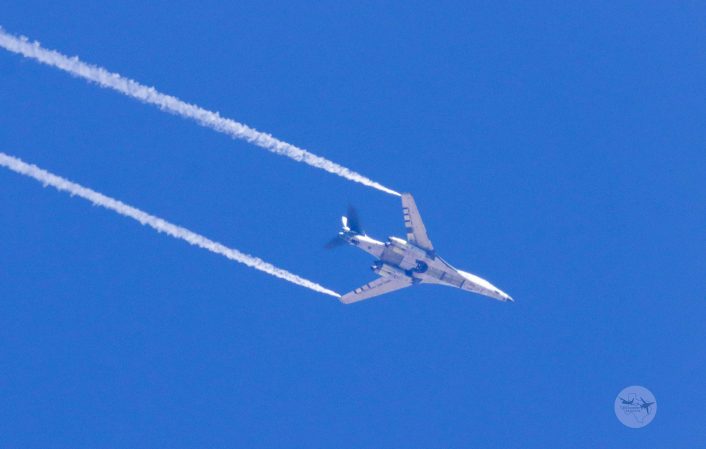
The aircraft Rodriguez spotted is indeed B-1B Lancer 86-0115 “Rage”, a Lancer bomber conducting a FCF (Functional Check Flight) following Programmed Depot Maintenance (PDM) at Tinker Air Force Base, Oklahoma. PDM is the heavy maintenance cycle during which aircraft (including the B-1Bs) receive structural inspections, receive replacement components as well as upgrades.
During PDMs, B-1s are almost completely disassembled and each part is inspected and all defects are fixed before they are rebuilt and sent back to their home stations as they were (almost) brand new.
After the PDM inspections are completed, the aircraft performs a series of test flights before it is “accepted” again and sent back to its squadron.
“Rage” was venting fuel most probably as part of the FCF fuel system checks: during these sorties, crews verify the proper operation of pumps, transfer valves and venting systems by moving fuel between tanks and stressing the system under different flight conditions. Excess fuel can also collect in the surge tanks located in the outer wings and be expelled through vent outlets near the trailing edge, producing the visible fuel stream that you can see in the photographs taken by Rodriguez.
One of the most interesting thing about “Rage” is that the bomber was regenerated from the Boneyard where it had spent more than 2 years at the 309th AMARG (Aerospace Maintenance and Regeneration Group) at Davis-Monthan AFB, Arizona. According to our friend Rob Stephens at Redhome Aviation, this BONE (from B-One, the most used nickname used for the type) was flown to the Oklahoma City Air Logistics Complex at Tinker AFB on July 2, 2024 after Air Force Global Strike Command determined it would be more economic to restore the aircraft from the boneyard as compared to repairing 86-0126 “Hungry Devil.”
“Hungry Devil” was damaged while undergoing heavy structures repair development at Boeing-Palmdale. It was set to test the feasibility of depot-level repair and replacement of the Forward Intermediate Fuselage, when it was damaged beyond what was economically feasible to restore to flight. Officials have not specified exactly what was damaged or the total extent of the damage, but rumors were that the aircraft’s thick, milled skin and ribs were damaged in the process.
For this reason, after spending 1,042 days parked in the Arizona desert, the bomber went through the multi-phase process required to return to active service. The last phase of this process is PDM. During PDM, “Rage” was stripped off its paint. It will get a fresh set of paint after all the functional check flights and tests are successful (actually, it might be in the process of being repainted at the time of writing). Then, it will be returned to fleet with the 7th Bomb Wing at Dyess AFB, Texas where it will join the other regenerated B-1B, 85-0081 “Lancelot.”
As reported by Redhome Aviation, “Lancelot,” also completed regeneration and returned to the fleet at Dyess AFB, Texas, on Jan. 21, 2026. The aircraft departed Tinker to Dyess AFB, Texas, using he callsign of the 345th Bomb Squadron, “Crook1.” Lancelot was brought back to replace B-1B 85-0089, which suffered an engine detonation and fire at Dyess AFB.
“No replacement is currently planned for B-1B 85-0085 “Ruptured Duck,” which crashed at Ellsworth AFB, South Dakota, in 2024. The B-1B fleet currently stands at 44 aircraft, highlighting how each remaining airframe has become increasingly valuable as the bomber continues to play a major role in the U.S. Air Force’s long-range conventional strike capability,” says Rob Stephens.
source
