


Two reviews published on December 12, 2025, warned that the V-22 Osprey remains exposed to safety risks that could lead to further “catastrophic” mishaps unless the joint program accelerates corrective actions and tightens oversight.
The findings come from a US Navy-led V-22 Comprehensive Review conducted by Naval Air Systems Command (NAVAIR) and a separate report by the Government Accountability Office (GAO), both of which highlight long-standing technical, procedural, and organizational weaknesses across the Marine Corps MV-22, Air Force CV-22, and Navy CMV-22 fleets.
Navy review highlights “accumulating” safety risk
NAVAIR’s V-22 Comprehensive Review concluded that the tiltrotor aircraft remains airworthy under existing controls but warned that its overall risk posture has continued to deteriorate over time.
According to the Navy, safety risks have accumulated due to slow implementation of corrective actions, inconsistent compliance with operational procedures, and shortcomings in applying airworthiness standards to formally mitigate risk. The review also pointed to the difficulty of enforcing uniform safety changes across a joint program with different mission profiles and risk tolerances.
The report links these systemic issues to recent fatal mishaps. Over the past four years, the V-22 fleet has suffered 12 Class A flight mishaps, resulting in the loss of four aircraft and the deaths of 20 service members.
The US Navy review again highlighted persistent concerns tied to the V-22’s drivetrain, including hard clutch engagement events and material defects linked to X-53 steel inclusions in the proprotor gearbox.
While procedural changes and inspections have reduced the likelihood of specific failure modes, some permanent hardware fixes remain years away, with elements extending into the 2030s. In the interim, the fleet continues to operate under restrictions and enhanced maintenance controls.
GAO faults joint oversight
Released the same day, the GAO report criticized how the Department of Defense manages safety across the joint V-22 enterprise.
As of mid-2025, Navy data identified 28 unresolved risks categorized as “catastrophic,” with an average age of roughly nine years, longer than for most other Navy aircraft programs.
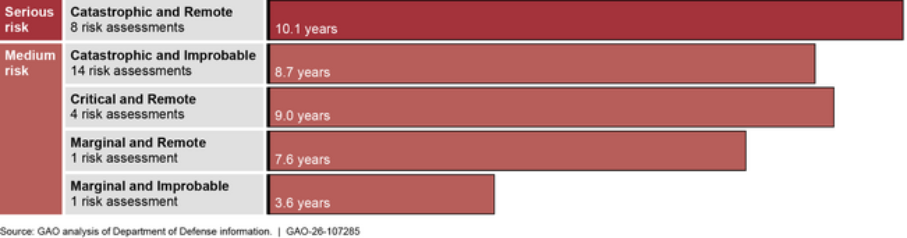
GAO also pointed to uneven information sharing between services and operating units, limiting commanders’ ability to assess fleet-wide risk trends.
Groundings, restrictions, and congressional scrutiny
The new reports follow months of heightened congressional scrutiny after multiple fatal crashes. A congressional report published in September 2025 noted that at least 65 people have died in V-22 mishaps since the aircraft entered service, including the four fatal crashes since 2022 that killed 20 service members.
The Osprey fleet has repeatedly cycled through groundings and operational pauses, including a fleet-wide pause in December 2024 after a CV-22 made a precautionary landing in New Mexico. Although the formal grounding was lifted in March 2024, all variants continue to operate under restrictions that limit missions to within 30 minutes of a safe landing zone.
source
