

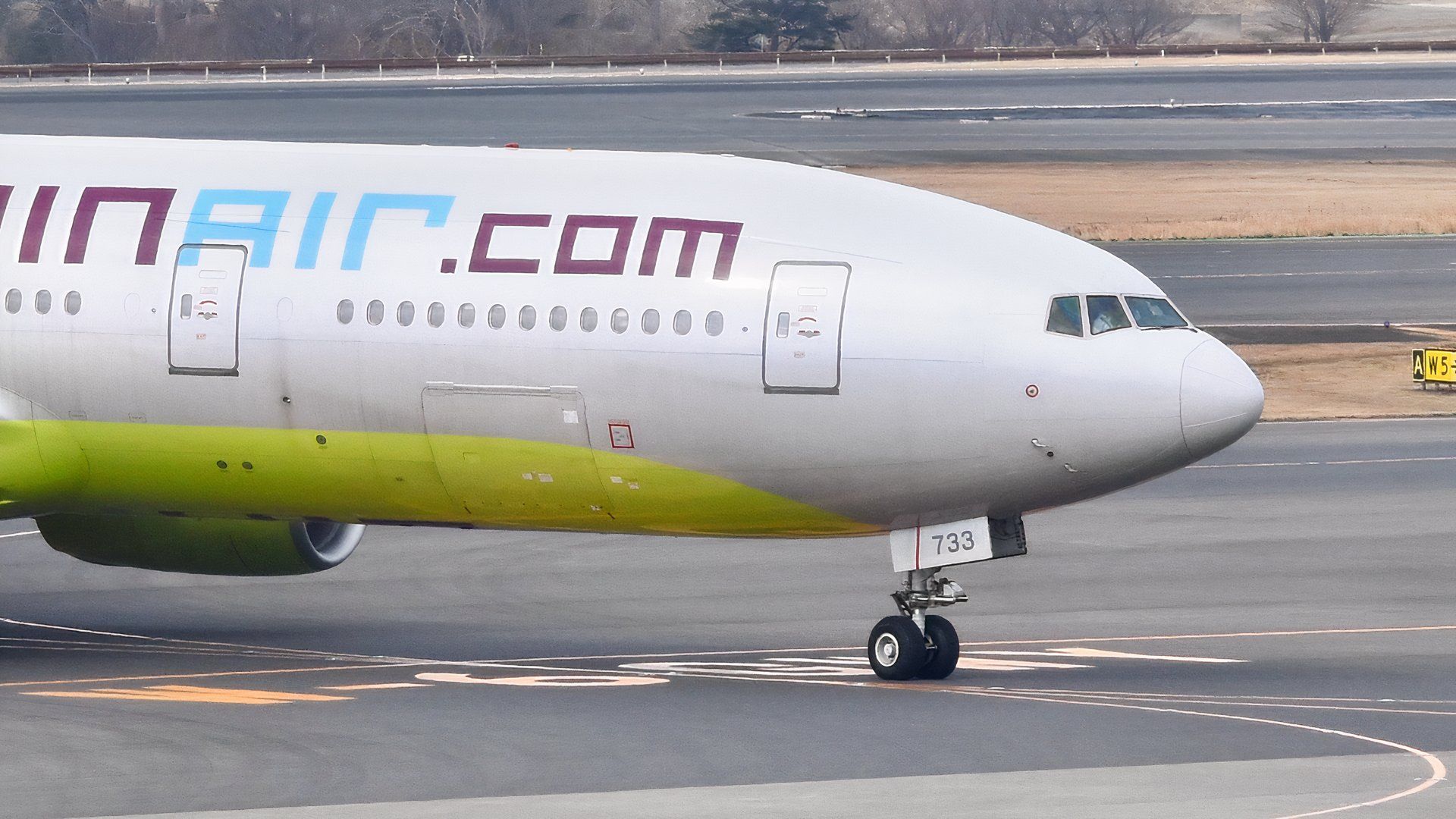
The domestic South Korean market from Seoul Gimpo to Jeju has more scheduled Boeing 777 passenger flights than any other airport pair in the world. This is based on using Cirium Diio data to examine the type’s full schedule in December. It overtakes Tokyo Haneda-Sapporo, which ranked first globally in November.
Some readers may not be surprised by Gimpo-Jeju’s pole position. After all, it is the world’s most-served airport pair overall. When all aircraft types and variants are included, over 120 daily flights (each way!) are typically available. Jeju is the so-called Hawaii of Asia. It is quick and cheap to reach, has some of South Korea’s best scenery and beaches, and there’s no other realistic way of reaching the island except by air.
Gimpo To Jeju: The World’s #1 777 Route In December

The market covers just 243 nautical miles (450 km) each way. For comparison, that’s the same distance as Philadelphia-Boston. The latest information shows that Gimpo to Jeju will have 310 monthly departures on the 777. Ten daily departures are available every day during the festive month. Other airport pairs come close, including Haneda-Sapporo (300 monthly departures) and London Heathrow-New York JFK (257 departures).
The Triple 7 will operate one in ten of Gimpo-Jeju’s total services. It is in the hands of Korean Air’s rare 338-seat non-ER 777-300s—see how the airline’s fleet is changing—and the low-cost carrier’s Jin Air’s 394-seat 777-200ERs.
When all twin-aisle equipment is included, widebodies will operate a third of the very short domestic market’s flights in December. There’s also Asiana and Korean Air’s A330-300s. Such a large amount of twin-aisle activity means the airport pair’s average seats per flight is 224. In contrast, New York JFK-Los Angeles is 169, while it’s 249 between Heathrow and JFK.
In the past two decades, Cirium indicates that many other widebodies have been deployed. The A300-600 was particularly important, as was the 767-300, and even the 747-400. At times in 2014, for example, the 747-400 had 15 daily departures from Gimpo to Jeju.
A Day In The Life: 777s On Gimpo-Jeju In December

As an example of the type’s activity, let’s consider Monday, December 1. On that day, Triple 7s will leave from Gimpo, which is not among the world’s top ten widebody airports, as follows. They’ll go at 6:05 am (Jin Air 777-200ER), 7:35 am (Korean Air 777-300), 9:10 am (Jin Air 777-200ER), 10:20 am (Jin Air 777-200ER), 12:10 pm (Korean Air 777-300), 1:40 pm (Jin Air 777-200ER), 2:35 pm (Jin Air 777-200ER), 4:40 pm (Korean Air 777-300), 6:15 pm (Jin Air 777-200ER), and 8:00 pm (Jin Air 777-200ER). These times are stated in Simple Flying’s new time format.
Going back to the South Korean capital, flights will depart at 7:00 am (Jin Air 777-200ER), 8:15 am (Jin Air 777-200ER), 9:50 am (Korean Air 777-300), 11:30 am (Jin Air 777-200ER), 12:30 pm (Jin Air 777-200ER), 2:25 pm (Korean Air 777-300), 4:05 pm (Jin Air 777-200ER), 5:20 pm (Jin Air 777-200ER), 7:30 pm (Korean Air 777-300), and 8:25 pm (Jin Air 777-200ER).

Nearly 12 Hours: Air Transat Adds New Longest Route
It will be the only Toronto-Africa route operated by a Canadian carrier.
Nearly 4x More Twin-Aisle Flights Than A Year Ago

When all widebodies are included, Gimpo-Jeju will have 37 twin-aisle departures on December 1. According to Cirium, they have increased from ‘just’ nine (!) in each direction on the same day in 2024. Despite the vast number, 34 departures is not a record. The record is 40, available on five dates in November 2025.
From January 1, 2026, onwards, the number of widebody services will reduce dramatically. Currently, 19 daily departures are available through March 28, the last day of the northern aviation winter, based on IATA slot seasons. Thereafter, eight daily takeoffs are scheduled. What is even more notable is that no 777 service is due to operate next year, at least not yet. Will that change?
source
