


By Scott Hamilton

Arjan Hageman. Credit: GE Aerospace.
Oct. 22, 2025, © Leeham News: The Open Rotor engine and its evolution, the Open Fan, promise dramatically lower fuel consumption compared with evolutions of the ducted fan engine. The Open Rotor has counter-rotating fans, while the Open Fan has a single rotating fan with stators that do not rotate behind it, which can be adjusted or pivoted for maximum efficiency.
Open Rotor testing in the 1980s proved noisy, offered slower cruising speeds than conventional jet engines, and caused vibration that transferred to the vertical tails of the Boeing 727 and McDonnell Douglas MD-80 test beds. Questions about maintenance and concerns over blade failure were paramount.
Developers of the Open Fan, GE Aerospace, and Safran, under the CFM International brand, say objections to the Open Rotor design have been overcome. The noise is lower than that of the CFM LEAP engine, according to testing. The cruising speed is now projected to be comparable to today’s Airbus A320neo and Boeing 737 MAXes. Maintenance durability, reliability, and dust ingestion testing aims to overcome entry-in-service maintenance shortcomings of the LEAP and competing Pratt & Whitney GTF engines.
Related Story
However, industry and airline officials LNA talks to aren’t yet convinced that blade out concerns have been resolved.
“We’re designing for blade-outs,” GE’s Arjan Hageman, vice president for the future of flight at GE, said in an interview with LNA earlier this month.
Composite blades key to Open Fan
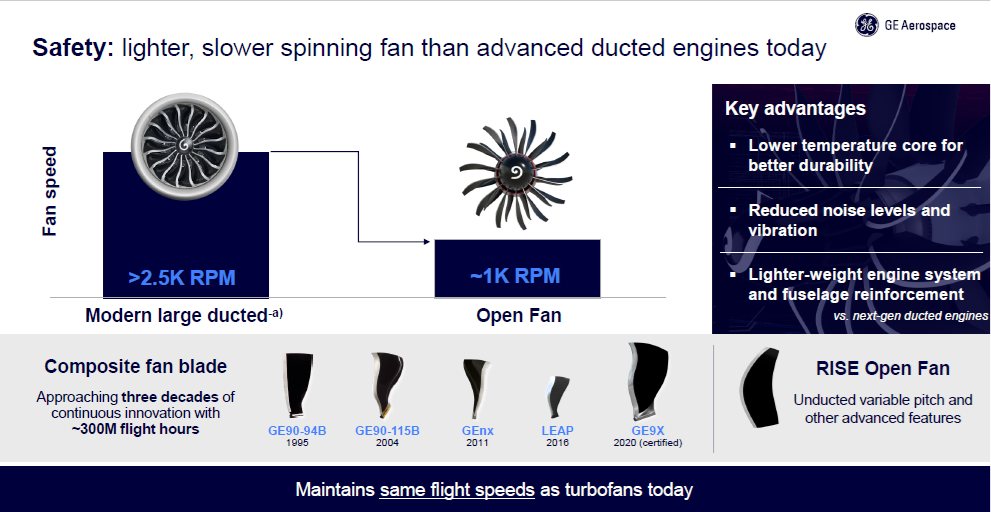
GE Aerospace points to its history of composite fan blades as a key reason to reassure the airlines, lessors, Airbus and Boeing about the reliability of the Open Fan blade out concerns. Credit: GE Aerospace.
A slower-rotating fan, about the size of the propeller on the ATR-72 turboprop, reduces energy in the event a blade separates. The RPM of an ATR-72 propeller is about 1.2k; GE says the RISE’s RPM is about 1k. The top RPM of the props on the Airbus A400M is about 860. A conventional ducted turbofan RPM is more than 2.5k, GE says.
Blade separations on the ATR have been rare, and none have been reported on the A400M. There have been rare cases of blade separation on a variety of ducted fan engines.
“We’re building on our composite blade experience,” Hageman says. “This will be the sixth-generation composite blade. We’re able to make them super strong, but super light, and very low weight.
“You have a low-velocity, low-weight fan blade. That means there’s a low level of energy. It’s six times lower than a comparable ducted engine,” he says.
Hageman says that normally, the fan is contained in the fan case. “So, there’s armoring that sits in these ducts that contain that fan blade. Now I need less of that, because I have six times less energy in these blades. I simply take that armoring from the fan case and apply it to the fuselage of the aircraft in the local area next to the engine. And that is the protection from a failed blade event. If you have a blade failure, a slowly rotating fan means that blade has a lower velocity.”
Airbus opens second A320 production line in Mobile
Airbus last week opened its second final assembly line (FAL) for the A320 production plant in Mobile (AL). The first line opened 10 years ago. An A220 FAL is also located in Mobile, supplementing the primary line in Montreal, Canada.
The second Mobile A320 line is essential to Airbus taking total monthly production rates to 75/mo by 2027. A new line was previously opened in Toulouse, France, replacing the previous A380 facility, and the FAL in Tianjin, China, is also expanding.
The Mobile plant was opened with a focus on delivering A320neo to US airlines and lessors. With the second line, it can now assemble around eight A320s a month. The fuselages and wings are shipped from Airbus’s European production plants via ocean to the Port of Mobile. The Pratt & Whitney and CFM engines come from the US. Systems and components originate in the US, Europe, and elsewhere. Assembling A320s (and A220s) in the US reduces tariffs imposed by President Donald Trump on European imports, although this wasn’t the reason for creating the Mobile plant.
Locating the A220 line in Mobile was a direct response in 2017 to a Trump tariff on Canadian imports.
The Mobile plant’s A320 delivery focus has added Latin American customers. Between these two regions, the Mobile FAL has assembled and delivered 600 A320 family members to customers. The Mobile complex is now the third largest commercial aircraft manufacturing center after Boeing’s Washington State facilities.
The Mobile facilities currently employ 2,000 and are expanding to 3,000. Airbus employs 6,000 at 40 Airbus and subsidiary sites in 13 states and the District of Columbia. Airbus says it supports 275,000+ American jobs through annual spending of $15bn with 2,000+ US suppliers in 40 states.
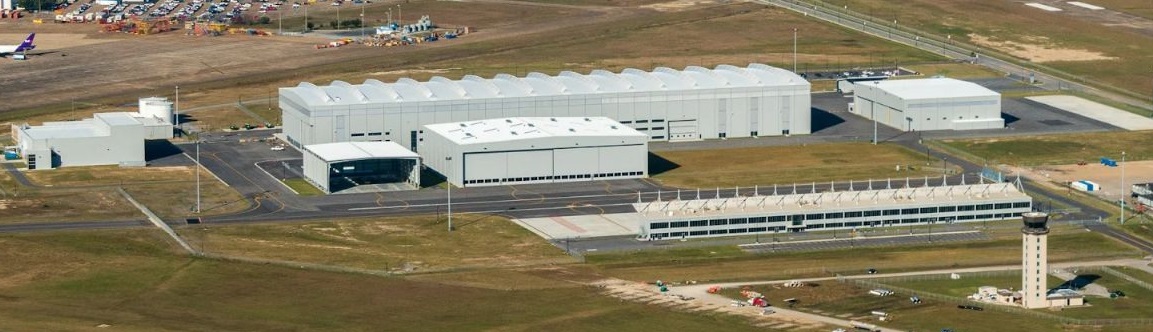
Airbus’s Mobile (AL) A320 Final Assembly Line when it opened in 2015. Credit: Airbus.
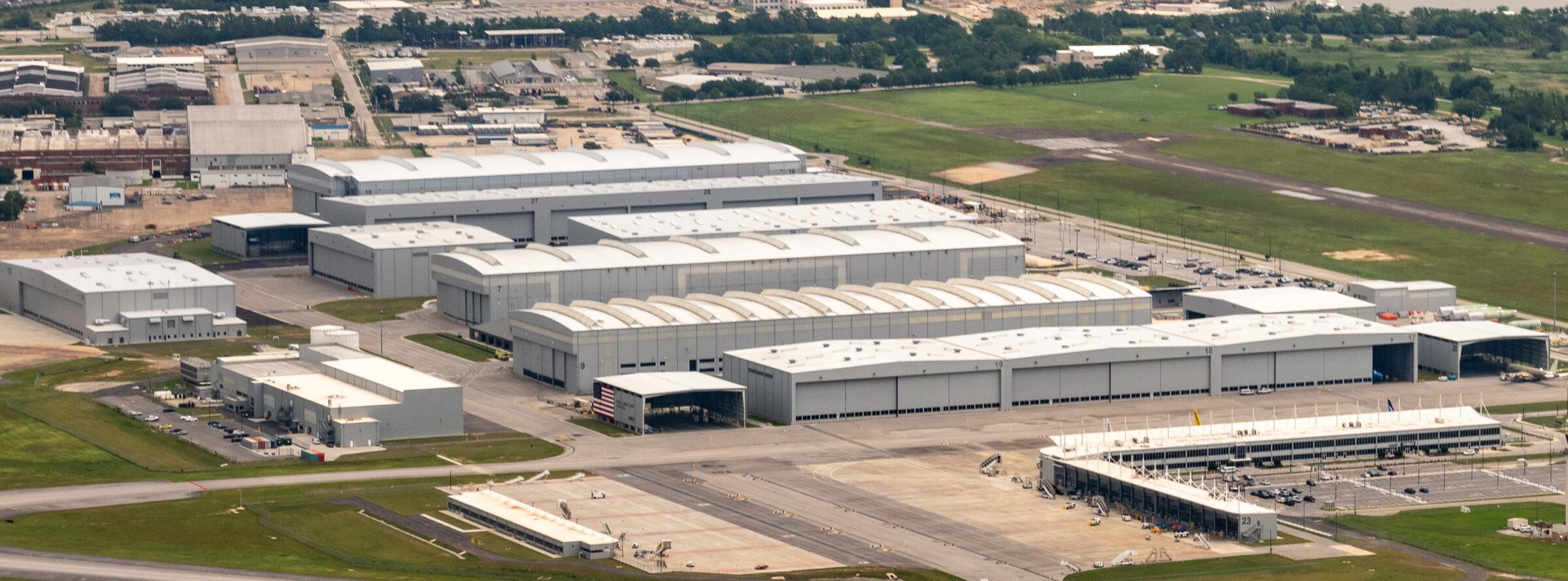
Airbus’s Mobile (AL) Final Assembly Lines for the A320 and A220 today. Credit: Airbus.
Related
source
