

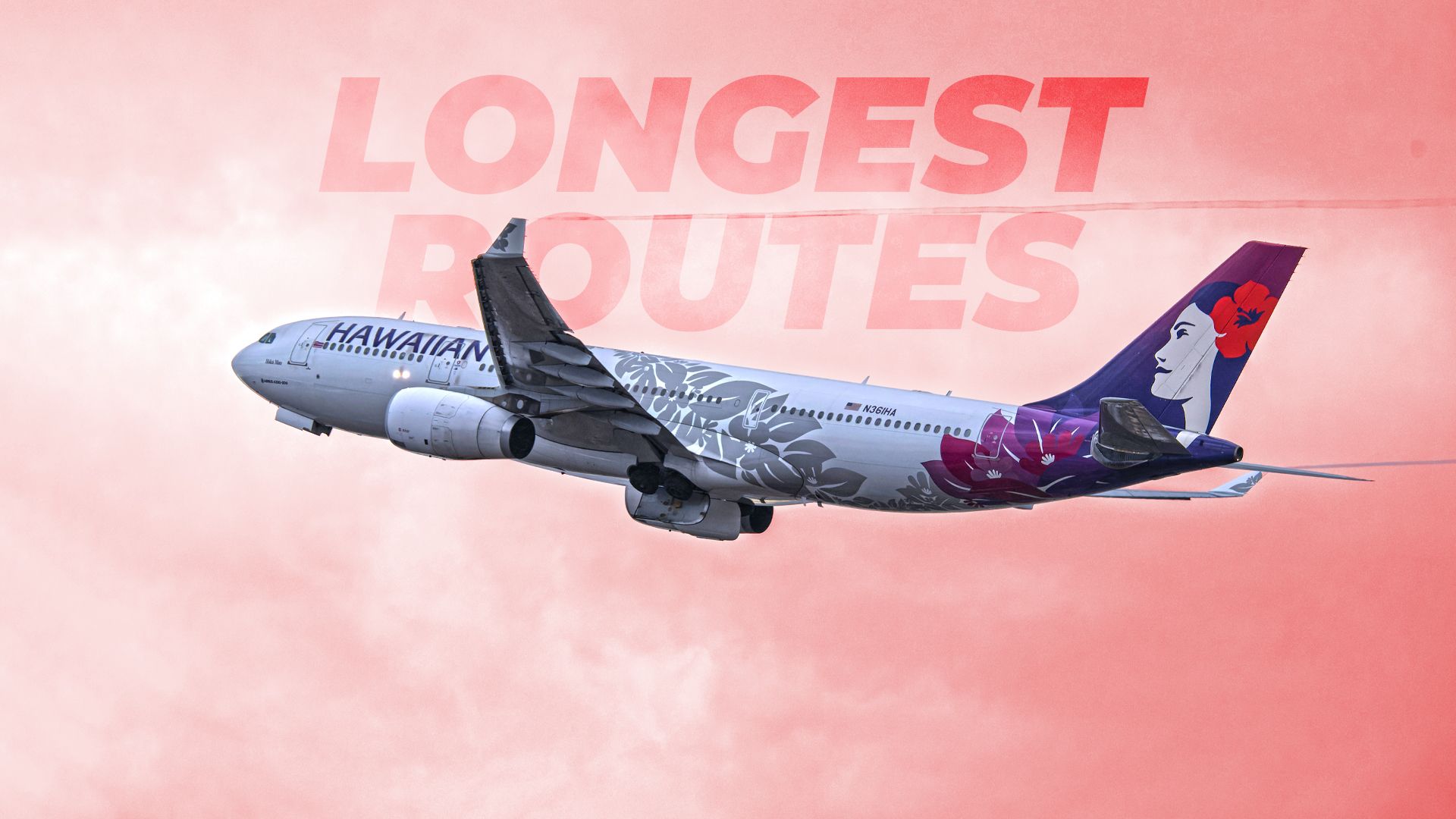
In 2025, Hawaiian Airlines continues to rely on its versatile Airbus A330-200 fleet to connect the Hawaiian Islands with destinations spanning Asia, Oceania, and North America. As the airline transitions to newer aircraft, such as the Boeing 787-9 Dreamliner, the A330 remains the backbone of its long-haul operations, especially on routes that demand both range and capacity. These aircraft not only symbolize Hawaiian’s expansion into major global markets but also maintain the airline’s signature island hospitality across the Pacific.
From the turquoise waters of Honolulu to the snowy mountains of Boston, the A330 serves as Hawaii’s bridge to the world. With flights stretching more than 5,000 miles, these routes highlight not only the impressive endurance of the aircraft but also its role in sustaining the state’s global connectivity. Hawaiian’s A330 network links Honolulu and Maui to major population centres across North America, Asia, and Oceania, flying through some of the world’s most remote airspace with confidence built over years of ETOPS experience.
Hawaiian Airlines And The Airbus A330

Hawaiian Airlines’ long-haul backbone in 2025 remains the Airbus A330-200, a widebody that pairs large cargo capacity with the right mix of range and seat density for the Pacific. The type’s sweet spot lies in the medium- to long-haul markets that define Hawaiian’s business model: oceanic sectors with limited diversion options and seasonal demand peaks.
The A330’s story with Hawaiian began in April 2010, when the airline took delivery of its first new Airbus A330-200 from the manufacturer’s facility in Toulouse, France. The milestone marked the start of Hawaiian’s transition from a Boeing-dominated widebody fleet to a new generation of long-range aircraft. At the time, the A330 offered modern technology, greater fuel efficiency, and increased passenger and cargo capacity compared to the Boeing 767 it was set to replace. That first aircraft entered service on the Honolulu–Los Angeles route, signaling Hawaiian’s ambitions to expand its long-haul network while improving the onboard experience.
Configured with lie-flat premium seats and a high-utility economy cabin, the A330 gives Hawaiian the flexibility to shift capacity between Asia, Oceania, and long United States mainland sectors without changing aircraft type. That versatility matters in an island hub system where daylight constraints, curfews, and tight bank structures can make or break profitability. Even as the 787-9 takes over the marquee new markets, the A330 remains essential. In 2025, it continues to cover routes whose stage lengths and demand patterns perfectly match its economics, fifteen years after the first delivery, proving why the aircraft remains a dependable workhorse within Hawaiian’s evolving widebody fleet.
‘Longer’ Long-Haul (5,000+ miles)

At the top of Hawaiian’s 2025 A330 network are its transcontinental routes, the true endurance tests of the fleet. Honolulu International Airport (HNL) –  Boston Logan International Airport(BOS) is the longest, averaging 5095 miles on both the outbound and inbound leg, with 55,322 seats available each way. In addition to this, Honolulu International Airport (HNL) —
  Sydney Kingsford Smith Airport(SYD) comes in a close second, covering 5066 miles each way with more seats available, around 72,500 seats each way. These flights demand precise payload management, careful fuel planning, and consistent performance under varying jet stream conditions.
Strategically, these routes take advantage of high-demand areas, balancing inbound leisure traffic with outbound Hawaii-based passengers. They also serve as premium showcases, usually offering the airline’s lie-flat first class and long-haul service model that competes directly with mainland carriers.
Operationally, these are high-yield sectors that rely on business-class strength and credit card partnership capture. Each flight clocks in at well over ten hours, pushing both aircraft and crew endurance, and reaffirming the A330’s reliability across the world’s largest ocean.
Long-Haul (4,000–4,999 miles)

Just below the top tier sit Hawaiian’s long mainland routes: city pairs such as Honolulu International Airport (HNL) —  John F. Kennedy International Airport (JFK) at 4,983 miles,
  Seattle-Tacoma International Airport (SEA) –
  Tokyo Narita Airport(NRT) at 4,796 miles and Honolulu International Airport (HNL) – Fukuoka Airport(FUK) at 4,396 miles. These flights average in the mid to high 4,000-mile range and form the next layer of the A330’s mission portfolio. They serve strong leisure and business/financial markets while connecting Hawaii, increasingly feeding nonstop demand.
The A330’s capacity makes these routes viable even in shoulder seasons. Unlike narrowbody aircraft that may face payload restrictions, the A330 maintains full seats and cargo on these mid-continent sectors. This flexibility allows Hawaiian to deploy widebodies efficiently without compromising range or comfort. It is also more than capable of handling these longer routes with its range, combining decent capacity with its extensive global reach.
|
Aircraft Type |
Current |
Historic |
Avg. Age |
Total |
||
|---|---|---|---|---|---|---|
|
In Service |
Parked |
Total |
||||
|
Airbus A321neo |
18 |
18 |
6.9 Years |
18 |
||
|
Airbus A330 |
33 |
1 |
34 |
12.3 Years |
34 |
|
|
Boeing 717 |
18 |
1 |
19 |
6 |
23.8 Years |
25 |
|
Boeing 787 Dreamliner |
4 |
4 |
1.8 Years |
5 |
||
*Data from Planespotters.net
These routes serve as economic lifelines between Hawaii and mainland population centers. Strong inbound leisure demand pairs with steady outbound Hawaii resident traffic, and the A330’s seating density and cargo capacity keep unit costs competitive. For Hawaiian, this segment is less about prestige and more about reliable profitability, a reminder that smart aircraft deployment can be as important as new aircraft types.
Transpacific Asia (3,000–3,999 miles)

Across the Pacific, the A330 continues to anchor Hawaiian’s vital Asia network. Routes such as Honolulu International Airport (HNL) –  Tokyo Haneda Airport (HND) at 3,854 miles and Tokyo Narita Airport (NRT) at a slightly shorter 3,818 miles. The 3,000–3,999-mile range perfectly matches the A330’s efficiency curve. These are cornerstone markets for Hawaiian, feeding a high volume of Japan-origin leisure traffic and connecting Hawaii with key tourism and trade partners.
Scheduling is carefully optimized to capture connecting flows in both directions. Afternoon departures from Honolulu arrive in Asia during the morning bank, while the return legs bring passengers back in time for inter-island or mainland connections. The A330’s cabin layout, balancing premium and economy demand, is tailor-made for this market profile.
These routes highlight how the A330 serves as a cultural and commercial link between Hawaii and its largest international market. With frequency, reliability, and cargo uplift, the aircraft remains a linchpin in Hawaiian’s transpacific operations.
Short-Haul Flexibility (2,000–2,999 miles)

The shorter end of the A330 network includes important routes such as Honolulu International Airport(HNL) –  Los Angeles International Airport (LAX) at 2,556 miles, Kahului Airport (OGG) – Los Angeles International Airport (LAX) at 2,486 miles. While these sectors are short-haul in distance, they carry strategic weight: connecting Hawaii with West Coast hubs where consistent, high-capacity service matters.
These flights benefit from the A330’s spacious configuration and cargo volume. They operate across seasonal peaks, with robust demand year-round. The aircraft’s performance ensures reliability even when operating from hot-weather airports or on long overwater stages with limited diversion options.
Hawaiian’s widebody service underscores its commitment to regional connectivity. Although shorter-haul flights are typically served by narrowbody aircraft, the A330’s range comfortably covers these sectors with margin to spare, making it an ideal platform for linking Hawaii’s year-round tourism draw. It is also generally a more comfortable experience for passengers to fly on a widebody like the A330, helping Hawaiian develop a reputation for comfort and space.
The A330’s Legacy and Hawaiian’s Future

In Hawaiian Airlines’ 2025 network, the Airbus A330 remains both a workhorse and a bridge to the future. Its long-haul reach underpins the airline’s most vital international and transcontinental routes, from the five-thousand-mile hauls to the East Coast, where it showcases Hawaiian’s service on long sectors, to the high-frequency Japan corridors that keep cabins full throughout the year. Few aircraft have proven as versatile or as well-suited to the unique geography and demand profile of Hawaii’s air network.
As the airline gradually introduces more Boeing 787-9s, the A330’s mission continues to evolve. Rather than disappearing overnight, it is being refined, focused on routes where its economics, range, and proven reliability still provide the optimal balance. The type’s generous cargo capacity and well-balanced seat configuration ensure it remains a steady revenue generator, even as newer technology enters the fleet. For crews, maintenance teams, and passengers alike, the A330 represents familiarity, dependability, and comfort.
Ultimately, 2025 marks the twilight of an aircraft that helped Hawaiian redefine its reach. The A330’s legacy will live on in the network it built, the miles it crossed, the markets it opened, and the confidence it gave Hawaiian to compete globally. Its enduring presence through this transition period cements it as one of the most significant aircraft in the airline’s modern history.
source
