


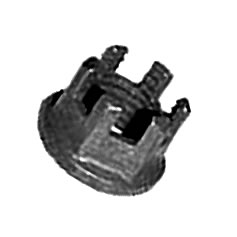
If you’re worried about a nut coming loose or falling off a bolt, you may want to use a castellated nut. Also known as castle nuts, they allow for a pin-based locking mechanism.
Castellated nuts are used in conjunction with bolts with a hole through the shank. You can twist them onto the end of a bolt, followed by aligning the notches with the bolt’s hole. Once aligned, you can then insert a locking pin, such as a split pin, through the hole. Here are six things to consider when choosing a castellated nut.
#1) Thread Size
Like all nuts, castellated nuts are available in different thread sizes. Many castellated nuts use Unified National Fine (UNF) series thread sizes consisting of two numbers. The first number represents the thread diameter, whereas the second number represents the threads per inch (TPI). A castellated nut with a 10-32 thread size, for instance, has a #10 thread diameter (.190 inches) and 32 TPI. If a castellated nut doesn’t use UNF thread sizes, it will likely use metric sizes, instead.
#2) Material
You can find castellated nuts in different materials. Carbon steel castellated nuts are very strong and able to resist high loads. Stainless steel castellated nuts offer a superior level of resistance against rust and corrosion. Brass castellated nuts are durable and able to withstand harsh environments, including saltwater environments.
#3) Surface Treatment
In addition to the material, you should consider the surface treatment when choosing a castellated nut. A surface treatment is a protective layer or finish added to the surface of a nut. It’s designed to extend the nut’s life by protecting it from environmental contamination and damage. Some castellated nuts feature a cadmium surface treatment. The outer layer is covered in cadmium, which shields and protects the underlying material.
#4) Thread Direction
Something else to consider when choosing a castellated nut is the thread direction. All castellated nuts have threads; they are ridges that allow them to connect to bolts. Some castellated nuts, though, have right-hand threads, whereas others have left-hand threads. Right-hand threads require a clockwise rotation to tighten and a counterclockwise rotation to loosen. Left-hand threads require a counterclockwise rotation to tighten and a clockwise rotation to loosen.
#5) Nut Style
One of the most important things to consider when choosing a castellated nut is the nut style. This will determine the tool required to install and remove the nut. Hex-style castellated nuts are the most common. They feature six sides, allowing them to be installed and removed with sockets and wrenches. Other styles in which castellated nuts are made include slotted hex and low profile.
#6) Lubricant
You can find castellated nuts with and without lubricant. Some of them feature a thin layer of dry-film lubricant. Also known as solid-film lubricant, it helps to reduce friction and increase wear resistance between the nut and the bolt with which it’s used.
source
