



General Atomics Aeronautical Systems will integrate a U.S. Marine Corps mission kit into the YFQ-42A for the MUX TACAIR Collaborative Combat Aircraft program.
General Atomics Aeronautical Systems (GA-ASI) announced it has been selected by the U.S. Marine Corps (USMC) for the Marine Air-Ground Task Force Uncrewed Expeditionary Tactical Aircraft (MUX TACAIR) Collaborative Combat Aircraft (CCA) program. The company has been competitively awarded to integrate a Marine Corps mission kit into the YFQ-42A as part of the program to evaluate integration with crewed fighters.
Just a month ago, we reported Northrop Grumman and Kratos have also been selected for the same program. As part of the effort, the former will integrate its uncrewed and autonomous technologies on the latter’s XQ-58 Valkyrie.
The Contract
GA-ASI says the contract includes the “rapid development of autonomy for the government-supplied mission kit – a cost-effective, sensor-rich, software-defined suite capable of delivering kinetic and non-kinetic effects.” The value and timeline of the contract have not been disclosed, although it could be similar to the one awarded to Northrop Grumman and Kratos, which was an Other Transaction Agreement (OTA) with an initial value of $231.5 million and an initial Period of Performance of 24 months.
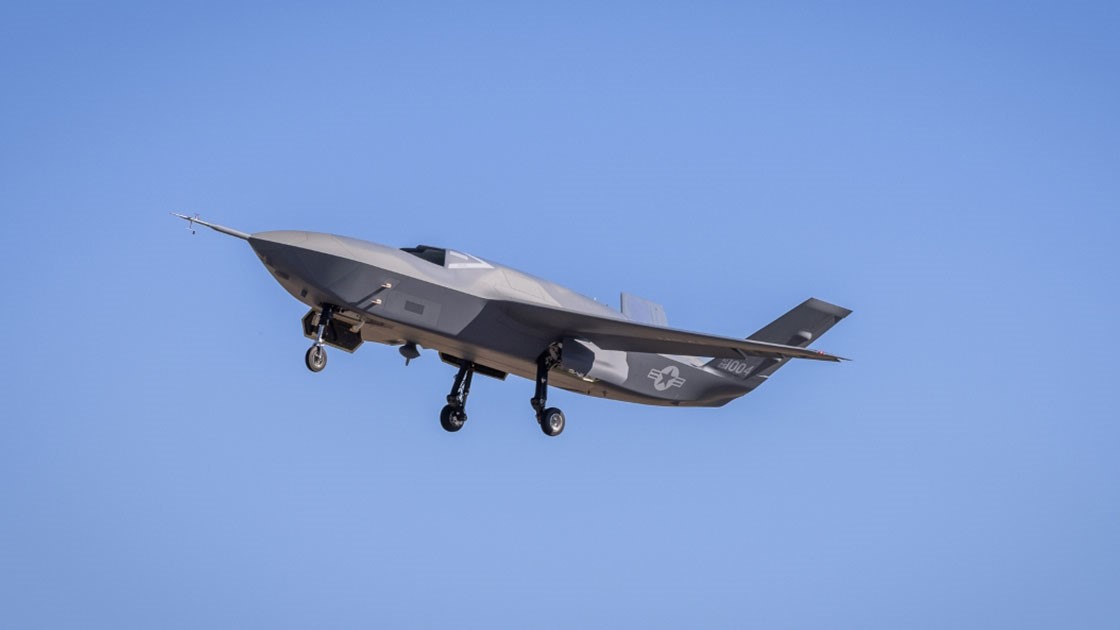
“This selection builds upon the GA-ASI autonomous systems in use today and demonstrates our commitment to delivering next generation capabilities for critical USMC missions,” said Mike Atwood, Vice President of Advanced Programs for GA-ASI. “Our FQ-42, combined with our proven autonomy architecture and integration expertise, positions us to rapidly deliver an affordable CCA solution that enhances the Marine Air-Ground Task Force’s operational effectiveness in contested environments.”
As mentioned earlier, the company will integrate a mission kit provided by the Marines into the YFQ-42A. The aircraft will then be assessed while flying in Manned-Unmanned Teaming (MUM-T) role with fighter jets as part of Marine Air Ground Task Force (MAGTF) operations.
MUX TACAIR CCA
The Marine Air-Ground Task Force Uncrewed Expeditionary Tactical Aircraft (MUX TACAIR) Collaborative Combat Aircraft (CCA) program was launched by the U.S. Marine Corps to support manned fighter jets in operations against a peer/near-peer adversary, improving their survivability in high-threat environments. Among the main missions will be electronic warfare and surveillance.
The service is adopting a “spiral approach,” similar to the increments of the Air Force’s own CCA program, to progressively add new capabilities to the uncrewed system. According to the FY 2026 budget documents, where $58 millions were requested for MUX TACAIR, the rapid prototyping program will produce a “prototype air vehicle with fully integrated mission systems” to start demonstrating the initial capabilities.
The goal is to quickly field the CCA associated to each increment that provides a “Minimum Viable Product that is operationally relevant and balances schedule and technical complexity.” It is worth noting that, since the mention of the MAGTF in the program’s name, one of the increments might include the ability to launch and recover the aircraft from naval vessels.
The YFQ-42
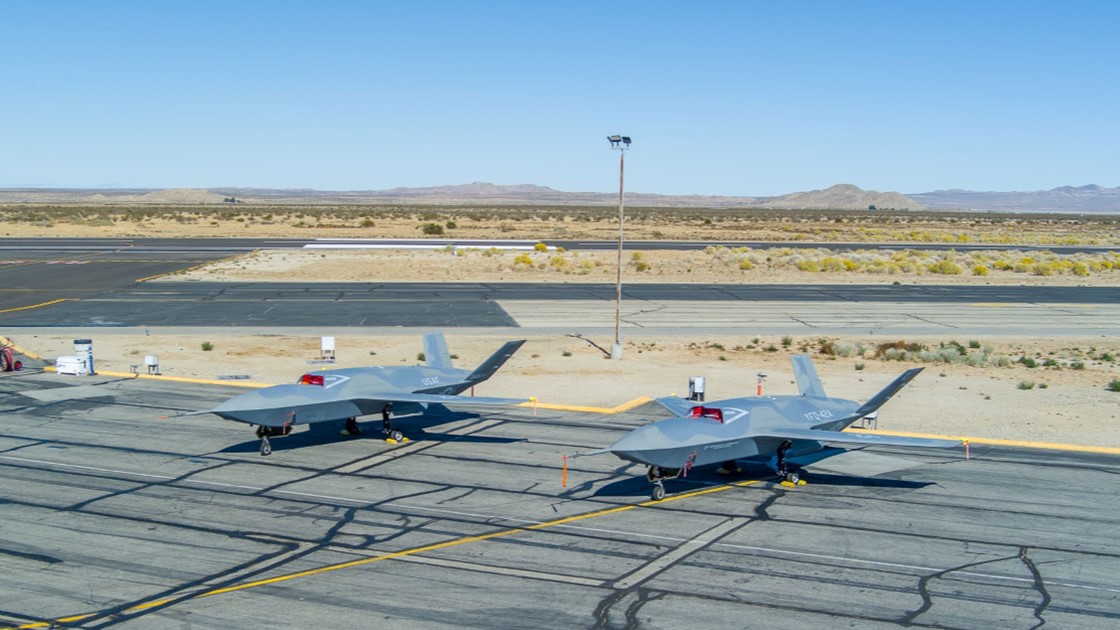
As we previously reported here at The Aviationist, GA-ASI is also on contract with the U.S. Air Force for the Collaborative Combat Aircraft Program. Two aircraft are currently being flight tested, with the first taking off for the first time on Aug. 27, 2025, and the second on Oct. 31, 2025.
The YFQ-42A is designed for semi-autonomous air-to-air operations and draws on the “genus-species” approach pioneered with the XQ-67A Off-Board Sensing Station (OBSS). GA-ASI says it leveraged advanced model-based digital engineering to accelerate the aircraft’s development while optimizing capabilities for future air dominance.
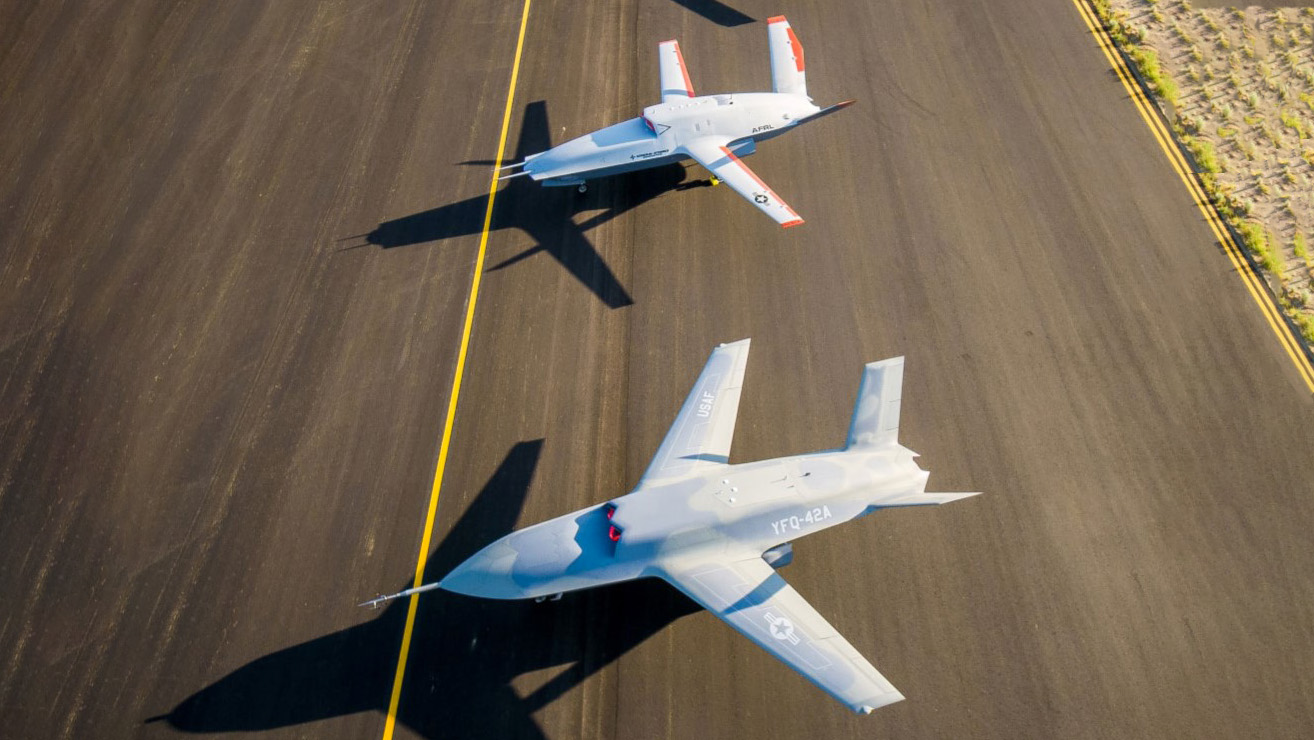
Compared to the XQ-67, the YFQ-42A features an engine air inlet with serrated edges, similar to the B-2 Spirit stealth bomber, as well as apparently slightly modified fuselage mold lines. The nose is also different, changing from the XQ-67’s ‘shovel’-like design to a more conventional one.
Differences can be seen in the wings’ design, with the YFQ-42 showing a higher sweep angle and a higher taper ratio, as well as a larger surface. The V-tails, although they have an angle similar to the XQ-67’s, appear to be shorter, with higher taper ratio and no clipped tips.
These design changes might be the result of attempts to reduce the airframe’s radar cross-section to match stealth requirements of the CCA program. Also, the modifications reflect the CCA’s requirements for speed and maneuverability.
GA-ASI is the world leader in unmanned aerial systems. Our cutting-edge digital engineering and manufacturing capabilities enable us to deliver scalable and advanced systems at the lowest cost. Our production, engineering and test facilities across the country are ready to… pic.twitter.com/YQhbSJabsF
— General Atomics Aeronautical Systems, Inc (GA-ASI) (@GenAtomics_ASI) January 12, 2026
Central to the program is the autonomy core that will make the YFQ-42 able to operate together with manned aircraft. The company says this core has been refined through more than five years of testing on the MQ-20 Avenger, which is also being used to test multiple autonomy agents for the Air Force.
By combining a stealthy, air-to-air-focused design with this AI-driven autonomy, the YFQ-42A is intended to provide warfighters with an advantage in future combat scenarios. Originally intended to complement the Next Generation Air Dominance manned fighter, the Boeing F-47, the CCAs will also fly with the current 5th gen platforms, the F-22 Raptor and the F-35 Lightning II.
GA-ASI emphasized that the program is designed around scalability and affordability. The company is preparing for high-rate production that would support the Air Force’s stated goal of fielding more than 1,000 CCAs on an accelerated timeline.
