



GA-ASI has named its YFQ-42 Collaborative Combat Aircraft as Dark Merlin, a small, fierce falcon species which hunts other falcons while collaborating in groups.
General Atomics Aeronautical Systems (GA-ASI) has announced on Feb. 23, 2026, the decision to name Dark Merlin its YFQ-42A Collaborative Combat Aircraft (CCA). The selection of the name of a specific falcon species has been motivated by its characteristics which reflects the ones of CCAs.
In fact, dark merlins are a small and fierce falcon species that use surprise attacks to hunt and bring down other falcons in flight, similarly to the CCA’s planned air-to-air role. Moreover, in another similarity with CCAs, these falcons often collaborate in groups for maximum effect against their targets.
“Dark merlins are hunting machines, built for speed and aerodynamics,” said GA-ASI President David R. Alexander. “They harass other falcons for fun, and they eat what they kill. The name sums up our new uncrewed fighter perfectly.”
Taking inspiration from a nimble predator, GA-ASI announces #YFQ42A Dark Merlin.
Read the news: https://t.co/Bt74bVOGRR#DarkMerlinUAS #UCAV pic.twitter.com/nhvBRtUn5Y
— General Atomics Aeronautical Systems, Inc (GA-ASI) (@GenAtomics_ASI) February 23, 2026
Notably, dark merlins are also a known presence around GA-ASI’s manufacturing plant in San Diego, California, where the YFQ-42 is built. In fact, while this species is native to the Pacific Northwest of the United States, it often migrates into southern California.
In its press release, GA-ASI also noted another reference to revolution being brought by autonomous systems in the air combat world:
The 1962 book “Profiles of the Future” imagined global technological marvels yet to change the world, offering that “any sufficiently advanced technology is indistinguishable from magic.” It’s no coincidence that the Dark Merlin name also reflects the wizardry of Merlin from Arthurian legend, paying homage to the somewhat supernatural new era of semi-autonomous air combat.
The YFQ-42
As we previously reported here at The Aviationist, GA-ASI is also on contract with the U.S. Air Force for the Collaborative Combat Aircraft Program. Two aircraft are currently being flight tested, with the first taking off for the first time on Aug. 27, 2025, and the second on Oct. 31, 2025.
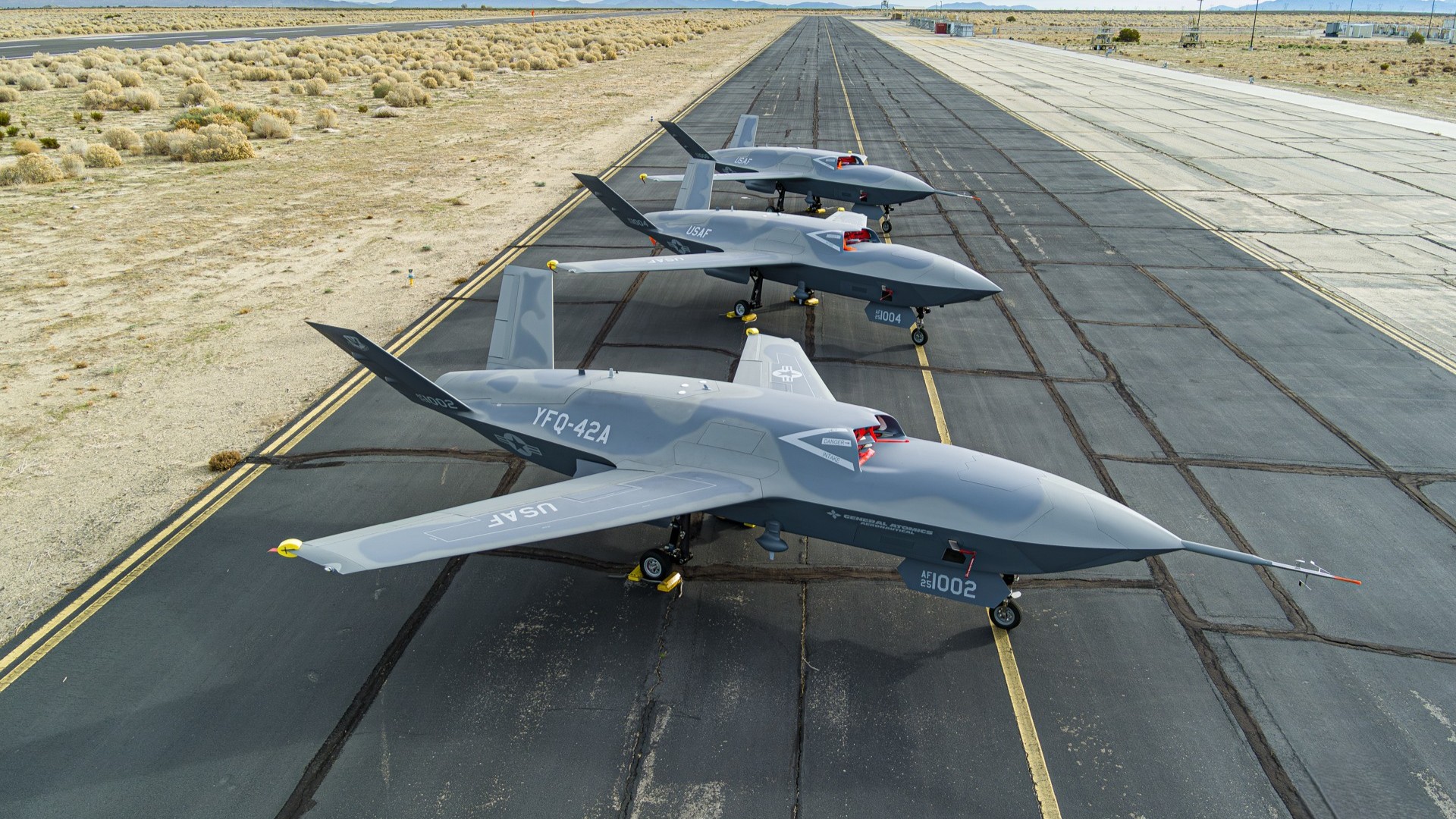
The YFQ-42A is designed for semi-autonomous air-to-air operations and draws on the “genus-species” approach pioneered with the XQ-67A Off-Board Sensing Station (OBSS). GA-ASI says it leveraged advanced model-based digital engineering to accelerate the aircraft’s development while optimizing capabilities for future air dominance.
Compared to the XQ-67, the YFQ-42A features an engine air inlet with serrated edges, similar to the B-2 Spirit stealth bomber, as well as apparently slightly modified fuselage mold lines. The nose is also different, changing from the XQ-67’s ‘shovel’-like design to a more conventional one.
Differences can be seen in the wings’ design, with the YFQ-42 showing a higher sweep angle and a higher taper ratio, as well as a larger surface. The V-tails, although they have an angle similar to the XQ-67’s, appear to be shorter, with higher taper ratio and no clipped tips.
These design changes might be the result of attempts to reduce the airframe’s radar cross-section to match stealth requirements of the CCA program. Also, the modifications reflect the CCA’s requirements for speed and maneuverability.
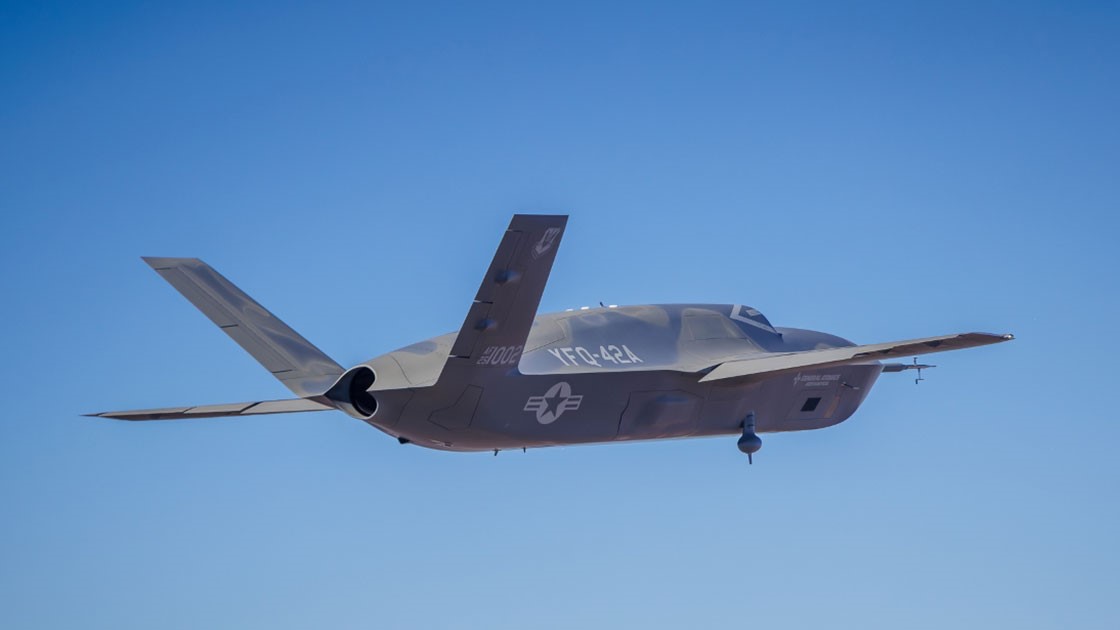
Central to the program is the autonomy core that will make the YFQ-42 able to operate together with manned aircraft. The company says this core has been refined through more than five years of testing on the MQ-20 Avenger, which is also being used to test multiple autonomy agents for the Air Force.
Recently, the YFQ-42A has successfully completed the first semi-autonomous airborne mission using third-party autonomy software supplied by Collins Aerospace. Collins’ Sidekick Collaborative Mission Autonomy software was integrated through the government-owned Autonomy Government Reference Architecture (A-GRA).
During the test, the autonomy software was activated from the Ground Station Console (GSC), and a human operator transmitted mission commands directly to the aircraft, which executed them accurately for more than four hours, says the company. A robust and reliable data exchange was established between the autonomy software and the aircraft’s mission systems, with the test highlighting both the effectiveness of Sidekick’s capabilities and the flexibility of the A-GRA architecture.
The A-GRA standard is designed as a Modular Open Systems Approach (MOSA), something that has become a recurring aspect of recent development programs of the U.S. military, as we often reported here at The Aviationist. With the main focus of MOSA being the ability to easily integrate and upgrade components on an aircraft, the approach ensures that autonomy algorithms can be swapped or upgraded without the need for extensive modifications to the aircraft itself.
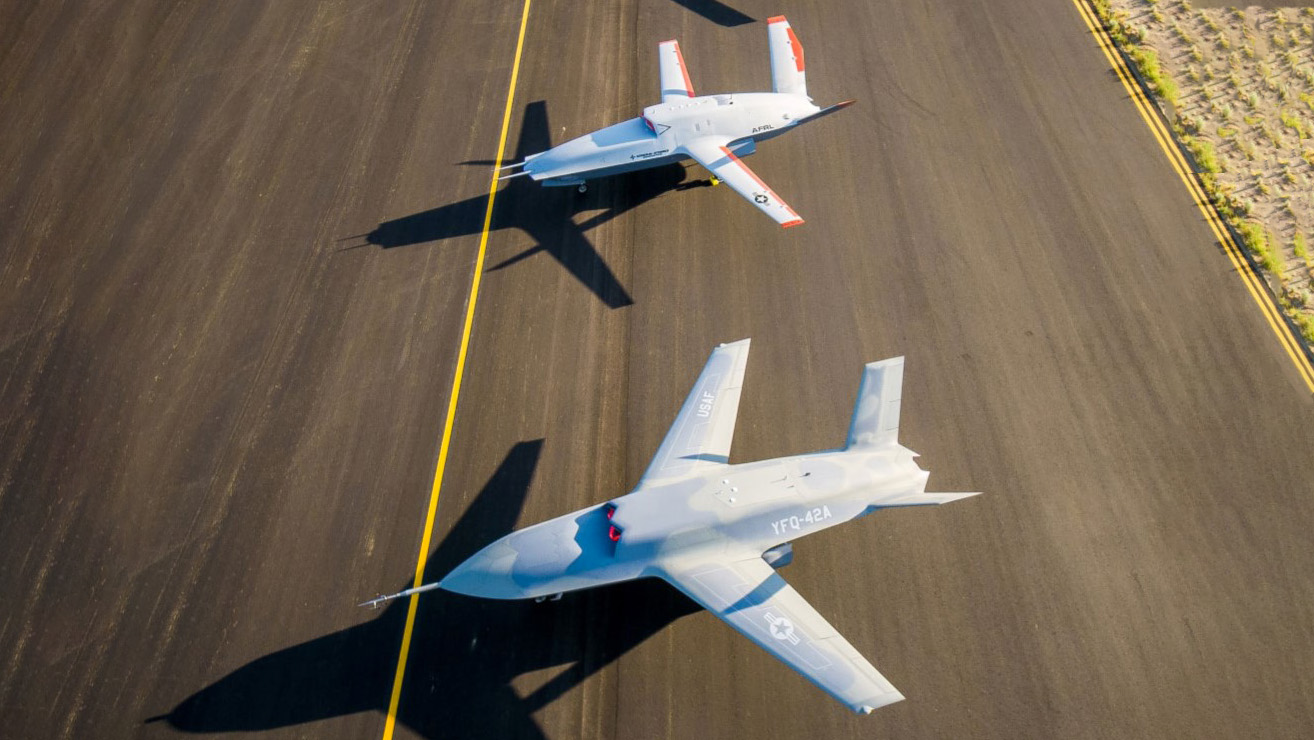
The testing focuses on proving that mission software can be rapidly ported between platforms, creating what the Air Force describes as a competitive and adaptable ecosystem for future autonomous air combat systems. The service explains this validates a core principle of the new acquisition strategy: decoupling software from hardware through an open, modular architecture to accelerate innovation and avoid dependence on a single vendor – the so-called “vendor lock.”
By combining a stealthy, air-to-air-focused design with this AI-driven autonomy, the YFQ-42A is intended to provide warfighters with an advantage in future combat scenarios. Originally intended to complement the Next Generation Air Dominance manned fighter, the Boeing F-47, the CCAs will also fly with the current 5th gen platforms, the F-22 Raptor and the F-35 Lightning II.
GA-ASI emphasized that the program is designed around scalability and affordability. The company is preparing for high-rate production that would support the Air Force’s stated goal of fielding more than 1,000 CCAs on an accelerated timeline.
