


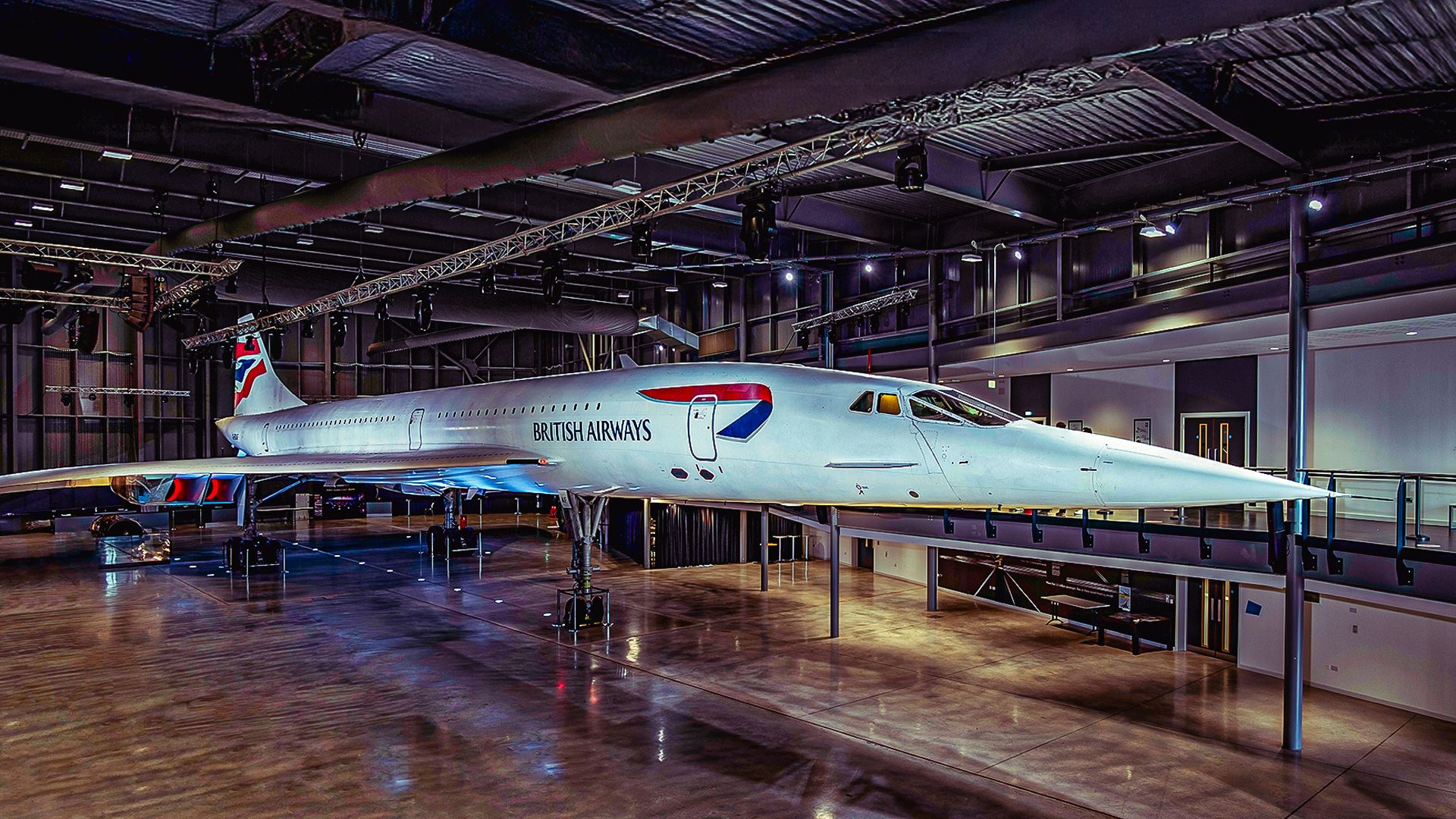
Equally famous for its incredible engineering and inflight champagne parties, the Concorde was beloved by every person connected to it. Engineers, craftsmen, pilots, and customers all found the amazing supersonic airliner to be unrivaled by any other commercial flying machine in the world. So then, why was the assembly line shuttered after just 20 examples were made?
Just 14 commercial grade Concordes were made, while a half dozen of the type were never flown in revenue service. The jets were adored by celebrities who gladly paid tens of thousands of dollars to ride across the Atlantic from Europe to New York. Unfortunately, the transatlantic route, limited destinations, and occasional charter flights just weren’t enough to keep the books in the black.
The final plane rolled out of the factory doors in 1979, and scheduled flights continued until 2003, when the last Air France and British Airways Concordes were retired. The operating costs were a major burden, but even more problematic was the limitation on routes. The noise caused by the powerful engines and sonic booms at altitude prohibited the airlines from flying to more than a handful of destinations.
The One And Only True SST

The Concorde served for 27 years before regulations and economics ended its star-studded career. The Soviet Union had attempted to compete by building the Tupolev Tu-144, which actually took its first flight before Concorde. However, the Tu-144 was a far inferior aircraft in terms of performance, reliability, and passenger comfort. The last Tu-144 flight took place before the final Concordes were even made.
No supersonic transport (SST) has been made since Concorde’s plant was shut down. The high cost of development and manufacture is prohibitive to most aerospace companies, more so today than in the 1970s. The grand double-deckers have also been phased out by almost every carrier in the world, the Boeing 747 and Airbus A380. Simply having four engines, never mind after-burning ones, is no longer desirable for carriers in 2025.
Sadly, the high fuel consumption and complex maintenance needs of such an incredibly high-performance aircraft made it radioactive to all but two air carriers. With the rising demand for private air travel, and shifting concern toward performance in the business jet market, is there truly no demand for an SST? Not necessarily, but as it stands, NASA, Lockheed Martin, and Boom Supersonic are currently working on a new generation that solves Concorde’s problems.
Uncompromising Performance

Concorde flew up to Mach 2.04, or a little over 2,100 kilometers per hour, and equally impressive was its cruising altitude of 60,000 feet. When the mighty jet crossed the Atlantic Ocean, it flew a smooth climb along a direct flight path because there was simply no traffic at its flight level. Heritage Concorde outlines the full specifications, including its takeoff speed, that was over 400 kilometers per hour.
Two distinct French and British projects came together to form Concorde in 1962. This collaboration served as the cornerstone for the project and later led to the establishment of Airbus. The program yielded construction of 20 Concordes by the French Aerospatiale and the British Aircraft Corporation (BAC). Aerospatiale would later become EADS and BAC was reorganized under the umbrella of BAE Systems.
|
Specification |
Concorde |
|---|---|
|
T-O Speed |
397 km/h (246 mph) |
|
Service Ceiling |
18,290 m (60,000 ft) |
|
Max Cruising Speed |
Mach 2.04 – 2,179 km/h (1,345 mph) |
|
Landing Speed |
300 km/h (187 mph) |
Concorde typically made the trek from London to New York in about 3 hours and 30 minutes; Its fastest recorded time was 2 hours and 53 minutes. The altitude at which Concorde flew was only surpassed by military spy planes and spacecraft. The air at FL600 (60,000 feet) allows for a very smooth, turbulence-free flight as it puts the jet far above the weather. The view is also breathtaking, with the sky a deep blue color and the gentle curve of the earth visible from the cabin windows.
The Select Market For Concorde

Washington Dulles Airport (IAD) was actually the first US destination in Concorde’s portfolio when it was finally authorized to fly in the States. New York came second and Miami even joined the roster as the third American city to host the supersonic jetliner. There was even a brief run route from Washington, DC to Dallas, Texas, which had Concorde flying at subsonic speeds.
Aside from London, New York, and Paris, the other long-standing destination at the core of the Concorde network was Barbados, which was one of the last destinations served before the jet’s retirement by British Airways. Many new destinations were explored, like Singapore and Bahrain, which briefly linked with London but eventually ended. Ultimately, noise restrictions were severely limiting.
Air France had a number of South American destinations on the schedule, including Mexico City and Caracas. Charter services took the fleet to many unique destinations. Both  British Airways and Air France chartered the planes hundreds of times a year for countless unique missions. Some were brief “supersonic experience” flights, while a handful took the jets down under to Australia or New Zealand, and winter flights to Lapland were dispatched to visit Santa Claus!
The Unique Needs Of An SST

The maintenance man-hours spent on Concorde were roughly four times higher than those of a Boeing 747 jumbo jet. Touching a Concorde required a myriad of specialized training to prepare engineers and technicians for the unique needs of the plane. The New York Times reported that British Airways estimated every hour of flight time for Concorde required 57 hours of ground maintenance.
Concorde also burned a very large amount of fuel during taxi and takeoff. The plane was made to be efficient while cruising at high altitude, but on the ground it was a world-class gas guzzler. Spare parts were prohibitively expensive due to both the exotic materials and the extremely small supply base that made components for the tiny fleet of SSTs.
Concorde had the first fly-by-wire avionics systems of any airliner, complemented by a host of computer aid systems and sensors. The jets were kept to stringent safety and performance parameters because they flew at supersonic speeds. It wasn’t enough to simply perform routine maintenance and checks; extensive inspections, preventative maintenance, and real-time systems monitoring were all necessary.
The Tragedy Of Flight 4590

The Concorde fleet struggled with tire wear and tear as well as blowouts in general. Sadly, on July 25, 2000, Air France charter flight 4590 suffered a catastrophic failure as a result of a tire failure. The jet was in its takeoff roll when the tire exploded from a piece of debris on the runway. The explosive tire failure caused a massive over pressurization of the wing fuel tanks. The wing began spilling enormous amounts of fuel as the Concorde was approaching takeoff speed.
The FAA recounts that the fuel ignited almost immediately due to the leaks’ proximity to the engine inlets. The jet began to veer off centerline, and the pilot rotated to get airborne, but the engines engulfed in flames began to cut out after liftoff. The pilots attempted to climb, but the heavy, crippled aircraft could not accelerate. Within one minute of takeoff, the first engine failed and both airspeed and altitude began to drop.
The terrible consequence was that the Concorde crashed into a hotel 90 seconds after it began its takeoff roll. All 109 souls aboard the jet, registration F-BTSC, were killed. In the aftermath, another four victims were found deceased on the ground. Until this horrible accident, Concorde had actually boasted the best safety record of any commercial aircraft in the world. The entire fleet was grounded after the crash of flight 4590.
The public lost confidence in the safety of the plane despite upgrades to a long list of systems and components, including Kevlar lining to protect the fuel tanks. There was never another accident with significant damage or injuries after flight 4590. However, many attribute the program’s failure largely to the fear that the sight of the exploding Concorde instilled in many flyers.
Are SST’s Ever Coming Back

Concorde will never grace the skies again with its beauty and power, but in 2025, there are ongoing efforts to bring supersonic airliners back to the world of commercial aviation. The Lockheed Martin X-59 Quesst (Quiet SuperSonic Technology) is preparing for its maiden test flight in the California desert under NASA’s shepherding. The new manufacturer, Boom Supersonic, hopes to use the scientific data from the X-59’s test flights to help refine its new SST, the Overture, before it begins production.
NASA plans to make all data regarding the X-59’s tests of performance and noise levels throughout supersonic flight regimes available to the international aviation community and the public. United Airlines and Boom are already partners, with hopes of beginning to fly a new generation of SSTs in the coming years.
