


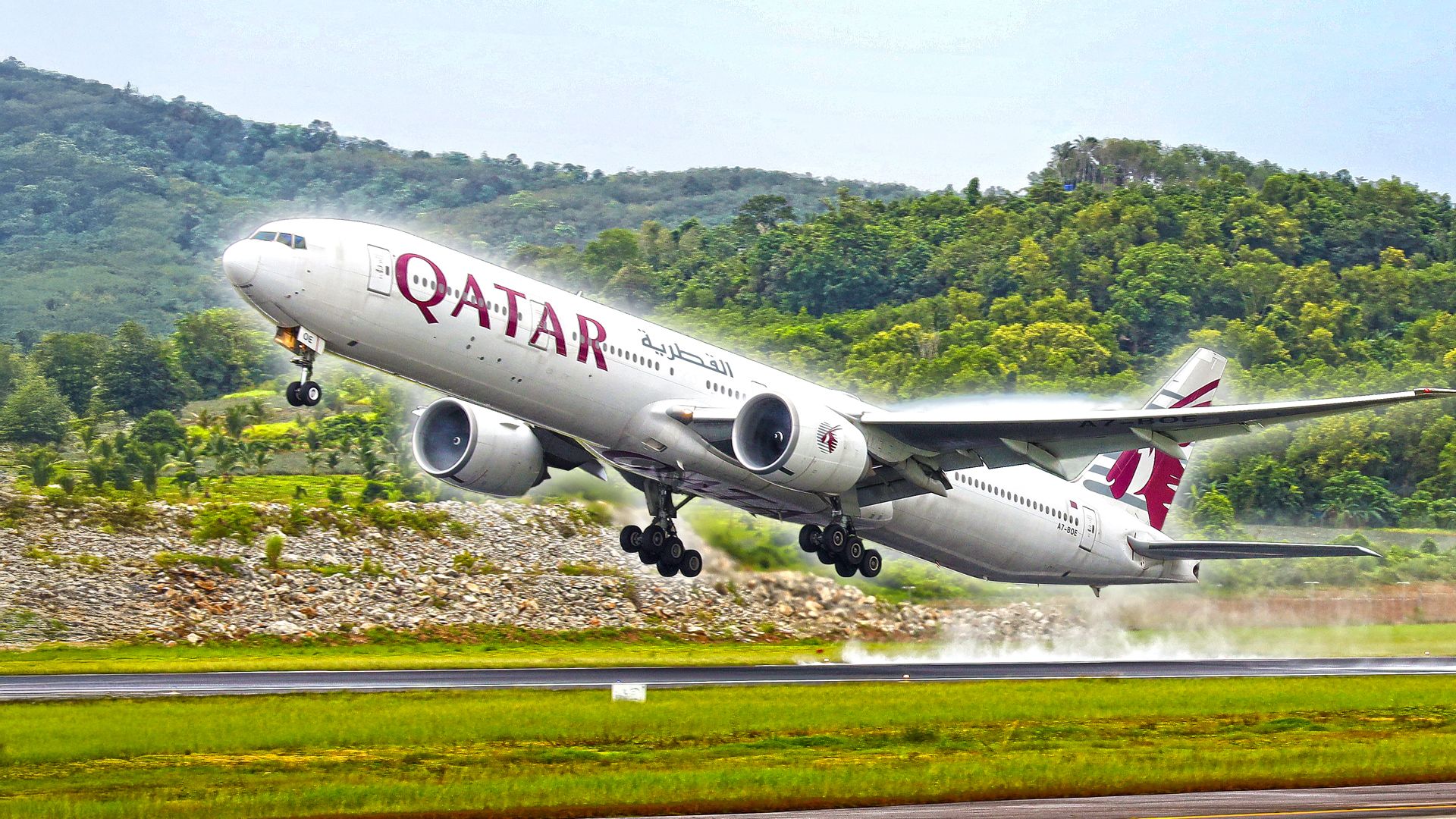
The Boeing 777-300ER is the most successful variant of the world’s most successful widebody aircraft program. With it, airlines finally got an aircraft that could match the iconic Boeing 747 on range and could serve as a large flagship, but without breaking the bank on fuel costs. As such, it quickly became popular with airlines worldwide, and it essentially destroyed the future market for the Boeing 747. Over 800 777-300ERs were sold, while Boeing sold 694 747-400s and 155 747-8s.
But while the 777-300ER isn’t as flashy or modern on the inside as a Boeing 787 or Airbus A350, it remains one of the more comfortable long-range airliners in the world. It’s frequently used by most carriers as a flagship aircraft, and as such, these planes tend to feature the best of what an airline has to offer. They remain just as popular with passengers as they do with airlines and will be around for decades to come.
Overview Of The Boeing 777-300ER

The Boeing 777 first debuted in 1995 with United Airlines. Initially, Boeing developed three variants of the 777, with the 777-200 being the base model. Subsequently, Boeing added fuel capacity and upped the Maximum Takeoff Weight (MTOW) to create the long-range 777-200ER. This model became the most popular variant in the original 777 family, and Boeing later stretched the 777-200ER to create the 777-300. The first-generation 777s also featured three engine options (GE90, Trent 800, PW4000).
The second-generation 777 featured structural strengthening, an upgraded variant of the General Electric GE90 (while ditching the Rolls-Royce and Pratt & Whitney options), raked wingtips, a modified main landing gear, and technological improvements. The 777-300ER was the first variant of the second-generation 777s to enter service in 2004, followed by the shrunken 777-200LR and the 777F (the freighter version of the 777-200LR)
The upcoming 777X is the third-generation 777, with the 777-9 succeeding the 777-300ER and the 777-8/777-8F replacing the 777-200LR/777F. The 777X has received well over 500 orders, nearly as many as the first-generation 777, but far less than the 1,261 sales of the second-generation 777. The 777-300ER makes up 838 of these orders, followed by the 777F at 362 sales. The 777-200LR only received 61 orders.
The Interior Design Of The 777

With the 777, Boeing introduced the “Boeing Signature Interior”. The design features an organic design with curved panels that flow together and indirect lighting rather than the less aesthetically pleasing direct lighting seen on earlier aircraft. The 777 features mood lighting, and the entire design makes the environment appear more relaxing. Even today, over 30 years after the 777 entered service, the interior still appears modern, and the Signature Interior was later ported to the 747 and 767.
With the 777,  Boeing introduced pivoting overhead bins. While these are standard on most airliners being delivered today, this was a major innovation in the 1990s. Airliners previously used shelf-style overhead bins, which could be tricky to reach and were often rather small. Pivoting bins are designed to fit bags on their sides, allowing for more carry-ons per bin, and the curved design allows for more headroom in aisle seats. These are now standard on every Boeing aircraft and most Airbus planes.
The Boeing 777 has a perfectly circular fuselage, unlike the ovoid shape seen on the 787 and A350. However, the fuselage is wide enough that the 777 has nearly vertical sidewalls, making the cabin appear taller and more spacious. But not only does the cabin appear tall, it also has a ceiling height of 7 feet, 11 inches (2.4 meters), meaning that even Shaq has plenty of headroom in the aisles. This is also comparable to the 787 and A350, despite the aircraft’s comparative age.
The Size Of The Boeing 777-300ER

The Boeing 777 is the widest commercial aircraft currently in production. It has virtually the same ceiling height as the Boeing 787, and the A350’s ceiling is roughly one inch (0.05 meters) higher. The vertical sidewalls make the cabin appear less claustrophobic, a common complaint for aircraft with curved sidewalls like the Airbus A330. The width itself also allows for wider seats or aisles in premium cabins, particularly in business and first class.
 United Airlines, for example, installs 22-inch (55.9 centimeter) wide seats in Polaris on the 777-300ER, whereas the 787-9 only has 20.5-inch (52 centimeter) wide seats in Polaris. Airlines typically install eight-abreast premium economy in both the Airbus A350 and the Boeing 777, but the 777’s extra width permits slightly wider seats or wider aisles. The downside, however, is that airlines typically install 10-abreast economy seats, with tight seats and narrow aisles.
|
Seven-Abreast Widebodies |
Eight Abreast Widebodies |
Nine-Abreast Widebodies |
Ten-Abreast Widebodies |
|---|---|---|---|
|
Boeing 767 |
Airbus A330 |
Airbus A350 XWB |
Airbus A380 (Lower Deck) |
|
Airbus A340 |
Boeing 777 |
Boeing 747 |
|
|
Airbus A380 (Upper Deck) |
Boeing 787 Dreamliner |
Boeing 777 |
|
|
Boeing 767 |
|||
|
Boeing 787 |
There are a handful of airlines, however, that still install the original nine-abreast layout in economy. These are notably offered by Singapore Airlines, Japan Airlines, Air India, and EVA Air, among others. The seats typically measure at least 18 inches (45.72 centimeters) wide, and these planes have significantly more aisle width than a 10-abreast 777, greatly increasing cabin mobility and service efficiency.
The Seating Products Offered Onboard

In the Americas, Air Canada, American Airlines, LATAM, and United Airlines all use the 777-300ER as their flagship aircraft. In Europe, the same is true for Air France, KLM, Turkish Airlines, SWISS, and others, while Cathay Pacific, ANA, EVA, China Airlines, and many more in Asia also use the 777-300ER as their flagship planes. This means that these aircraft feature premium-heavy layouts and often feature the very best of what the carrier has to offer.
United Airlines debuted its Polaris business class on the 777-300ER in 2016. The 777-300ER is the only aircraft in Air France’s fleet to feature its world-class La Première first class cabin, and ANA’s 777-300ERs are the only aircraft to feature its exceptional “The Room” business class and “The Suite” first class (though its 787-9s will soon be reconfigured with an updated business class product called “The Room FX”). Nearly all airlines prioritize the 777-300ERs to receive their latest cabins.
|
Airline (Data From aeroLOPA) |
First |
Business |
Premium Economy |
Economy |
Total Seats |
|---|---|---|---|---|---|
|
Air France |
4 (1.2%) |
60 (19.2%) |
44 (14.1%) |
204 (65.4%) |
312 |
|
All Nippon Airways |
8 (3.7%) |
64 (30.2%) |
24 (11.3%) |
116 (54.7%) |
212 |
|
American Airlines |
8 (2.6%) |
52 (17.1%) |
28 (9.2%) |
216 (71%) |
304 |
|
Cathay Pacific |
6 (2.4%) |
53 (18%) |
34 (11.7%) |
201 (68.4%) |
294 |
|
SWISS |
8 (2.5%) |
62 (19.4%) |
24 (7.5%) |
226 (70.6%) |
320 |
|
United Airlines |
N/A |
60 (17.1%) |
24 (6.9%) |
266 (76%) |
350 |
The width of the 777-300ER allows airlines to install products that might not fit on a Boeing 787 or Airbus A330.  Qatar Airways, for instance, installs its award-winning QSuite on the Airbus A350 and Boeing 777, but had to install the Adient Ascent on the Boeing 787 due to that plane’s narrower width. ANA’s 777-300ER is also the only aircraft to feature the Safran Fusio in its current form, as it likely would not fit on the 787 (which is why the Dreamliners will feature a different seat for “The Room FX).
The Future Of The Boeing 777-300ER In Passenger Service

A handful of carriers have either begun retiring their 777-300ERs (such as Japan Airlines) or have announced plans to retire their 777-300ER fleet (like the Middle Eastern three). However, the 777 first entered service in 2004 and found incredible popularity during the late 2000s and the 2010s. As such, these aircraft will continue to be popular for years to come, and several airlines have installed new cabins on these planes.
Cathay Pacific is installing its new “Aria Suites” on select 777-300ERs, American Airlines is installing its “Flagship Suites” on its entire 777-300ER fleet, and SWISS currently has plans to install its “SWISS Senses” cabins on its 777-300ER fleet. While some airlines may partially retire their 777-300ER fleets over the coming years, the interior retrofits signal a strong commitment to keeping at least some of these aircraft around.
|
United Widebody Fleet |
Average Age |
|---|---|
|
Boeing 767-300ER |
29.6 years |
|
Boeing 767-400ER |
24.1 years |
|
Boeing 777-200/200ER |
26.4 years |
|
Boeing 777-300ER |
7.8 years |
|
Boeing 787-8 |
12.3 years |
|
Boeing 787-9 |
6.8 years |
|
Boeing 787-10 |
5.3 years |
There are also some carriers that have not yet announced reconfiguration plans for the jets, but will continue to fly the planes. United Airlines has not announced plans to reconfigure any 777s with its updated Polaris seats, but its 777-300ERs were delivered between 2016 and 2022. This makes them younger than many of the 787s that the carrier is flying, and as such, these planes will almost certainly receive updated cabins as they are expected to remain in service until at least the late 2030s.
Looking At What The Boeing 777X Will Bring

The Boeing 777X is the third generation 777, consisting of the 777-9 and the 777-8 (along with the 777-8F). On the inside, the 777X will include a significant interior overhaul on an almost unprecedented level for a refresh of an existing aircraft. This is not the Boeing Sky Interior seen on the 737 MAX and 787, but rather an entirely new design concept that will be exclusive to the 777X as of now.
The 777X will feature new overhead bins with even more storage capacity. The mood lighting system has also been updated, and Boeing is introducing a new, smaller center bin for premium cabins, along with the standard full-size or bin-delete options. The 777X will also come with larger, dimmable windows and a lower cabin altitude with greater humidity comparable to the Boeing 787.
