


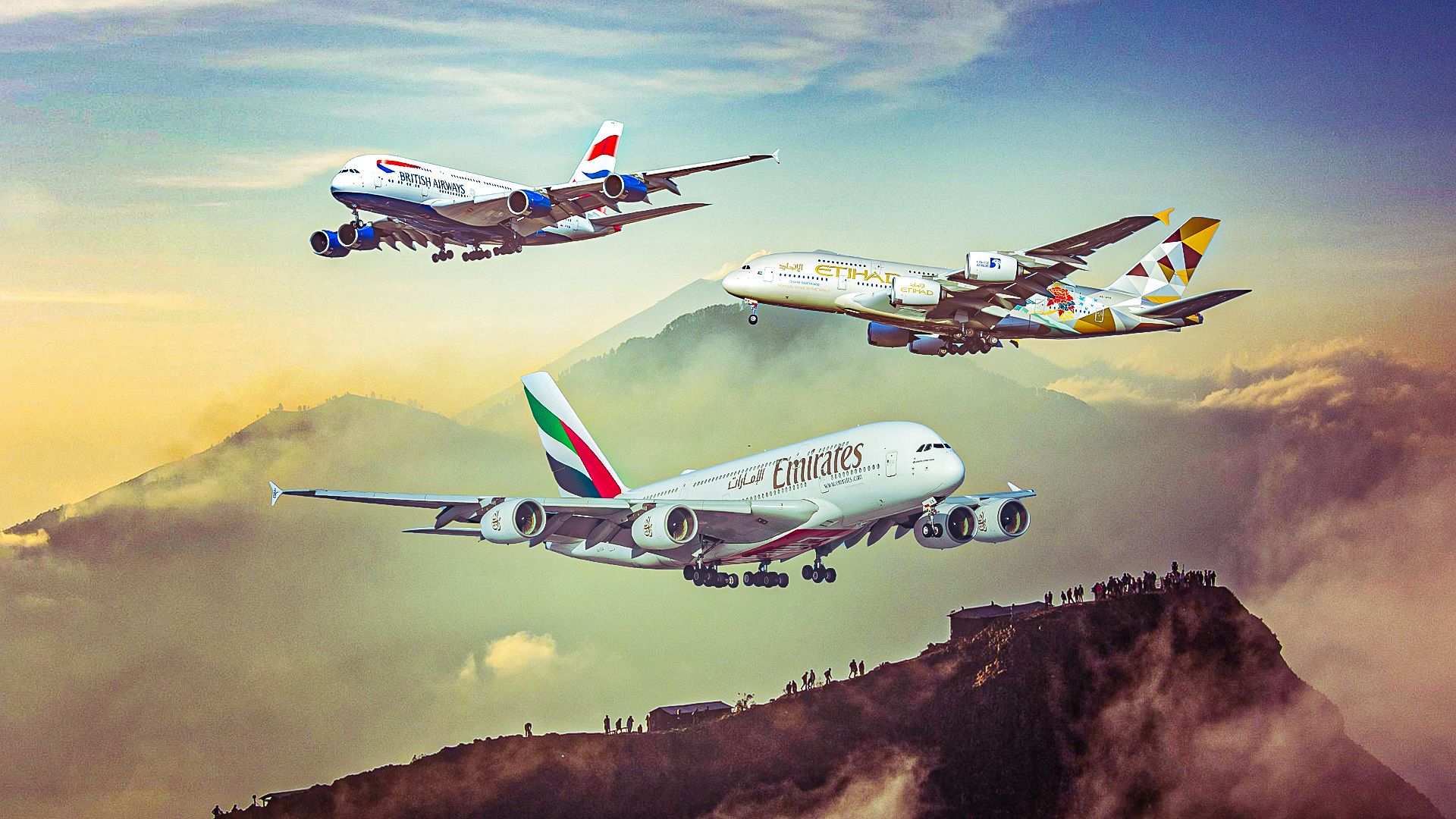
For more than a decade, aviation analysts have debated whether the Airbus A380, the world’s largest passenger aircraft, has a future in modern airline fleets. Production ended in 2021, and many predicted the “super jumbo” would quietly fade from the skies. Yet in 2025, the opposite has happened. Airlines are reviving their A380s, passengers still love them, and airports are once again tailoring their facilities to accommodate their double-decked presence. This article examines why the A380 is here to stay and why retirement remains a distant prospect.
Today, we take a look beyond the headlines to explore practical and commercial reasons why airlines remain committed to the Airbus A380. From Etihad’s new investment to Emirates’ unwavering confidence, the evidence shows that the aircraft continues to fill a vital niche that no other jet can match. The A380 has evolved from a misunderstood giant into a strategic workhorse, finding fresh relevance in an ever-changing industry. Its return has also reignited the public’s fascination with long-haul travel and reminded the world that flying can still be a special experience in many ways. In many respects, the A380’s revival says as much about shifting passenger priorities as it does about the resilience of the airlines that operate it.
The A380’s Comeback. Demand Outpacing Capacity

When long-haul travel collapsed in 2020, most observers assumed the A380’s days were numbered. Airlines parked or retired the giant, believing its four-engined design was too costly for a leaner post-pandemic world. But as travel demand rebounded faster than expected, carriers quickly found themselves short of capacity on key trunk routes.
 Etihad Airways provides one of the clearest examples. The airline initially grounded its ten A380s in 2020, publicly admitting it might never fly them again. Yet by 2023, surging demand from London, Heathrow forced a rethink. Today, Etihad operates multiple A380s daily on Abu Dhabi to London services, complete with refreshed interiors and its signature “the Residence” suite. According to ch-aviation fleet data, all of Etihad’s A380s are now active, with projected retirement dates extending to January 2033, proof of their long-term value.
Because the A380 moves huge volumes of passengers between slot-restricted airports, exactly when those slots are needed most, it contributes to the aircraft’s tenure. Heathrow, Dubai, and Sydney all limit frequencies, meaning the only way to grow is by increasing the number of seats per movement. The A380 remains unmatched in that metric. This highlights how the aircraft’s supposed weakness, its size, is precisely what makes it indispensable when airports and runways are already at capacity.
The Airline That Made The A380 Succeed

If any carrier embodies the A380’s success story, it’s  Emirates. The Dubai-based giant operates more than half the world’s active A380 fleet, and its business model was built around the aircraft from the outset. Where others saw risk, Emirates saw opportunity. The A380 was a change that allowed global traffic to funnel through its desert hub with unmatched comfort and capacity.
A concrete example is that Emirates’ A380 fleet spans from early-build aircraft delivered in 2009 to brand-new units handed over in 2021. The oldest aircraft in the fleet are now about 19 years old, yet ch-aviation records show all remain active with projected retirement dates around January 3032. That shows over two decades of continuous service life, a remarkable longevity for such a complex aircraft. Emirates Strategy works because it leverages scale and consistency. The aircraft’s per-seat cost is competitive when full, and Emirates’ global network ensures it usually is.
This model links directly to why the A380 still matters and is important to have in the Emirates fleet. In the hands of Emirates, the jet is not a burden but a brand ambassador, an airborne marketing billboard that reinforces Dubai’s image as a world-leading hub. Its continued success guarantees maintenance support, spare parts are easily available, and secondary market confidence, all of which make retirement less likely.
British Airways And The Premium-Leisure Sweet Spot

Across Europe,  British Airways has quietly built a similar argument for keeping the A380 flying. The airline operates 12 of them on routes like London to Los Angeles, Boston, and Johannesburg, where demand consistently fills every seat. During the post-pandemic surge, British Airways found that the aircraft was perfectly suited to high-density premium leisure markets, where passengers value space and comfort but still book in large numbers.
British Airways’ decision to invest heavily in upgrading its A380 cabins instead of retiring them shows the company’s long-term commitment to the A380. The aircraft now feature the carrier’s newest Club Suits business class product, modern inflight entertainment systems, and refreshed galleys to improve turnaround efficiency. This investment signals confidence, not decline. For routes exceeding ten hours, the A380’s fuel burn disadvantage is offset by savings in slot allocation, reduced maintenance cycles, and lower unit costs per passenger. With Heathrow slots among the world’s most expensive, squeezing 469 seats into one movement makes financial sense.
Active Airbus A380 Fleet Summary
|
Airline |
Number Of Active A380s |
Average Projected Retirement Date |
Average Fleet Age |
|
Emirates |
120 |
January 2032 |
12 Years Old |
|
British Airways |
12 |
January 2032 |
12 Years Old |
|
Qantas Airways |
10 |
January 2032 |
15 Years Old |
|
Lufthansa |
8 |
January 2030 |
13 Years Old |
|
Singapore Airlines |
8 |
January 2026 |
11 Years Old |
This all relates to the global market trend, with British Airways’ strategy mirroring a pattern seen across major flag carriers who use the A380 on premium heavy routes where image, loyalty, and yield outweigh fuel penalties. It’s a formula that keeps the type relevant even as newer twin jets like the A350 and B787 expand.
Etihad, Lufthansa & Qantas Have Strategic Resurrections

Beyond Emirates and BA, several carriers that once shelved their A380s have reversed course. Etihad’s return is already noted, but Lufthansa and Qantas tell equally revealing stories. Lufthansa stored its A380s in Spain in 2020 and publicly hinted they were finished. Yet by 2023, demand for North America and Asia, plus late 787 and A350 deliveries, forced the airline to reactivate six of its A380s.
Qantas followed a similar path. Australia’s strict border closures initially made its A380s redundant, but the post-reopening boom flipped the equation. All ten aircraft have been reintroduced, with complete cabin refurbishments, including new business class suites and a refreshed first class zone. According to ch-aviation, their projected retirements hover around 2032, aligning with the Emirates Timetable.
The explanation for this is twofold. Capacity recovery and fleet delivery delays mean airlines facing slower new aircraft arrivals need reliable lift now, not in five years. The A380 fills that gap beautifully as it is already paid off, certified, and instantly recognizable. Linking these three airlines shows a common truth. The A380’s survival is not nostalgia but pragmatism. When demand rebounds faster than manufacturing pipelines, a 500-seat aircraft sitting in storage becomes an asset, not a liability.
Comfort Still Matters And Gives Passenger Appeal

Technology may evolve, but passenger perception changes slowly, and travelers adore the A380. The emotional connection translates into commercial value that airlines cannot ignore. Its double-deck configuration isolates noise, providing a quiet ride for even economy passengers. The cabin’s higher ceilings, wider aisles, and massive windows create a sense of space unmatched by smaller jets. Airlines from Singapore Airlines to Qantas routinely cite customer satisfaction surveys showing the A380 as their most loved aircraft.
For example,  Singapore Airlines rebuilt its A380 interiors in 2017 with next-generation first class units and ‘Skyroom’ double beds, extending the aircraft’s service horizon to at least 2026. Travelers pay a premium for those experiences, proving that comfort remains a key selling point.
This explanation ties directly to brand identity. In an era when efficiency dominates headlines, the A380 reminds passengers that flying can still feel special. The emotional pull builds loyalty and differentiates the airlines in crowded markets. Passenger demand effectively underwires the aircraft’s longevity. As long as customers actively choose A380 flights when given options, carriers will keep operating and refurbishing them to capture that presence.
Global Fleet Outlook. Active and Aging Gracefully.

According to ch-aviation, over 150 A380s are currently active across 11 airlines, with retirement projections stretching from 2026 for early Singapore Airlines units to 2033 for Etihad’s youngest A380s. Emirates alone operates more than 100 aircraft, most scheduled to fly for at least another seven years. Qantas and British Airways have similar horizons around 2032, while Lufthansa’s smaller fleet targets 2030.
The statistical view dispels the myth of imminent extinction. Even if Airbus stopped building this type of aircraft, its operational runway would remain long. Each airframe is designed for roughly 20 to 25 years of service, and the majority have not yet reached 15 years old. That leaves ample life left, especially with ongoing cabin refreshes and engine-performance programs. The A380 remains too young, too capable, and too beloved to disappear from our skies anytime soon. Airlines plan years in advance, and none of the major operators have placed replacement orders of equivalent capacity. The A350-1000 and 777X come closest, but neither matches the A380’s seat count nor passenger appeal.
If we link these numbers together, the fleet data aligns with everything seen in the marketplace so far: commitment, investment, and utilization are expected to continue through at least the early 2030s. The super jumbo may no longer roll off the production line, but its operational story is far from over.
