


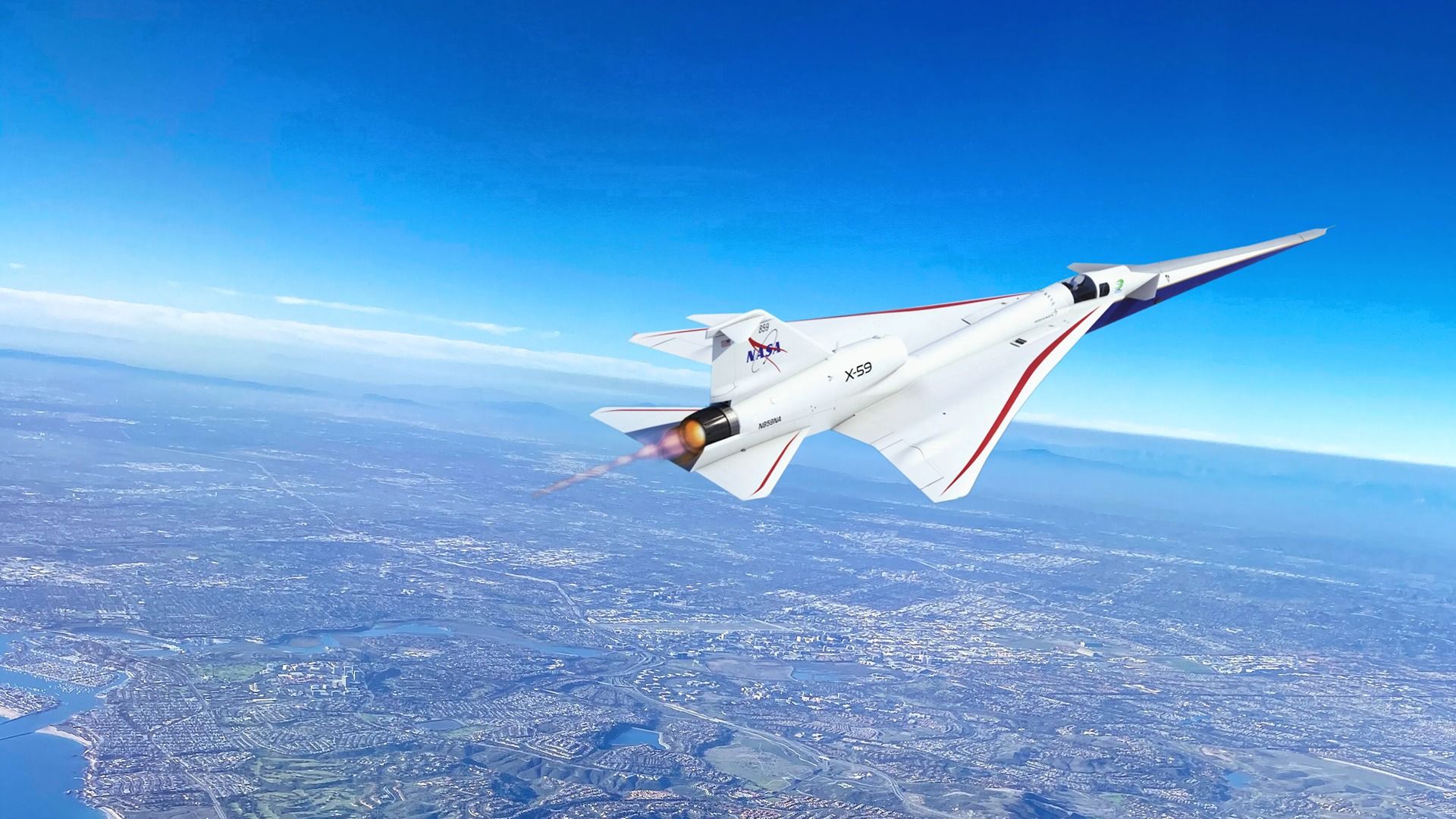
Lockheed Martin is in the final stages of developing and delivering the X-59 Quesst. It’s a supersonic aircraft that will be headed to NASA, and it promises to upend the supersonic aircraft industry. Whereas other experimental supersonic planes focus on breaking the boundaries regarding speed or capability, the X-59 is all about noise, or lack thereof. The purpose of the X-59 is to experiment with aircraft design to turn the infamous sonic “boom” into a sonic “thump.”
The results of this program could have serious effects across all of aviation. The technologies that are being worked on in quiet aerodynamics, advanced shaping, noise suppression, and community acceptability data could forever alter how supersonic aircraft are constructed. This could then lead to entirely new markets opening up in the civilian world for supersonic airliners, leaving established manufacturers like Boeing behind.
Looking At The Lockheed Martin X-59

The X-59 is a single-pilot, experimental aircraft designed by Lockheed Martin’s Skunk Works for NASA’s Quesst mission. “Quesst” stands for Quiet SuperSonic Technology, which reflects the X-59’s mission to explore and further develop technology for quiet supersonic flight. To be more specific, the X-59’s mission is to fly at supersonic speeds while producing a sonic signature low enough that observers on the ground perceive only a soft “thump.”
Performance-wise, the X-59 is meant to cruise at Mach 1.42 while flying at altitudes up to 55,000 feet. Its airframe is about 100 feet long (30.4 meters) with a wingspan of about 29.5 feet (9 meters), along with a Maximum Takeoff Weight (MTOW) of 14.7T. It’s powered by a single General Electric F414 engine with afterburning capability, and it will be flown over populated areas to determine public acceptance for the plane’s sonic “thumps.”
The X-59 is currently performing ground testing. The aircraft’s initial test was a self-powered taxi in July 2025, with an instrument test conducted shortly afterwards. NASA has already completed maximum afterburner engine runs, validating that the engine can deliver the thrust required for supersonic flight while integrating with the aircraft’s systems. Once ground tests are completed and the plane is ready, NASA will then perform testing flights.
What Is So Important About The X-59?

Currently, almost every government on Earth has banned supersonic flight over land. This is because of the sonic boom, a loud “bang” heard by anyone underneath the flight path of an aircraft flying past the speed of sound. Sonic booms can be as loud as 110 to 135 decibels, equivalent to the sound of a chainsaw in a person’s hands. The X-59 is meant to turn the sonic boom into a sonic “thump” that would be akin to the sound of a car door closing.
This would be accomplished through the X-59’s elongated and sharply tapered nose, along with canards and a carefully countered fuselage. This would allow the shockwaves created by supersonic flight to spread out, creating a longer but quieter noise. Additionally, the mounting of the engine also contributes, with inlets, exhaust, and nozzle shaping tuned to manage supersonic flow expansion, mixing, and pressure, ensuring that the exhaust plume does not reinforce shock signatures.
To support community testing, X-59 carries sensors, microphones, and telemetry systems to capture acoustic, aerodynamic, and environmental data. NASA will overlay this data with public response surveys to regulators. The primary purpose is to supply regulators with robust datasets that could lead to supersonic restrictions over land being eliminated. If the threshold for acceptable noise can be demonstrated, rule changes could follow.
What’s The Trouble For Boeing?

Decades ago, Boeing specifically designed its expensive 747 to be suitable as a cargo aircraft because it was expected that supersonic transports (such as the Concorde or Boeing’s own 2707) would supersede subsonic airliners, just as jetliners replaced piston-driven propeller aircraft. This didn’t happen, and Boeing would go on to become one of only two companies capable of economically producing large commercial airliners, the other being Airbus.
The list of reasons why Concorde failed is endless, but one of the largest factors in its demise was the global bans on supersonic flight over land. The results of the X-59 program could bring forward a new wave of supersonic aircraft that could legally fly above the speed of sound over land, and if a subsonic airliner were developed that could fly supersonic over land and still have competitive economics, this would prove a serious threat to the Airbus-Boeing duopoly.
|
Supersonic Airliners |
Years in Service |
|---|---|
|
Tupolev TU-144 |
1975-1976 |
|
Concorde |
1976-2003 |
Both Airbus and Boeing are undoubtedly observing the program, but  Boeing stands as the more vulnerable of the two, given its difficult financial situation and slightly weaker market position. The current duopoly is ripe for disruption, but the commercial aircraft industry is difficult to enter as it requires huge capital and scale for success. By offering something different, however, companies have significant potential to break the duopoly.
How The X-59 Could Affect Boeing

The results of the X-59 program could pave the way for new companies to develop supersonic airliners that are legally able to operate overland. With modern aircraft technology, it’s not unrealistic that a manufacturer could lower operating costs to a level that would at least be competitive with subsonic airliners. After all, this exact scenario occurred in the late 1950s, when technology advanced to the point that jetliners were more capable and flexible than propeller planes while also being economical.
Boeing and Airbus could respond with their own supersonic transport; however, Boeing is not in a position to do so easily. The company continues to record billions in losses every year, and is backed up on certification efforts for the Boeing 737 MAX 7, 737 MAX 10, and 777-9. While these planes are expected to be certified within the next few years, Boeing will then need to invest in further derivatives (such as the 777-8F), general performance improvements, and a replacement for the 737 MAX.
|
Airbus Aircraft |
Boeing Aircraft |
Embraer Aircraft |
Comac Aircraft |
|---|---|---|---|
|
Airbus A320neo (A319neo, A320neo, A321neo) |
Boeing 737 MAX (737 MAX 7, 737 MAX 8, 737 MAX 9, 737 MAX 10) |
Embraer E-Jet (E175) |
C909 |
|
Airbus A330neo (A330-800, A330-900) |
Boeing 777X (777-8, 777-9, 777-8F) |
Embraer E2 (E190-E2, E195-E2 |
C919 |
|
Airbus A350 XWB (A350-900, A350-1000, A350F) |
Boeing 787 Dreamliner (787-8, 787-9, 787-10) |
Subsonic airliners are already difficult and expensive to develop, and it’s unusual for even Boeing or Airbus’ aircraft programs to be completed on time or on budget. A supersonic transport would be immensely more challenging to take on, especially for a company with a full subsonic product line already in production that requires continuous investment. When you add in Boeing’s financial difficulties, this makes the company vulnerable to substantial changes in market dynamics.
The Boom Overture Supersonic Transport

The most serious effort to create a supersonic transport in today’s world is the Boom Overture. This aircraft has been in development for years, and as such, its design is largely frozen. Boom is not going to wait for the results of the X-59 program and then perform radical redesigns. Instead, Boom is creating an aircraft that will have a loud sonic boom and will be restricted to flying overwater routes exclusively.
The Boom Overture is designed to fly in today’s world rather than in a hypothetical world in which supersonic planes don’t produce sonic booms and governments repeal bans relating to supersonic flights over land. This simultaneously makes the Overture a more realistic concept while also making it vulnerable to the results of the X-59 program tests. After all, the Overture will have virtually no market if the X-59 program shows that supersonic planes can be designed not to produce a sonic boom.
Boom has its own answer to loud sonic booms, however, in the form of “Boomless Cruise”. The company is advertising that, with the development of the in-house “Symphony” engine, the plane can cruise over land without an audible sonic boom in certain weather and flight conditions. By flying in certain conditions at computer-controlled speeds between Mach 1.3 and Mach 1.4, the Overture can produce a sonic boom that refracts upwards rather than hitting the ground.
Rundown Of The Lockheed Martin X-59

The Lockheed Martin X-59 has received relatively little media coverage; yet, it is one of the most important experimental aircraft programs of the 21st century. If it proves that planes can go supersonic over land without shattering windows, then it could open the floodgates for a slew of airliners that finally make the supersonic era a reality. This undeniably has Boeing worried, as the company is in no position to respond to these new types of planes.
However, Boom is perhaps the company that should be most concerned about the X-59. If it proves that “boomless” supersonic flight is possible, and governments respond accordingly, then its loud Overture airliner that can only be quiet in specific conditions with carefully controlled speed may be dead on arrival.
