


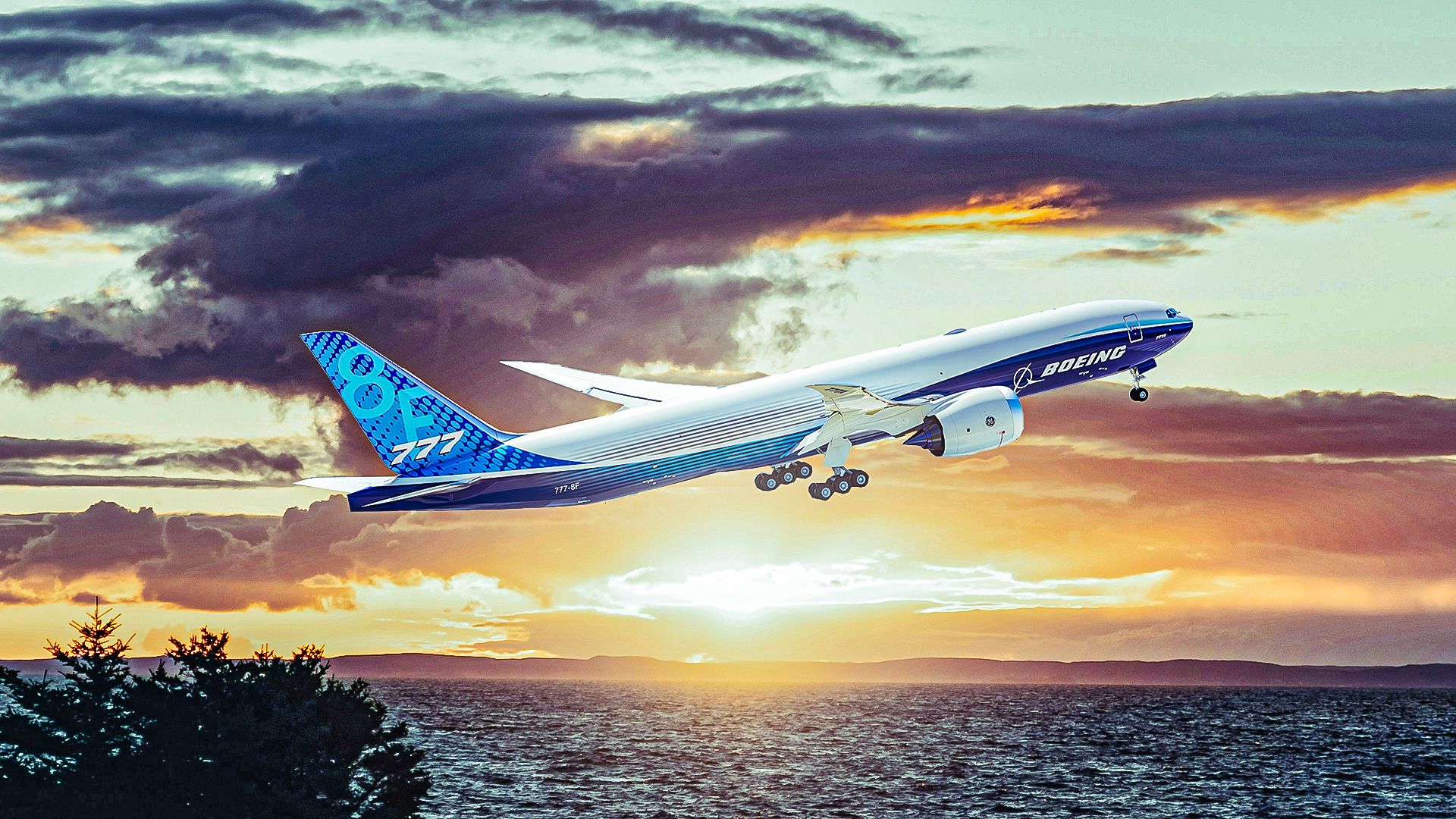
The Boeing 777-8F is set to make waves in the air cargo market when it takes to the skies in 2027. With its advanced technology and operational efficiency, coupled with its high cargo capacity and long range, the 777-8F may well help Boeing continue to dominate the cargo aircraft market, outshining the upcoming Airbus A350F.
In this article, we will take a closer look at the Boeing 777-8F and what cargo carriers can expect from the aircraft. We will also reveal which operators have ordered the 777-8F so far, and consider how the aircraft fits into Boeing’s wider 777X program.
Introducing The Boeing 777-8F

The Boeing 777-8F was revealed in 2022 and is Boeing’s next-generation cargo aircraft currently under development as part of the US manufacturer’s 777X program. The 777-8F is designed to replace and surpass the capabilities of the iconic 747-400F and 777F, offering airlines a more efficient, sustainable, and high-capacity option.
Production of the Boeing 777-8F began in July 2025, and the aircraft is expected to enter service in 2027, with  Qatar Airways being the launch customer. As reported by AIN Online at the time of the first hole being drilled on the assembly line, officially marking the start of production, Boeing’s Vice President and General Manager of the 777/777X, Jason Clark, celebrated the milestone, saying,
“It may seem small, [but] it’s that one hole…that gets everything started. All the work that goes into starting a program, the years of development, the years of engineering, the years of supply chain, procurement, and contracting, and all the other pieces – the blood, sweat, and tears – all that innovation comes together and is represented in the first in that first hole.”
The Boeing 777-8F’s Specifications

The Boeing 777-8F will share the same composite wing structure and folding wingtips as the 777-8, allowing for increased wingspan (and therefore fuel efficiency) inflight, while maintaining compatibility with existing airport gates. The aircraft’s wingspan when folded will be 212 ft 8 in, extending to 235 ft 5 in when inflight, and at maximum payload, it will be capable of flying up to 5,075 miles.
The aircraft will also feature the same two General Electric GE9X engines as the 777X passenger variants, which are the largest and most fuel-efficient engines in their class, offering significant reductions in fuel burn, emissions, and noise compared to older aircraft.
The Boeing 777-8F has a maximum take-off weight of 805,000 lb, and is designed to carry up to 260,000 lb of cargo. The aircraft contains more than 26,000 ft² of cargo space, as outlined in the table below:
|
Area |
Cargo capacity |
|---|---|
|
Main deck |
21,061 ft² |
|
Lower deck |
5,291 ft² |
|
Bulk compartment |
600 ft² |
The Boeing 747-8F remains the US manufacturer’s largest cargo aircraft to date, with a maximum payload of up to 307,000 lb. Thanks to its larger nose door, the aircraft is also capable of carrying larger and more awkwardly shaped pieces of cargo. However, fuel efficiency and operating costs are where the 777-8F has the edge, offering a more economical alternative for many freight operators, especially those prioritizing efficiency on long-haul routes.
Which Airlines Have Ordered The Boeing 777-8F?

Boeing has so far received a total of 59 orders for the 777-8F from seven different operators, making the aircraft more popular than its passenger equivalent, the 777-8, which has received 43 orders. Qatar Airways is set to be the aircraft’s launch customer and largest operator, having placed an order for 34 777-8Fs back in January 2022. The 777-8F will join Qatar Airways’ existing cargo fleet of 28 777Fs, allowing the carrier to significantly expand its worldwide cargo operations.
The world’s second-largest operator of the Boeing 777-8F looks set to be Cargolux, with ten examples on order, followed by Korean Air, with eight. The cargo carriers that have placed orders for the 777-8F are shown in the table below:
|
Airline |
Boeing 777-8F |
|---|---|
|
Qatar Airways |
34 |
|
Cargolux |
10 |
|
Korean Air |
8 |
|
Lufthansa |
7 |
|
China Airlines |
4 |
|
All Nippon Airways |
2 |
|
Silk Way West Airlines |
2 |
|
Total |
59 |
How Does The Boeing 777-8F Compare To The Airbus A350F?

Boeing has billed its upcoming 777-8F aircraft as the world’s largest and most capable twin-engine freighter with the highest payload capacity and lowest operating cost. The aircraft is expected to offer a 30% reduction in fuel consumption and emissions compared to earlier generations of Boeing cargo aircraft, such as the 747 and 767. Understandably, rival aircraft manufacturer Airbus may be concerned.
However, the Boeing 777-8F will face some stiff competition from the Airbus A350F. Thanks to its lighter design and higher proportion of composite materials, the A350F will provide operators with greater fuel efficiency than the Boeing 777-8F, and will also produce lower emissions, helping to keep cargo operations within ever-stricter worldwide regulations. The A350F will be powered by two Rolls-Royce Trent WXB-97 engines.
Just like the Boeing 777-8F, the Airbus A350F, which has been designed on the incredibly popular passenger A350 variant, is also expected to enter service in 2027. Major customers of the cargo aircraft are set to include Singapore Airlines and Etihad Airways Cargo.
 Boeing aircraft currently account for around 90% of all air cargo capacity, and the US manufacturer predicts a 67% increase in the global air cargo fleet by 2040, including more than 800 widebody aircraft. Boeing positions the 777-8F as a key part of its strategy to continue to lead the freighter market, responding to increasing demand for air cargo driven by e-commerce, pharmaceuticals, and express delivery. The 777-8F offers cargo operators a future-proof solution that combines efficiency, capacity, and environmental responsibility.
About The Boeing 777X

The Boeing 777-8F forms part of the US manufacturer’s flagship 777X program. The 777X is Boeing’s most advanced long-haul widebody aircraft to date, designed to carry forward the legacy of the hugely successful 777 family while incorporating significant technological innovations. The aircraft is intended to compete directly with the Airbus A350 on long-haul routes and to replace aging aircraft like the Boeing 747 and earlier 777 variants.
The Boeing 777X’s most noticeable change from previous 777 variants is its composite wing, which is longer and more aerodynamically efficient than its predecessor’s. This new wing includes folding wingtips, a first for a commercial aircraft, allowing the aircraft to maintain a larger wingspan inflight for better performance, while still fitting into standard airport gates when on the ground. This is in contrast to the Airbus A380, which, when it entered commercial service in 2007, required airports around the world to modify their infrastructure to accommodate the double-decker aircraft, including larger jetbridges and reinforced aprons.
In order to provide a superior passenger experience, the Boeing 777X has borrowed significant design features from the popular 787 series, including larger windows, improved cabin pressure, higher humidity levels, and better noise insulation. With such features designed to reduce jetlag for passengers, the 777X is bound to be a hit when it eventually takes to the skies.
However, the Boeing 777X program has so far been plagued by setbacks and delays. The aircraft was originally due to enter commercial service in 2020, but this has since been pushed back multiple times and is now expected to take place in 2026. These delays are due to a combination of technical, regulatory, and external challenges, including engine development issues, airframe structural problems, and tighter regulatory scrutiny from the US Federal Aviation Administration (FAA) following the Boeing 737 MAX crisis.
Which Airlines Have Ordered The Boeing 777X?

 Lufthansa is set to be the launch customer for the Boeing 777X, with the German flag carrier scheduled to take delivery of its first aircraft in 2026. However, by far the largest operator of the 777X will be
  Emirates, with a staggering 205 777Xs on order, made up of 35 777-8s and 170 777-9s. This is perhaps unsurprising, given that the carrier, based at Dubai International Airport (DXB), is already the world’s largest operator of the aircraft’s predecessor – the 777-300ER.
The airlines set to operate the largest fleets of passenger Boeing 777X aircraft are outlined in the table below:
|
Ranking |
Airline |
Boeing 777-8 |
Boeing 777-9 |
Total |
|---|---|---|---|---|
|
1 |
Emirates |
35 |
170 |
205 |
|
2 |
Qatar Airways |
– |
110 |
110 |
|
3 |
Korean Air |
– |
40 |
40 |
|
4 |
Cathay Pacific |
– |
35 |
35 |
|
5 |
Singapore Airlines |
– |
31 |
31 |
|
6 |
Etihad Airways |
8 |
17 |
25 |
|
7 |
British Airways |
– |
24 |
24 |
|
8 |
Lufthansa |
– |
20 |
20 |
|
9 |
All Nippon Airways |
– |
18 |
18 |
|
10 |
China Airlines |
– |
14 |
14 |
As the figures show, only two airlines have opted for the Boeing 777-8 as part of their fleet plans – Emirates and  Etihad Airways, with the larger 777-9 proving infinitely more popular with carriers around the world.
One thing is certain: together with the 777-8F cargo aircraft, the 777X family of aircraft looks set to shake up the global aviation market over the coming years, bringing high-capacity, technologically advanced aircraft to the forefront of both passenger and cargo operations.
