


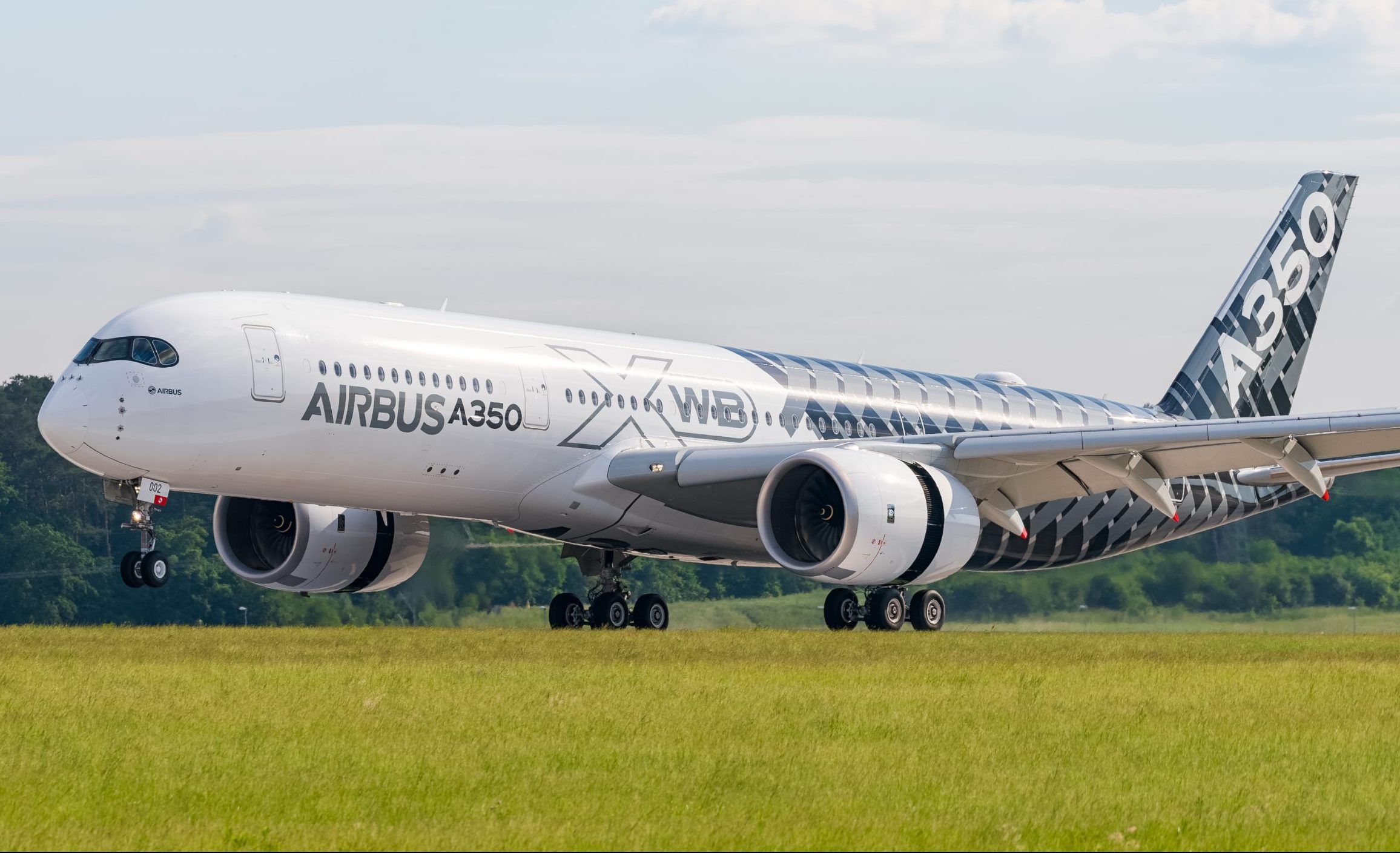
When it comes to modern long-haul aviation, the Airbus A350 stands out as one of the most advanced and efficient widebody aircraft ever built. Launched into service in 2015, the A350 was developed to meet growing airline demand for a fuel-efficient, long-range aircraft capable of connecting virtually any two cities on the planet. With its sleek design, carbon-fiber-reinforced fuselage, and state-of-the-art aerodynamics, the A350 represents a major step forward in both performance and passenger experience.
The success of the Airbus A350 has raised significant concerns for  Boeing, particularly as it challenges the American manufacturer’s dominance in the widebody market. Designed to compete directly with Boeing’s most profitable long-haul jets, the A350’s advanced materials, fuel efficiency, and long-range capabilities make it an attractive alternative for airlines looking to modernize their fleets. Its ability to efficiently serve ultra-long-haul routes, once a niche dominated primarily by Boeing, means Airbus is now winning key orders from major global carriers that traditionally favored Boeing aircraft.
A Legitimate Worry for Boeing?

In short, yes, the Airbus A350 poses a significant concern for Boeing, particularly in the long-haul, widebody aircraft market. One of Boeing’s most critical and traditionally profitable segments. Designed to go head-to-head with the Boeing 777 and Boeing 787 families, the A350 offers advanced fuel efficiency, long-range capabilities, and a highly praised passenger experience. These attributes have made it increasingly attractive to international carriers, especially those operating ultra-long-haul routes.
The A350 has also been winning key orders from major global airlines such as  Qatar Airways,
  Singapore Airlines, and
  Lufthansa, some of which have historically been strong Boeing customers. Airbus has positioned the A350 as a modern and efficient alternative to Boeing’s 777, and even a credible rival to the upcoming 777X, which continues to face delays and certification hurdles. Each major order that goes to Airbus is not only a lost sale for Boeing, but also a potential shift in long-term fleet strategy by the airline.
Adding to Boeing’s concern is the A350’s strong track record for reliability and stable production. While Boeing has struggled with ongoing production quality issues, most notably with the 787 Dreamliner, and faces delays with the Boeing 777X program, Airbus has maintained relatively consistent delivery timelines for the A350. This contrast in execution has heightened concerns among investors and airline customers alike.
A350 vs 777X – How the Orders and Deliveries Stack Up

When it comes to airline preference and fleet integration, the Airbus A350 currently holds a clear advantage over the Boeing 777X, largely due to timing and operational readiness. The A350 has been in commercial service since 2015 and is already a mainstay in the fleets of top global carriers such as Qatar Airways, Singapore Airlines, Lufthansa, and  Delta Air Lines. Airlines have praised the A350 for its fuel efficiency, lower operating costs, and strong passenger appeal. Its performance on long-haul and ultra-long-haul routes has made it especially attractive for airlines aiming to modernize their widebody fleets while reducing emissions.
In contrast, the Boeing 777X remains in the test flying stage, with no deliveries as of 2025 and a delayed entry into service now expected in late 2025 or 2026. Despite this, it has still secured a strong order book from major carriers like  Emirates, Lufthansa, and Qatar Airways, who view it as a long-term replacement for other aging fleets and airframes. However, the long wait has led some airlines to hedge their bets by adding A350s to their fleets in the meantime, weakening Boeing’s lock on this market segment. As operational needs evolve and sustainability targets become more pressing, the A350’s earlier entry and established in-service track record continue to give Airbus an edge in real-world airline adoption.
The following table, using data from Boeing and Airbus, shows the number of orders and deliveries for all three aircraft to date.
|
Aircraft |
Orders |
Deliveries |
|---|---|---|
|
Airbus A350 (All variants) |
1,428 |
669 |
|
Boeing 777X (All variants) |
610 |
In summary, while both the Airbus A350 and Boeing 777X are positioned as next-generation long-haul aircraft, their standing with airlines reflects a clear difference in momentum. The A350, already proven in service with more deliveries to date than the 777X has in total orders, has become a reliable and flexible choice for carriers worldwide. The 777X, although promising on paper with its advanced aerodynamics and capacity, continues to face delays that limit its current appeal. Until Boeing brings the 777X into commercial service and demonstrates its real-world performance, the A350 remains the more attractive and dependable option for airlines seeking immediate operational and environmental gains.
Performance and Range – How do they Compare?

The Airbus A350 and Boeing 777X are both designed as state-of-the-art widebody aircraft optimized for long-haul operations, but they differ in several key performance and operational areas. The A350 comes in two main variants: the Airbus A350-900 and the larger Airbus A350-1000. The Airbus A350-900 typically seats around 300–350 passengers and has a maximum range of approximately 8,100 nautical miles (15,000 km), while the A350-1000 can carry about 350–410 passengers with a slightly shorter range of roughly 7,950 nautical miles (16,000km). Two other variants include the Airbus A350-900ULR, with a similar capacity to the A350-900 but an increased range of around 9,700 nautical miles (18,000 km), and the Airbus A350Ftargeted at cargo operations.
The Boeing 777X family, comprising the Boeing 777-8 and Boeing 777-9 variants, aims to build on the success of the original 777 series with new technologies like folding wingtips for improved airport compatibility and the latest GE9X engines, promising significant fuel burn reductions. The 777-8 targets ultra-long-range missions with a range of about 8,700 nautical miles (16,000km) and seating around 350 passengers in a typical three-class layout, positioning it as one of the longest-range commercial jets available. The larger 777-9 seats approximately 400–426 passengers with a range of around 7,200 nautical miles (13,500). Boeing has focused on enhancing passenger comfort with a wider cabin and larger windows, aiming to compete directly with the A350-1000 in terms of capacity and comfort.
Operationally, the A350 has a head start with hundreds of aircraft already flying, allowing airlines to gather data and optimize maintenance and route planning. Its efficient fuel consumption and modern avionics help reduce costs and improve reliability. In contrast, the 777X, though promising superior range and capacity, is yet to enter service as of 2025, meaning operational data is limited. Once introduced, the 777X is expected to push boundaries in range and passenger capacity, but its delayed entry has forced some airlines to favor the proven A350 in the meantime. Ultimately, both aircraft offer cutting-edge technology and performance improvements; however, the A350’s operational maturity currently gives it an edge in real-world airline performance and economics.
Operational Efficiency and Cost of Ownership

When it comes to operational efficiency, both the Airbus A350 and Boeing 777X leverage cutting-edge technology to reduce fuel consumption and lower emissions, but their approaches reflect different priorities. The A350’s extensive use of carbon-fiber-reinforced polymer in its fuselage and wings significantly reduces weight, which directly translates into improved fuel economy. Paired with Rolls-Royce Trent XWB engines, widely regarded as some of the most efficient turbofans in service. This efficiency benefits airlines by reducing fuel costs, which typically account for the largest portion of an aircraft’s operating expenses.
The Boeing 777X, on the other hand, focuses heavily on increasing capacity and range without sacrificing efficiency. Its new GE9X engines are designed to be the most fuel-efficient large turbofan ever built. Additionally, the 777X incorporates significant aerodynamic upgrades to ensure maximum efficiency in flight. This blend of size and technology aims to optimize performance on high-demand, long-haul routes where economies of scale can reduce costs per passenger-mile.
From a cost-of-ownership perspective, the A350 benefits from its head start in service, allowing airlines to refine their maintenance schedules, training, and operational protocols to maximize efficiency. Its relatively mature supply chain and proven reliability contribute to lower unforeseen maintenance costs. Conversely, the 777X is still navigating certification and entry-into-service challenges, creating uncertainty around its initial maintenance costs and operational reliability. However, once fully operational, the 777X’s larger seating capacity could offer airlines better cost efficiencies on dense routes, potentially balancing or even surpassing the A350’s advantages, particularly for carriers prioritizing volume and route flexibility.
Next-Gen Engineering Innovations Compared

The Airbus A350 and Boeing 777X both showcase cutting-edge design innovations, though they approach performance and passenger experience differently. The A350 features extensive use of carbon-fiber-reinforced polymers (about 53% of its structure), which significantly reduces weight and improves fuel efficiency. Powered by Rolls-Royce Trent XWB engines, the A350 achieves approximately a 25% reduction in fuel burn compared to previous-generation aircraft, helping airlines lower their operating costs and emissions.
Meanwhile, the Boeing 777X combines advanced materials with unique engineering feats such as its folding wingtips—allowing a wingspan of 235 feet (71m) during flight but retracting to 199 feet (51m) on the ground for airport compatibility. Its wings have a higher aspect ratio with raked wingtips, which contribute to improved aerodynamic performance. The 777X is equipped with the largest commercial jet engine ever built, the GE9X, promising a 10-12% fuel efficiency improvement over the 777-300ER. This blend of innovation aims to optimize performance on ultra-long-haul routes while maximizing passenger capacity.
|
Feature |
Airbus A350 |
Boeing 777X |
|---|---|---|
|
Materials |
Over 50% CFRP, lightweight composites |
Advanced composites and aluminum alloys |
|
Wing Design |
Curved wings with adaptive winglets |
Raked wingtips with folding mechanism |
|
Engine |
Rolls-Royce Trent XWB |
GE9X engines (the largest commercial engines) |
|
Cabin Width |
18 feet, 5 inches (5.61m) |
19 feet, 7 inches (5.97 meters) |
|
Cabin Altitude |
6,000 feet |
6,000 feet |
|
Fuel Efficiency |
25% reduction compared to previous models |
10–12% improvement over 777-300ER |
The A350 and 777X are both advanced long-haul aircraft designed with a strong focus on passenger comfort, offering features like lower cabin altitude and improved air quality. They are well-suited for international travel, capable of flying long distances efficiently while accommodating high passenger demand. Both aircraft play a crucial role in modern airline fleets, offering a balance of range, capacity, and comfort that meets the demands of global travel.
The Long Haul Battle in Summary

The Airbus A350 is undeniably a competitive concern for Boeing, especially in the long-haul widebody segment where the A350 has established itself as a proven and efficient aircraft. With hundreds of deliveries across both the A350-900 and A350-1000 variants, Airbus has gained a solid operational track record with major global carriers. Its strong fuel efficiency, lower operating costs, and favorable passenger experience have helped it carve out market share, particularly at a time when Boeing has been grappling with program delays and reputational challenges.
The Boeing 777X, while technically impressive and backed by strong initial orders, remains in the test flight stage as of mid-2025. The continued delays in certification and entry into service have created uncertainty for airlines and opened the door for Airbus to secure key orders that might have otherwise gone to Boeing. Several carriers have even adjusted fleet strategies by supplementing or replacing delayed 777X orders with A350 aircraft, eroding Boeing’s grip on this crucial segment. The A350’s earlier market entry and stable delivery performance have positioned it as a default choice for many airlines planning for the next two decades.
In this context, the A350 is more than just a competitor; it represents a strategic threat to Boeing’s dominance in widebody aircraft. Unless Boeing can stabilize its production pipeline, deliver the 777X without further setbacks, and restore airline confidence, the A350’s lead will only widen. For Boeing, the challenge isn’t just providing a technically superior aircraft; it’s proving to the market that it can deliver it reliably and on time. Until then, the A350 will remain a real and present concern.

- Stock Code
-
AIR
- Business Type
-
Planemaker
- Date Founded
-
December 18, 1970
- CEO
-
Guillaume Faury
