


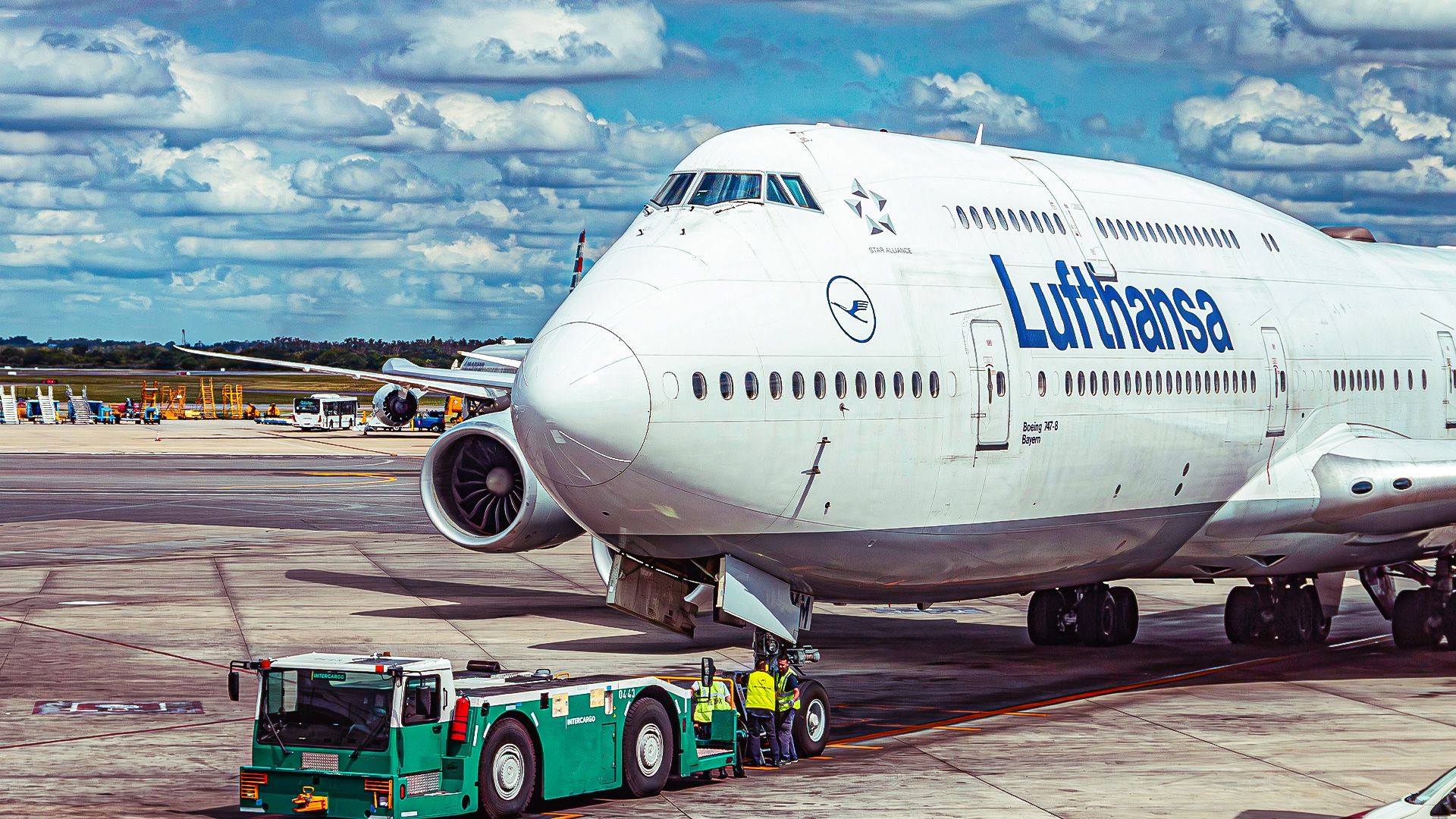
The Boeing 747 is one of the world’s most iconic planes, and it is easily recognizable thanks to its frontal hump, which often contains a luxurious lounge or additional seating in passenger variants. The 747 is an old bird, having first been delivered with what became Pan American World Airways in January 1970, but the most recent passenger variant of the massive quadjet, the 747-8 only recently ceased manufacture after the final aircraft was delivered to Atlas Air in January 2023.
Having been seen so long in the skies, some may wonder why the 747 has only a partial upper deck at the front, rather than a full second level, particularly as the Airbus A380, which was manufactured from 2003 to 2021, is an even larger quadjet with two decks for the full length of the plane. As it turns out, the reason for the 747’s partial upper deck speaks to its original purpose of being a freighter, rather than a passenger jet, as this article describes.
The Circumstances Of The 747’s Design

The reason for the use of the area as additional seating was due to the great oil crisis of 1973, and airlines needed to up the number of passengers in order to make money. The first 747s had so few windows for the same reason that the cockpit is located above, not within, the nose of the plane; because the 747 was designed to be a freighter aircraft.
Studies for Concorde had begun as early as 1954, and it had seemed that supersonic air travel would take over the world. Thus, Boeing proposed the CX-HLS as a military freighter, a sector that still had a use for jet aircraft with high carrying capacity. However, the contract was won by the Lockheed C-5 Galaxy, which went on to become another iconic plane.
Pan Am approached Boeing in 1958 for a passenger jet more than twice the size of the 707, hoping to reduce its fleet seat cost by 30%. As the CX-HLS mock-ups looked compatible, and the design had not been used, according to a Quora discussion, the CX-HLS would serve as the inspiration for the eventual 747-100 as a passenger quad-engined jetliner.
What Makes The 747 A Good Freighter?

According to a post from Airways Magazine, the Boeing 747-100, being the original variant of the 747, was designed only with three windows per side. For these early passenger variants, the intention for the shortened upper deck was to be used as a lounge area with limited seating, largely serving the crew. However, according to Aircraft Spotting, airlines later began to use the upper deck for premium passenger seating, and so Boeing offered an option for ten windows on either side.
There are a lot of shared elements between the 747-100 and the proposed CX-HLS, but despite taking inspiration from it, the 747 was intentionally designed as a passenger aircraft, and many elements, such as the wing configuration, placement of the engines, the nose configuration and the wing-to-body configuration were optimized for this purpose.
|
Boeing 747-100 and 747-8 Specifications |
||
|
747-100 |
747-8 |
|
|
Range |
4,620 nautical miles |
7,730 nautical miles |
|
Cruise Speed |
490 knots (907 km/hour) |
504 knots (933 km/hour) |
|
Typical Capacity |
366 |
495 |
|
Cargo |
6,190 cubic feet |
6,345 cubic feet |
|
Length |
231 feet 10 inches |
250 feet 2 inches |
|
Wingspan |
195 feet 8 inches |
224 feet 7 inches |
|
Maximum Takeoff Weight |
750,000 pounds |
987,000 pounds |
|
Fuel Capacity |
48,445 US gallons |
63,034 US gallons |
|
Takeoff Distance |
10,650 feet |
10,200 feet |
|
Powerplant |
4x Pratt & Whitney JT9D turbofans 4x Rolls-Royce RB211 turbofans 4x General Electric CF6 turbofans (43,500–51,600 pounds of thrust each) |
4x GEnx-2B67 turbofans (66,500 pounds of force each) |
One aspect of the CX-HLS that remained is the raised cockpit, and this would keep the door open to freight variants of the aircraft, allowing the full length of the fuselage to be used for cargo. Moving the flight deck and small cabin higher also allowed for a large nose door, which is still seen on the 747-F. In a theoretical military context, this door would allow vehicles to be driven straight on and off, while the raised cabin behind the flight deck would carry around 70 troops to operate and unload the vehicles.
Why Not Use A Full -Length Top Deck?

Throughout the variants of the 747, the upper deck did change. It was extended in the case of the 747-100BSR SUD (stretched upper deck) models, which were produced to operate super-dense regional Japanese routes for Japan Airlines. The extended 747-8 also has a longer upper deck, corresponding with the fuselage plug added ahead of the wing.
Boeing did look at stretching the upper deck to the full length of the aircraft several times over the years, but never made the leap. In terms of aerodynamics and structure, it would have been quite an undertaking, and Boeing found that adding the hump for the cockpit and the short ‘C’ deck did not affect aerodynamics too adversely, according to popular opinion on Quora:
“The aerodynamic configuration of the 747 is very similar to that of the 707. The 747 wing has slightly more sweepback than that of the 707 and is of about the same aspect ratio. An improved airfoil design is also incorporated in the wing of the 747. The fact that the hump was built into the design did not hurt the aerodynamics of the design.”
Another factor was that one of Boeing’s objectives when designing the plane was for it to be easily convertible to a freighter aircraft, and many freight variants and conversions exist. The reason why the 747-100BSR SUD variant could get away with stretched upper decks was that the variant spent very little time at cruise, as it was specialized for short-haul flights. Adding just the hump allowed the 747 to remain aerodynamically viable for the long-haul, while still providing freighter utility:
“The purpose of ‘C’ Deck was for the cockpit. With the cockpit above ‘A’ Deck, the entire nose can be raised giving full access to ‘A’ AND ‘B’ deck for unprecedented cargo loading. This was a huge reason the cargo version was so ‘efficient’ and a big selling point. Extending “C” deck further than they did would have required engineering an entire new structure and the tooling required for manufacturing.”
How Viable Was The Airbus A380?

To see how a 747 with a full upper deck might have performed, one need look no further than the Airbus A380, which is the world’s largest passenger airliner and also the only full-length double-deck jet airliner in the world. Comparing delivery numbers, the A380 only saw 254, according to Airbus, while the 747 across all variants saw 1,574 throughout its long career.
For a commercial passenger jet, a big upside of being so large is the huge passenger capacity, which is good for airlines operating dense hub-to-hub routes. Customers also love the A380 for its spacious cabin, and the A380 features some of the most luxurious class-nonspecific commercial cabin experiences. There are some significant downsides to being so big and so heavy, with the main one being lower fuel-efficiency.
|
Fuel efficiency, by distance and the number of passengers |
|||
|
Aircraft |
Passengers |
Distance |
Fuel Efficiency per Person |
|
A380 |
554 PAX |
11,000 km |
3.16 L/100 km/PAX |
|
B747-400 |
487 PAX |
10,147 km |
3.16 L/100 km/PAX |
|
B747-8 |
467 PAX |
11,000 km |
2.82 L/100 km/PAX |
In the case of the 747-8, its efficiency is significantly improved through the use of more modern engines and aerodynamic improvements, among other things. Another consideration is the wingspan, and the A380 is limited in this respect, only being able to use specific airport gates wide enough to accommodate it. The wingspan of the A380 is 16% larger than the 747-8, and for airports, where gate space is at a premium, and expensive to change, this can be quite significant.
Boeing May Owe Freight Dominance To The 747

Boeing has long been the dominant manufacturer in the air freight business, and the flexibility of the 747, being able to cater to both commercial passenger and freight markets may be a big reason for Boeing’s success. According to Air Insight, Boeing has a 90% market share of aircraft in the US air freight industry. In fact, the most recent 747-8 variant saw more deliveries as the 747-8F freighter than as a passenger aircraft.
Boeing also has other good freighters to offer the sector, with the 777F and 748F also selling very well, and the 777X freighter is expected to be certified in the next couple of years. That said, Airbus is looking to start competing in the sector, with the A350F on the horizon. These new freighters cannot come soon enough, as demand in the air freight sector has sharply increased in recent years, and is predicted by Boeing to rise by a further four percent in the coming decades.
In this kind of environment, freight airlines will be looking to get as much out of the remaining 747 freighters as they can, and the 747-8F, thanks to its range and nose-loading capabilities, will be worth its weight in gold. It goes to show that one smart decision, like the one made by Joe Sutter, the chief engineer responsible for designing the Boeing 747, can have a huge effect on the future of a company and even an entire industry.
