


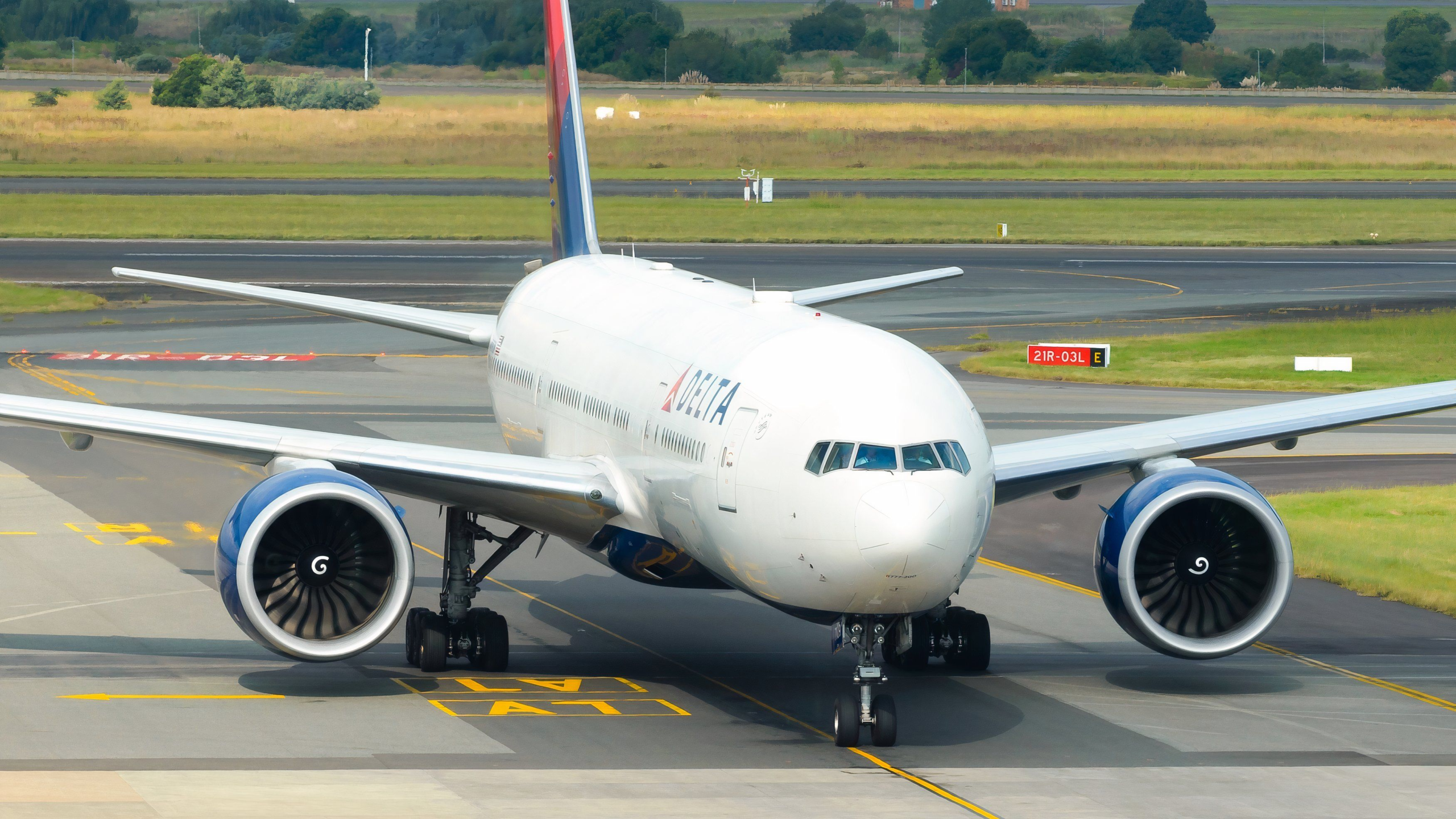
The  Boeing 777 prides itself as being the best-selling widebody aircraft program in history, with over 2,300 units ordered and counting. First entering service in 1995 with launch customer United Airlines, Boeing has developed multiple variants of the 777 and is imminently introducing a new series – the Boeing 777X – within the next 18 months.
The initial Boeing 777 model was the 777-200, a long-haul twinjet that entered the market at the perfect time as ETOPS regulations were being relaxed. However, what many people don’t know is that Boeing initially explored a trijet design for the 777, which was called the 777-100. Envisioned as a competitor to the Lockheed L-1011 and McDonnell Douglas DC-10, the trijet design never made it past the concept stage as Boeing opted for a twinjet instead.
Early Boeing 777-100 Trijet Concept

In the early 1970s, both Lockheed and McDonnell Douglas had debuted their trijet widebody aircraft to some degree of success. While Lockheed would take a big financial hit on the L-1011, the aircraft was nonetheless considered an excellent machine, while the DC-10 had proven a hit with almost 400 commercial sales. Boeing had enjoyed great success with its first trijet, the Boeing 727, and sought to replicate this with a widebody version.
In 1978, Boeing unveiled three new aircraft ideas. Two of these would go on to become the Boeing 757 and the Boeing 767, while the third was a large trijet known at the time as the 777-100. This aircraft would seat approximately 275 passengers and come in two versions, one a shorter-range transcontinental variant and the other a longer-range intercontinental model. This plane would have filled the rather large gap in Boeing’s portfolio between the Boeing 767 and the Boeing 747.
However, during the late 1970s and early 1980s, twin-engined aircraft were not capable of long overwater flights due to the “60-minute rule,” which mandated that twinjets could only fly routes a maximum of 60 minutes from a diversion airport. With three or four engines, operators were able to fly routes that twinjets simply weren’t allowed to, making trijets like the 777-100 a viable concept at the time. Ultimately, Boeing did not go through with the 777-100 and chose to focus on the 757 and 767 instead, shelving the idea of any 777 family for over a decade.
Why Boeing Didn’t Build The 777-100

As any planemaker does before investing billions into a new aircraft, Boeing sought to gauge interest from prospective customers about the idea of a large trijet. It came to the conclusion that airlines were far more interested in twinjet aircraft, particularly as technology improved and these aircraft could fly further and safer than ever. As such, Boeing was unable to drum up any real interest or commitments to a 777-100.
The single most important factor was the introduction of Extended-range Twin-engine Operational Performance Standards (ETOPS) regulations in 1985. This introduced a 120-minute rule for twinjets and diversion airports, suddenly enhancing the route capabilities of planes like the 767 and Airbus A310. This limit was later increased to 180 minutes in 1988, essentially marking the need for a third engine as redundant.
In the late 70s, a trijet 777 would have been ideal for airlines conforming to regulations and making efficiency savings over a quadjet. The L-1011 and the DC-10 had both sold hundreds of units and filled the gap between small twinjet and very large aircraft like the 747, so there was definitely a market there. But, along with changing ETOPS rules, the engineering costs and complexity of a new trijet proved too great for Boeing.
The End For Trijets And Quadjets?

In the modern day, ETOPS certification can extend to over six hours from a diversion airport, allowing long-range twinjets like the 777, 787 Dreamliner and Airbus A350 unrestricted access to routes. With these aircraft able to fly with just two fuel-consuming engines, it’s no surprise that plane manufacturers have stopped building trijets and quadjets.
The only exceptions this century have been the Boeing 747, Airbus A340 and Airbus A380, all of which come with four engines and failed to make their manufacturers any profits due to inadequate sales. The last commercial trijet in production was the McDonnell Douglas MD-11, which concluded in 2000 following the company’s merger with Boeing.
|
Aircraft Type |
Model |
Production End |
|---|---|---|
|
Trijet |
McDonnell Douglas DC-10 |
1989 |
|
McDonnell Douglas MD-11 |
2000 |
|
|
Quadjet |
Boeing 747 |
2023 |
|
Airbus A340 |
2011 |
|
|
Airbus A380 |
2021 |
With the final 747 rolling off the factory line in early 2023, all commercial aircraft in production today have two engines, and it seems likely to remain that way. However, there is a possibility that a quadjet could go back into production, but it won’t be an Airbus or Boeing model. This is because the Russian aircraft company Ilyushin may re-enter its IL-96 widebody back into production with the stretched IL-96-400M.
The Boeing 777-200

By the time Boeing revisited its idea for the 777 in the late 1980s, it had firmly settled on a large widebody with two engines. At that time, its commercial aircraft lineup consisted of two narrowbodies – the 737 and 757 – as well as the 767 twinjet and 747 quadjet, so there was still a gap to fill between the latter two aircraft. The company considered a stretched version of the 767, dubbed the 767-X, but it became apparent that customers were in demand for a new, clean-sheet widebody design.
The program formally launched in 1990 with a landmark order from launch customer United Airlines and would enter service five years later. But Boeing decided the first variant would be called the 777-200, not the -100. This was unlike its naming for the Boeing 737 and Boeing 747 families, both of which had -100 versions, although it had also skipped the -100 for its 757 and 767 programs.
|
Variant |
First Delivery |
Orders |
|---|---|---|
|
777-200 |
1995 |
88 |
|
777-200ER |
1997 |
422 |
|
777-200LR |
2006 |
61 |
|
777-300 |
1998 |
60 |
|
777-300ER |
2004 |
838 |
|
777F |
2009 |
362 |
|
777X |
Est. 2026 |
551 |
So why call it the -200 and not -100? Boeing kept the -100 free as it envisioned a possible shortened version of the 777 at some point down the line. It had also launched the 757-200 and 767-200 this way and wanted to maintain a degree of consistency in its naming conventions. Boeing seriously considered a shrunk version of the 777, dubbed the 777-100X, which would have shortened the fuselage by around 20 ft, but would end up going the other way and developed the stretched 777-300ER, which has proven to be one of the most successful widebody variants ever.
Stepping Up With The 777-300

Just a month after the 777-200 entered service, Boeing launched the 777-300 at the Paris Air Show in 1995, having envisioned demand for a higher-capacity twinjet replacement for the world’s aging Boeing 747-100/200, DC-10 and L-1011 fleets. This model would implement a huge 10-meter stretch on the fuselage to bolster the aircraft’s capacity to almost 370 passengers across three cabin classes. In fact, this made the 777-300 the longest commercial aircraft ever built at the time, although it would be surpassed by the Boeing 747-8.
The initial -300 variant offered significant increases in capacity and range, but performed rather poorly from a sales perspective with just 60 orders. But it formed the base for yet another variant that would become the best-selling 777 aircraft by some distance. The 777-300ER featured more powerful GE90 engines rated to 115,000 lbf of thrust along with a massive 20% boost in range, opening up most of the world’s prominent city pairings that the base -300 model struggled to operate.
|
Specification |
777-200 |
777-300 |
777-300ER |
|---|---|---|---|
|
Length |
209 ft 1 in (63.7 m) |
242 ft 4 in (73.9 m) |
242 ft 4 in (73.9 m) |
|
Height |
60 ft 9 in (18.5 m) |
60 ft 9 in (18.5 m) |
60 ft 9 in (18.5 m) |
|
Typical Pax (3-class) |
305 |
368 |
368 |
|
Range |
5,240 NM (9,700 km) |
6,015 NM (11,125 km) |
7,370 NM (13,650 km) |
|
Engines |
PW4000 / GE90-77B / Trent 875 |
PW4000 / GE90-92B / Trent 892 |
GE90-115B |
|
Thrust (per engine) |
74,000–77,000 lbf |
90,000–92,000 lbf |
115,000 lbf |
The 777-300ER could deliver up to 25% lower fuel burn compared to the 747-400 whilst still maintaining a high passenger count. As such, it became a mainstay in the global long-haul fleet and remains so to this day. Making its entry into service in 2004 with Air France, there are still over 700 777-300ER airframes in active service today, as per data from ch-aviation.
The Boeing 777 program will continue with the upcoming 777X, which is scheduled to enter service within the next 18 months with launch customer Lufthansa. With over 500 commitments for this aircraft already, the 777 family will remain a key machine in the global long-haul fleet for decades to come.
