


When one of us first argued in Foreign Policy in 2022 that Israel and the Gulf states should form a U.S.-backed multinational rapid-response force, the idea seemed ahead of its time. The Abraham Accords were still fresh, and the notion of Arab and Israeli troops training and operating side by side seemed politically remote.
Now, three years later, the logic has not only endured — it has been tested repeatedly in crisis after crisis.
The region has outgrown ad-hoc security
The merit for this concept, which we began developing in 2019 while leading Marines in the Middle East, has only strengthened. The Oct. 7, 2023, Hamas attack on Israel and the subsequent Gaza war radiated far beyond the borders of that conflict. Iranian-aligned militias struck U.S. and coalition bases, and Houthi forces began launching drones and missiles at Red Sea shipping. The United States response, Operation Prosperity Guardian, was a qualified success, but it reaffirmed the value of regional maritime responses.
In April 2024, Iran’s unprecedented barrage of more than 300 missiles and drones toward Israel again exposed the region’s dependence on U.S. coordination. Gulf partners quietly supplied radar tracking and early warning data, demonstrating that cooperation is not just possible but probable when common interests are served. It also confirmed U.S. Central Command’s yearslong focus on integrating air and missile defense as part of a broader regional security construct.
Meanwhile, trade and technology ties among Israel and Arab countries have deepened, exemplified by the UAE-Israel land-corridor project, which also transits through Saudi Arabia and Jordan, and now includes Egypt. Economic integration has moved faster than security integration, leaving new linkages vulnerable to disruption. We believe this underscores the need for regional security pillars beyond maritime and missile defense, such as cyber, special operations and crisis response.
The case for a standing force
A standing response force offers something the Middle East still lacks: a highly trained force integrated across like-minded countries and maintained at peak readiness to respond to the region’s rhythmic crises.
A highly trained force would provide deterrence across a broad range of security challenges, including humanitarian and disaster relief operations, while raising the cost of aggression by a resurgent Iran and its proxies. An integrated force would also generate a basic level of interoperability before the crisis occurs. And a force ready to deploy on a moment’s notice would offer early leverage and decision space for political leaders.
This vision aligns squarely with President Donald Trump’s emerging foreign policy approach: pushing partners and allies to take primary responsibility for their own defense, with the U.S. serving as a strategic enabler rather than a first responder. The administration’s new defense framework calls for increased “burden-sharing,” empowering regional actors to lead while the U.S. provides intelligence, training and high-end support.
Such an approach would not replace the Gulf Cooperation Council’s Peninsula Shield Force — which has rarely deployed in four decades — but could augment it as either the “tip of the spear” or as an adjacent force legitimized by international agreement. Ultimately, it would show that collective defense need not rely on Western forces alone.
The strategic moment: Riyadh–Washington 2025
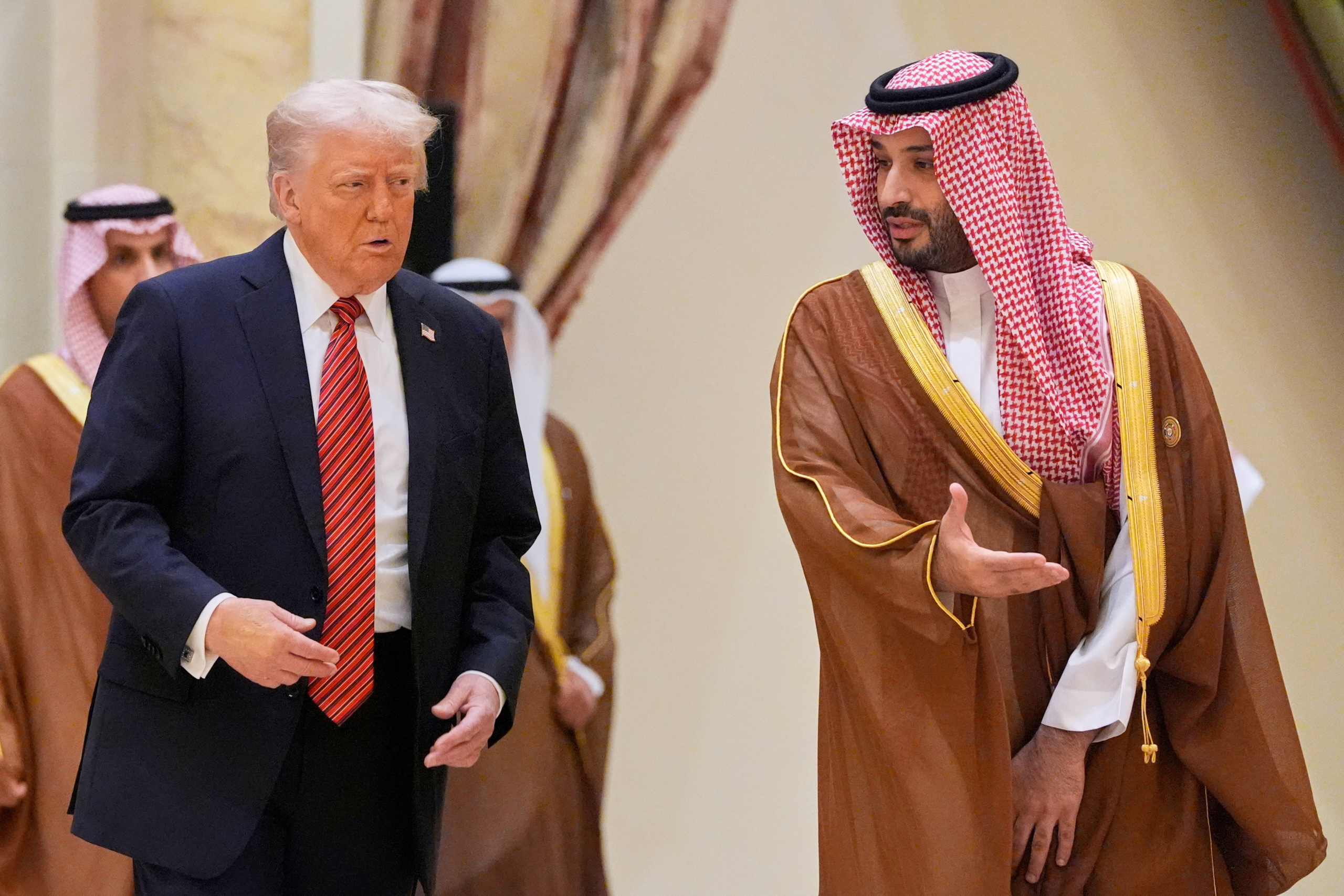
Saudi Crown Prince Mohammed bin Salman’s scheduled visit to Washington this month could be the inflection point. Saudi Arabia and the U.S. are reportedly finalizing a mutual-defense pact to accompany possible normalization with Israel. If concluded, this arrangement would be the largest realignment since the Abraham Accords.
Moreover, Saudi Arabia is continuing with a decadelong military transformation effort as part of the Kingdom’s Vision 2030. One of its major defense goals is to become a regional leader in military coalitions. To that end, it recently operationalized a new Joint Forces Command (modeled on the United Kingdom’s Joint Operational Command and a U.S. combatant command) and continues with comprehensive reorganizations of each Saudi military service using the “best practices” of many western militaries.
This convergence creates the perfect environment for launching a Gulf–Israel rapid-response initiative. A Saudi–U.S. pact would provide the anchor; normalization would supply the political glue. Together they could yield the first truly multilateral Arab-Israeli security instrument — one born of regional ownership and cooperation, not outside imposition.
Just as importantly, such a force would demonstrate that Washington’s new burden-sharing model can work in practice: regional allies assuming the lead, backed by American advisory and technological support.
A rough blueprint for action
First, embed the concept in the Saudi–U.S. defense framework. The agreement should include provisions for joint contingency planning and a pathway for participation by other Abraham Accords partners and regional allies — reflecting the Trump administration’s principle that sustainable security depends on capable partners, not permanent U.S. deployments. From our earlier work, we know the concept suffered from the perception of a lack of “U.S. skin in the game.” The framework should therefore also address this issue head on and note that the U.S. will provide capabilities consistent with U.S. foreign policy.
Second, begin transitioning the concept to reality in 2026. Under U.S. Central Command’s umbrella, conduct deliberate planning next year to develop the response force’s mission, lines of operation and a general organizational structure. Planning should focus initially on mutually agreeable activities like humanitarian assistance and disaster relief operations and, over time, expand into “gray zone” and higher intensity military tasks. U.S. advisers and trainers should facilitate these missions, consistent with the administration’s focus on enabling rather than substituting for regional capacity.
Third, institutionalize interoperability. Establish a long-range training plan and, over time, standardize communications and develop shared logistics networks to cohere the organization. With U.S. planning support, technical input and regional oversight, this would model the U.S. administration’s “partners-first” approach to defense cooperation. In our view, the key to avoiding abstractive delays is to begin with smaller units focused on a narrow set of agreeable missions and build interoperability over time with larger units oriented on a wider spectrum of activities.
Seizing the opportunity
The lull since the so-called Twelve-Day War last June gives us an opportunity to think more broadly about the Middle East’s security challenges — border security, drug trafficking, climate change, cyberattacks, Iranian proxies and terrorism. All of these transcend borders, and so too should the region’s responses. The meeting between Trump and the crown prince offers a rare moment when political, strategic and diplomatic incentives align.
If Riyadh, Washington, and Jerusalem act decisively, they can move the region from episodic coordination to a sustainable security architecture — one consistent with Trump’s emphasis on America’s allies doing more for themselves, while the U.S. remains the indispensable enabler.
A Middle East rapid-response force would not only deter aggression — it would symbolize a new era of partnership and self-reliance.
Sam Mundy is a retired Marine Corps lieutenant general who served as commander of the U.S. Marine Corps Forces Central Command from 2018 to 2021. He serves as an adviser to several companies and works as a consultant in the defense and security sector.
Devin Young is a retired Marine Corps colonel who served as the staff judge advocate and director of strategy and plans of the U.S. Marine Corps Forces Central Command from 2018 to 2021. He lives and works in the Middle East as a consultant.
