


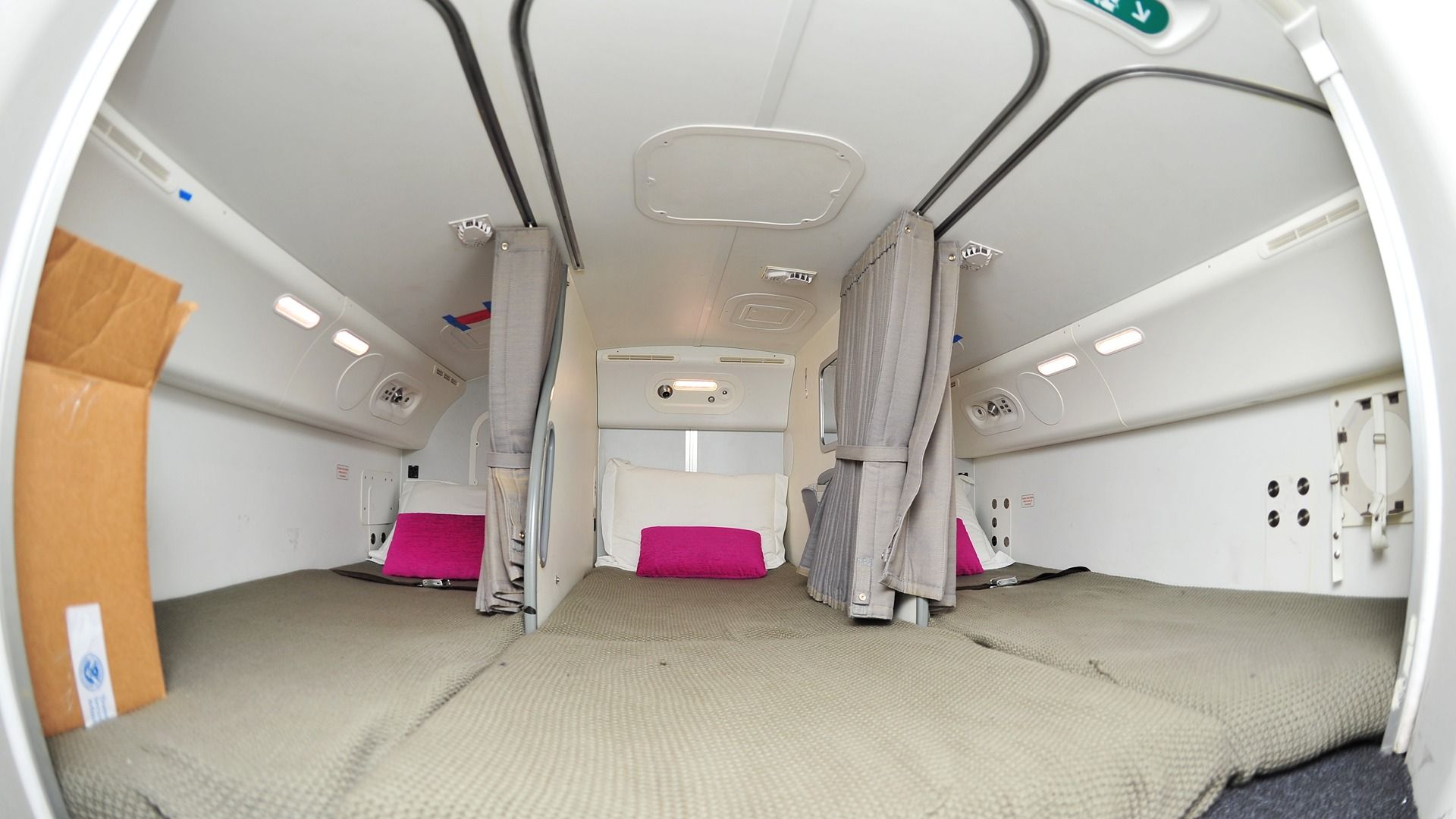
There are some areas on a widebody aircraft that are accessible only to the flight and cabin crews, where they can get some rest during a flight. Entry is prohibited to passengers, and you would barely know that they are there; they are so hidden away. Usually, these crew rest areas, or crew rest compartments as they are sometimes called, are behind a door that looks like a closet, but with steps leading to the rest area.
With longer flights now possible, it’s more important than ever that crew have rest during a flight and remain alert during their duty time. Crew rest areas are essential spaces discreetly hidden away; their locations vary, but they must be quiet, and for some, they are quite claustrophobic. Let’s find out more about dedicated crew rest areas on wide-bodied aircraft.
Which Aircraft Types Have Them?

Most aircraft have crew rest areas for cabin crew and the flight crew. They are separate compartments with bunk beds designed to take up little space but allow for an hour or two of rest inflight. These are often accessed through a discreet door and sometimes a passcode to make them safe and secure. There is either a small staircase or ladder-style steps leading up or down to the rest area.
The flight crew rest area usually consists of two bunks in a small room close to the cockpit, either just behind or just above. On the Airbus A350, it is above the forward galley. Sometimes there is a reclining seat and an inflight entertainment monitor. Their crew rest area is only used when three or more pilots are on duty. The cabin crew have a larger area with between six and twelve bunks (nine to twelve bunks on Airbus A380), depending on the aircraft type and the number of crew required. These are sometimes a side-by-side configuration, or an over-and-under configuration and each has a curtain for privacy.
The cabin crew rest area is often at the rear of the aircraft, above the aft (rear) galley and close to the tail, like the Boeing 747 and Boeing 777. On older aircraft, like the Airbus A330 and Airbus A340, the crew rest area for cabin crew is in the cargo hold. On the Boeing 767, the crew rest area is in the main cabin and is a curtained-off row of seats. Newer aircraft types like the Boeing 787 Dreamliner and the Airbus A350 have crew rest areas above the main cabin in the upper fuselage.
Why Is The Crew Rest Area Important?

Crew rest is very important for long-haul crew, as working days are often in excess of 12 hours without a break, unlike in regular jobs. A London-to-Singapore flight is around 14 hours, not including the 90 minutes before the flight or the time spent getting through the airport to downtown accommodation. The amount of crew rest depends on the flight time and is usually between one and a half hours and three hours, on average.
The Federal Aviation Administration (FAA) says that a crew rest compartment should be “in a location where intrusive noise, odors and vibration have a minimum effect on sleep.” They must be temperature-controlled and have adjustable lighting. Bunks should be 78 inches by 30 inches and have 35 cubic feet of space around them. There should also be a communal area for changing, entering, and exiting that is 65 cubic feet.
According to the FAA, there are three types of crew rest areas:
- Class one: A dedicated sleeping area with bunks or flat sleeping surfaces in the upper or lower fuselage accessed by a hidden door
- Class two: A lie-flat seat that is separated from other passengers by a curtain
- Class three: A reclining seat with foot support, that is curtained off
All crew are onboard for safety primarily, and on long-haul flights, it is important that all crew need to be alert and ready to deal with any emergencies. There are very strict rules for pilots and cabin crew regarding working hours. For example, cabin crew at Cathay Pacific should have a minimum of three hours off when the flight duty period exceeds 14 hours. The rules for pilots are much stricter, and for flights over eight hours, there must be designated crew rest areas to meet safety regulations. For longer flights, there will be one or two relief pilots.
What Is In A Crew Rest Area?

Crew rest areas are very basic, no-frills. The cabin crew bunks are more basic than the flight crew ones, but that is unsurprising for safety reasons. Each bunk has a padded mattress, a blanket, and a pillow. It has either an end or a side open for access, then closes with a heavy curtain that blocks sound and light. There is a personal light-and-airflow nozzle, and some have power outlets. A hook is provided for hanging up a uniform, and sometimes there is a small space to stow personal items.
Safety equipment is always essential. Each bunk has a seatbelt, which must be worn. There are oxygen masks in case of decompression. There is an intercom for maintaining contact with the cabin and the flight deck. Emergency lighting is present, as is the seatbelt sign, and there will also be a fire extinguisher. The crew rest area is closed and never in use during taxi, take-off, or landing for safety reasons.
Some experienced crew will often bring their own items with them to make the most of their crew rest time and be as comfortable as possible. This may include a travel-size pillow, a thin duvet, and a hot water bottle, as it is often cold. Some change into pajamas, others stay in uniform, but after their rest, they must be well perfectly presented once again, so they will carry their own amenity kit to freshen up.
How It All Works During A Flight

During a flight, the Senior Cabin Crew Member (SCCM or Purser) will split the crew into two shifts for their rest. The first shift goes to the crew rest area after the main meal service. Then after their shift, they swap with the remaining crew to go on their rest. It is ensured that there are enough cabin crew in the cabin to handle an emergency. The second shift is often preferred because it’s easier to sleep later in the flight.
Shifts and bunk position are often based on seniority and how long you have been with the airline. The SCCM usually has the bunk nearest the door and the intercom, so they can communicate quickly with the rest of the crew in an emergency. With the flight crew, there are always two crew members flying, and there may be three or four pilots onboard a long-haul flight. If there are only two, their bunks will never be used.
The doors to crew rest areas are hidden for security and privacy, and are often opened only with a passcode. Passengers are strictly prohibited from such areas. The crew rest areas are locked and cannot be used during taxi, take-off, and landing. On the  Emirates Airbus A380, the crew rest area is on the same deck as the economy cabin and Qantas’ A380 has bunks below the economy cabin.
The Downside Of Crew Rest Areas

Crew rest areas are often small and cramped and can be quite claustrophobic. They have no windows and can feel very closed in.
On a Boeing 747, where the bunks are close to the tail, it can be uncomfortable during turbulence, and the seatbelts on the bunks are critical to avoid injury. Some crew rest areas are under the main cabin, like the Airbus A330 and A340, and there is access through an escape hatch in the cabin floor in an emergency. They too can be uncomfortably cramped.
On the Boeing 767, for example, crew rest is not ideal, as it is the center-last row of seats in economy, with a curtain drawn around it. This is not the best, as crew cannot take rest lying down, it can also be noisy from the cabin and the galley, and crew do get disturbed by passengers too, even though it is curtained off. However, this does save airlines money as they don’t need a dedicated crew rest area.
Flying east is often more difficult than flying west, and jet lag can be a challenge for both flight and cabin crew. Sometimes, if they cannot sleep during their crew rest period, they try to rest, listen to music, or watch a movie. This is because the body’s internal clock adjusts better to a longer day than to a shorter one, and when you fly east, you lose hours, which can upset the body’s natural clock.
In A Nutshell

Crew rest areas are important for cabin and flight crews to ensure they have adequate rest during long flights. They are generally comfortable for just a few hours’ rest, but can also be claustrophobic. They are essential for safety, as they ensure all crew members remain alert in case of an emergency. These areas on most wide-bodied aircraft, apart from on the Boeing 767, are strictly kept private.
Airlines and manufacturers will find more ways in the future to design the crew rest areas. The Boeing 777-300ER has a crew rest area in the fuselage crown above the cabin, and, according to Boeing, this allows airlines to gain more passenger and cargo space, increasing potential customer revenue per flight. Removing the crew rest area from the main cabin area could add four to seven passenger seats or six LD cargo containers.
Crew rest areas are essential for safety and security and help the crew adjust to long working hours. As aircraft travel further than ever before and longer flights are introduced, it becomes all the more important to have comfortable crew rest areas. These areas were previously never seen by passengers and were always kept private, but now the public is becoming more aware of these hidden spaces in widebody jets.
