


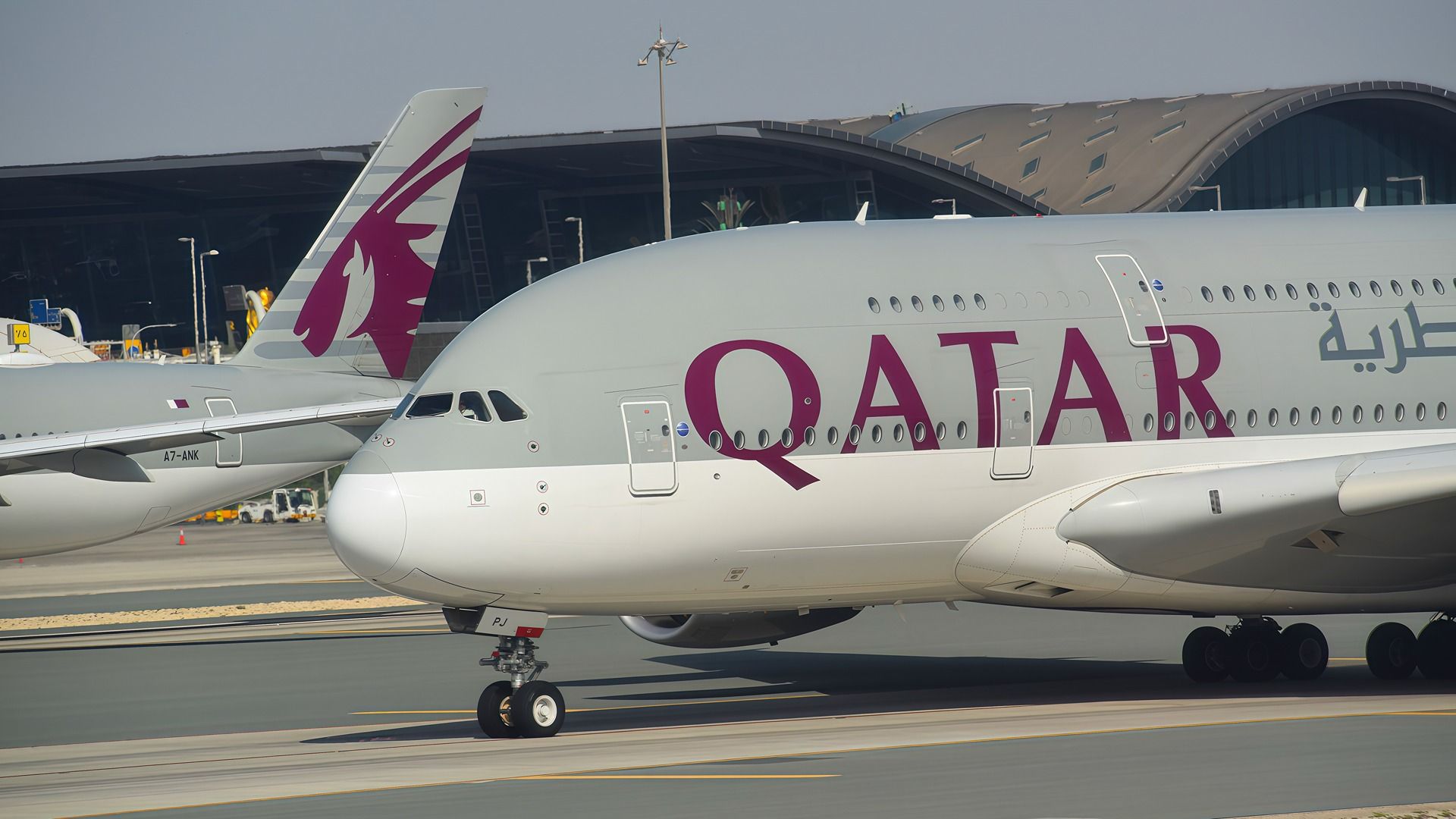
 Qatar Airways, the national flag carrier of Qatar, is a key player in the long-haul travel market. The airline operates a hub-and-spoke model, in which nonstop services to and from a principal hub at Doha Hamad International Airport (DOH) are coordinated to offer exceptional connections to destinations worldwide. To support this kind of long-haul network, the carrier has an incredibly diverse and capable long-haul fleet, which is anchored by multiple widebody models. Across the board, legacy airlines are capable of operating long-haul services on high-volume routes due to the capabilities of these dynamic models. The crown jewel of the Qatar Airways fleet is undeniably the Airbus A380.
An aircraft with two full-length passenger decks, the Airbus A380 offers best-in-class capacity across all the different cabins, including high-yielding premium cabins, where Qatar Airways generates its largest profits. Airbus A380 services are thus slotted onto the highest-capacity routes on which business travel is abundant. The airline, unlike some of its peers, has still kept several Airbus A380 models in service despite the once sky-high levels of demand for these kinds of jets slowly seeming to fade. We analyze the active role that the Airbus A380 continues to play in the Qatar Airways network.
A Brief Overview Of The Airbus A380

The Airbus A380 is the world’s largest passenger airliner, featuring a full-length double-deck configuration and four engines that allow it to move huge volumes on slot-constrained long-haul services. Originally launched in 2000, the aircraft first flew in 2005, and it entered service with  Singapore Airlines in 2007. Typical layouts for the model seat between 500 and 600 passengers, with an all-economy configuration accommodating up to 850. The aircraft’s range sits near 8,000 nautical miles, making it one of the longest-range aircraft to ever hit the market.
The airline was described by pilots as a joy to fly, using advanced fly-by-wire controls, advanced aerodynamics, and very large high-lift wings, with power coming from either Rolls-Royce Trent 900 or Engine Alliance GP7200 engines. Despite a quiet cabin and exceptional comfort, the aircraft’s sales lagged behind those of Boeing 787s or Airbus A350s, which each offered better operating economics for carriers on most routes.
Production of the Airbus A380 ended in 2021, with the final delivery of the aircraft being made to Emirates, the largest operator of the type. Other operators of the model included British Airways, Qantas, Qatar Airways, Lufthansa, ANA, Korean Air, Asiana, Etihad, and Singapore Airlines. Air France also retired its fleet. Post-pandemic traffic surges have brought many Airbus A380s back into service, especially on dense trunk routes where unit costs remain low if the airline is able to fill the model’s seats.
The Airbus A380 And Qatar Airways

Qatar Airways’ relationship with the Airbus A380 has been pragmatic. The airline introduced the aircraft type in 2014, and it ultimately operated a fleet of just ten aircraft. It used these models on slot-constrained trunk routes such as services from Doha Hamad International Airport (DOH) to London Heathrow (LHR), Bangkok (BKK), and Sydney (SYD). These jets quickly became money-printers for the airline, being effectively utilized to capture large amounts of premium demand that existed within the market, including a dedicated first-class cabin and an onboard lounge.
These aircraft never received the airline’s Qsuite, and they carried along higher trip costs than newer twin-engine models. CEO Akbar Al Baker repeatedly described the Airbus A380 as commercially suboptimal for the airline’s network, instead choosing to favor Airbus A350-1000 and Boeing 777 models. During the pandemic, Qatar Airways elected to ground its Airbus A380 subfleet.
Capacity shortfalls and Airbus A350 groundings prompted a limited reactivation of several airframes as demand began to rebound. Even in these situations, the airline framed this kind of revival as temporary, instead choosing to prioritize retirement as newer, more efficient widebody aircraft quickly joined the fleet. From a strategic perspective, the Airbus A380 served as a peak-demand and prestige tool as opposed to a long-term backbone for the fleet.
The aircraft became extremely valuable for bilateral slot constraints, but its high capacity misaligned its year-round economics, making it difficult to justify operating on higher-yielding routes. Qatar Airways placed no additional Airbus A380 orders, and the carrier has steadily reduced its reliance on the type, signaling its eventual phase-out as replacement capacity matures and airport access begins to improve.
How Does Qatar Airways Plan On Using Its Airbus A380 Fleet This Winter

The best way to get an understanding of how Qatar Airways uses its Airbus A380s is by taking a look at how the carrier will be deploying the models this upcoming winter season. According to data provided to Simple Flying by aviation industry database Cirium, Qatar Airways concentrates its Airbus A380s on a set of four thick, slot-constrained routes. Nonstop services from Doha Hamad International Airport (DOH) to Bangkok, London Heathrow, Sydney, and Paris are all operated using the flagship model.
These jets are currently rotated with around 392 flights between now and the end of January. This accounts for more than 200,000 seats in total. Roughly half of all Airbus A380 movements were made on this sector between Doha and Bangkok, with roughly half of the flights operated being this connection.
|
Cabin: |
Qatar Airways Airbus A380 Seats: |
|---|---|
|
First Class |
8 |
|
Business Class |
48 |
|
Economy |
461 |
Roughly 320 of these are flights from London Heathrow, and 200 are flights to Paris, anchoring premium route traffic throughout Europe. First class and an onboard premium lounge help differentiate the type from other models, allowing it to most effectively serve premium-oriented routes. The carrier’s longest connection, to Sydney, is ideal for when the airline is seeking to deploy high-gauge services.
Capacity And Overall Seat Economics

While Bangkok sits at the top of the overall flights category, ASMs undoubtedly tell a different story. Bangkok accounts for around 40% of overall Airbus A380 ASMs, with Sydney sitting at roughly 30%, followed by London and Paris at 17% and 10%, respectively. This totals an average of 3.22 billion available seat miles, with average stage lengths sitting at around 3,900 miles.
Despite seeing lower-frequency Airbus A380 service, Sydney remains a major portion of the operating economic picture for the Qatar Airways Airbus A380 this upcoming winter. The airline’s consistent 517-seat layout allows it to generate large amounts of seat miles on this single ultra-long-haul service, with cargo belly capacity augmenting the aircraft’s ability to turn a tidy profit on these services.
This high gauge allows the carrier to offer a diverse array of services, with some fares in economy offering relatively little in terms of benefits, while others in business class offer lavish perks. Across the board, the aircraft is used as a tool of precision, and it is only deployed when the airline has identified a market that it can cleanly and effectively target.
Why Isn’t The Aircraft Deployed On More Routes

The Airbus A380 is only effectively deployed when demand, yields, and infrastructural obligations line up. Qatar Airways currently has roughly 10 airframes, so spreading these aircraft across even more routes strains the airline’s limited maintenance and crew capacity. Focusing on just four routes improves overall aircraft reliability.
Structural barriers also limit the jet’s ability to service more airports, with the majority of facilities currently lacking Airbus A380-ready gates, taxiways, or overall towing capacity. The jet’s long turns complicate overall hub banks, with the A380’s trip costs currently sitting rather high. Ultimately, routes must sustain more than 500 seats of year-round demand without fare dilution.
Beyond this select handful of routes, smaller twin-engine models, including the Boeing 787 and the Boeing 777, offer improved operating and financial performance. The Airbus A380’s hefty premium mix comes along with some high risks, with first class and larger galleys only paying in true long-haul trunk markets.
What Is Our Key Takeaway From This Analysis?

At the end of the day, the Airbus A380 is an exceptional aircraft, one that is capable of offering impressive performance if airlines can consistently fill its cabins. This, however, has proven a bit easier said than done over time. The aircraft’s high gauge comes along with high risk, and the plane’s operating costs can be truly extraordinary.
Nonetheless, the aircraft can be an exceptional asset. Its premium risk significantly magnifies the potential upside of operating any service, while also being a major risk in environments where demand underperforms expectations. Few operators are as capable as Qatar Airways at carefully identifying the optimal routes for this jet. This provides investors with continued confidence that the carrier will continue using the Airbus A380 as a core element of its global long-haul fleet for decades to come.
Whether Qatar Airways will deploy the model on routes to new destinations seems mostly unanswered. All that can be said is that, if the carrier does deploy the jet to additional airports, it will only do so for routes with exceptional amounts of proven demand.
