


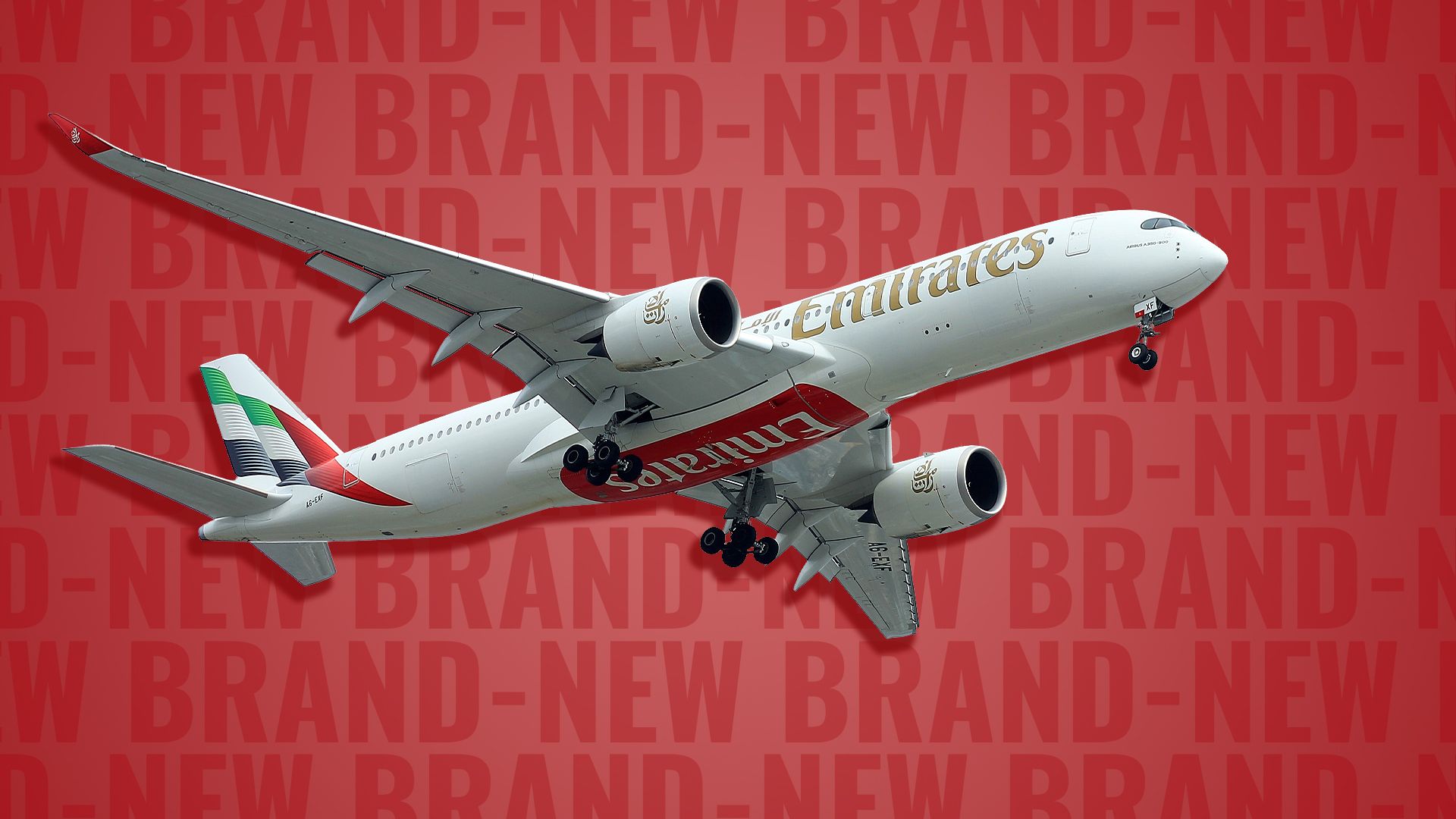
 Emirates is taking delivery of new Airbus A350-900s. The A350 is one of only three aircraft types operated by the famed Gulf carrier (along with the Airbus A380 and Boeing 777), but while the A350-900 is an enormous airliner, it’s one of the smallest aircraft variants operated by Emirates (only slightly larger than its Boeing 777-200LRs). These planes are being used for growth, and they represent a new era for Emirates in terms of its fuel efficiency, capabilities, and passenger experience.
The Airbus A350-900 is a machine designed for long-haul and ultra-long-haul flying. Not only can it fly farther than a Boeing 787-9, but it can also carry more payload across a longer distance. But while the A350 is renowned for its lifting capabilities across long distances, Emirates is using the planes for a different purpose from its hub in Dubai. Using data from Cirium, an aviation data analytics company, these are the routes that Emirates deployed its Airbus A350-900s on in October 2025.
Overview Of Emirates’ Airbus A350-900 Fleet

Right now, Emirates is flying 13 Airbus A350-900s, and has 52 remaining on order, meaning that its fleet will tally up to 65 aircraft when deliveries are finished. Currently, all A350-900s are in a three-class configuration (business, premium economy, and economy) with a total of 312 seats, although Emirates is planning a less dense configuration with an extra row of premium economy and more galley space for ultra-long-haul flights that will have a total of 298 seats.
Emirates has gone back and forth on its Airbus A350 order. In 2007, it ordered 50 A350-900s and 20 A350-1000s, but this order was canceled in 2014, the same year that Emirates ordered 150 Boeing 777Xs. In 2019, Emirates and Airbus reached an agreement that would see the carrier’s remaining orders for 39 Airbus A380s be converted to 40 Airbus A330-900s and 30 Airbus A350-900s. Later the same year, the A330-900s were dropped while the A350 order book was bumped to 50 units, and then 15 more were ordered in 2023.
Currently, Emirates only has the Airbus A350-900 on order. Sizewise, these aircraft are larger than its Boeing 777-200LR fleet but are smaller than the rest of Emirates’ fleet. Additionally, Emirates has orders for 20 smaller Boeing 787-8s and 15 larger Boeing 787-10s. As a whole, the Emirates fleet is about to become more diverse in terms of aircraft variety and capacity options. The 777-200LR fleet only numbers 10 aircraft, while it flies well over 100 777-300ERs and A380s. Note, however, that Emirates has multiple layouts on both aircraft.
Regional And African Routes

While the A350 is the long-haul champion of today, many of Emirates’ routes with this aircraft are within the Middle East. This includes by far its busiest A350 route, from Dubai to Bahrain, which saw 76 total flights each way in October, meaning that this route, on average, saw the A350 between two and three times a day. This route spans a distance of 263 NM (488 km), which makes it one of the world’s shortest Airbus A350 routes.
Emirates’ second-busiest route with the Airbus A350 in October was from Dubai to Kuwait City, which saw 37 flights each way. In addition, Emirates operated daily A350 services to Muscat (which is now twice daily on the A350) and Dammam, while it flew 22 flights to Amman, along with 11 flights to Baghdad. Emirates operates multiple daily nonstop routes on some of these routes, and is typically swapping a Boeing 777 in for the A350. As such, these flights represent relatively minor tweaks in capacity in most cases.
|
Origin |
Destination |
Aircraft |
|---|---|---|
|
Dubai |
Amman |
Airbus A350-900 Airbus A380-800 |
|
Dubai |
Baghdad |
Airbus A350-900 |
|
Dubai |
Bahrain |
Airbus A350-900 Airbus A350-900 |
|
Dubai |
Dammam |
Airbus A350-900 Boeing 777-300ER Boeing 777-300ER |
|
Dubai |
Kuwait City |
Airbus A350-900 Airbus A350-900 Boeing 777-300ER |
|
Dubai |
Muscat |
Airbus A350-900 Airbus A350-900 |
|
Dubai |
Tunis |
Airbus A350-900 |
While Emirates has an extensive network to and from Africa, the Airbus A350 only operated one of these routes in October. This was the route from Dubai to Tunis, which operates six days out of the week with the Airbus A350-900. While this isn’t a regional route, it’s still far shorter than what the Airbus A350-900 is capable of, at 2,404 NM (4,452 km). More so than a capacity adjustment, this change demonstrates an adjustment in premium capacity, as Emirates previously flew the Boeing 777-300ER on this route with eight first class seats, whereas the A350s do not feature first class.
The Asian Routes With The Airbus A350

Emirates is deploying the Airbus A350-900 on three of its routes to South Asia. In India, Emirates is sending the aircraft to two cities, including its busiest Asian A350 route, from Dubai to Ahmedabad, with 35 monthly flights. It also sends the A350 daily to Mumbai, a route which sees three daily Boeing 777-300ERs and a daily Airbus A380. In addition, Emirates deploys the Airbus A350 daily to Colombo, a route that typically also sees two daily Boeing 777-300ERs.
Out of Emirates’ five routes to China, the Airbus A350-900 is deployed on only one. This is the daily route from Dubai to Hangzhou Xiaoshan International Airport. Hangzhou is Emirates’ most recent destination in China, having launched in July 2025, and the service was initially operated by the Boeing 777-300ER before being changed to the A350 at the end of October. Additionally, Emirates deploys the A350 on one of its two daily flights to Ho Chi Minh City, while the Boeing 777-300ER operates the second.
|
Origin |
Destination |
Aircraft |
|---|---|---|
|
Dubai |
Ahmedabad |
Airbus A350-900 Airbus A350-900 |
|
Dubai |
Colombo |
Airbus A350-900 Boeing 777-300ER Boeing 777-300ER |
|
Dubai |
Hangzhou |
Airbus A350-900 |
|
Dubai |
Ho Chi Minh City |
Airbus A350-900 Boeing 777-300ER |
|
Dubai |
Mumbai |
Airbus A350-900 Airbus A380-800 Boeing 777-300ER Boeing 777-300ER Boeing 777-30ER |
What we see here is that, apart from Mumbai, Emirates is primarily deploying the A350 to smaller cities in Asia. In actuality, the dip in capacity from the Boeing 777-300ER is relatively small, but the A350 has fewer business class seats and no first class seats. The economy cabins on the current A350s are almost identical in size to those on the 777-300ERs equipped with premium economy, but notably, all Airbus A350s feature premium economy, while the 777-300ER fleet is in the process of being retrofitted.
Flying The Airbus A350-900 To Europe

Emirates flies to four destinations in Italy (Rome, Milan, Venice, and Bologna), and it sends the Airbus A350 to Bologna every day. This route has operated with the Boeing 777-300ER for over a decade, and the arrival of the Airbus A350-900 again shows that Emirates is looking to trim premium capacity while bringing premium economy to more markets. The A350 flight is the only flight that Emirates operates between Dubai and Bologna.
The same is true for its routes to Edinburgh, Lyon, and Oslo. All of these operate only once daily, and were former Boeing 777-300ER routes that are now flown exclusively by the Airbus A350. However, its fifth European destination served by the Airbus A350,  Istanbul Airport, sees three daily flights, with the other two operated by the Boeing 777-300ER and the Airbus A380.
|
Origin |
Destination |
Aircraft |
|---|---|---|
|
Dubai |
Bologna |
Airbus A350-900 |
|
Dubai |
Edinburgh |
Airbus A350-900 |
|
Dubai |
Istanbul |
Airbus A350-900 Airbus A380-800 Boeing 777-300ER |
|
Dubai |
Lyon |
Airbus A350-900 |
|
Dubai |
Oslo |
Airbus A350-900 |
Overall, what we’re seeing is that Emirates is primarily looking to add premium economy capacity while cutting back on business and first class capacity to smaller destinations. On many of its A350 routes that feature another aircraft type, the A350 flight is the only one that offers premium economy. Additionally, while the A350s do fly to some major outstations, like Mumbai, the planes are primarily flying to cities where Emirates may only have one or two daily flights.
What To Expect Onboard The Emirates Airbus A350

While Emirates is famous for the excellent seats onboard its Airbus A380s, the carrier has long offered a seven-abreast business class product on its Boeing 777s. The Airbus A350s, however, come with an updated variant of the Safran SkyLounge seat found on its A380s, which feature direct aisle access along with updated finishes. These seats are also being retrofitted onto the airline’s 777-300ER fleet, and an updated version is expected with the Boeing 777X.
The A350s are being delivered with premium economy, and as such, this is the only type in Emirates’ fleet to feature this cabin on all aircraft. These planes feature the same Recaro PL3530 seats as on retrofitted Airbus A380s and Boeing 777s, and the cabin features an excellent 40 inches (101.6 centimeters) of legroom, as per aeroLOPA. Rather uniquely, the premium economy seats are configured seven-abreast, whereas most Airbus A350 operators install eight-abreast in premium economy.
Emirates installs the Safran Z400 for economy in a standard nine-abreast layout, with 32 inches (81.28 centimeters) of legroom, a 13.3-inch (33.78 centimeter) pivoting screen, and a six-way adjustable headrest. In total, the A350 features 32 business class seats, and the current layout includes 21 premium economy seats and 259 economy seats. The upcoming “359U” subfleet will still feature 32 business class seats, but will come with 28 premium economy seats and only 238 economy seats.
Rundown Of The Emirates A350

The Airbus A350 is the latest and greatest aircraft in the Emirates fleet. While it doesn’t include a lounge or a first class cabin, the seats that it does come with are the best that the carrier has to offer, and of course, the A350 comes with lower noise levels and a lower cabin altitude than the Boeing 777s that it’s displacing.
Network-wise, Emirates is primarily using the A350-900 on existing routes to secondary destinations that may not be able to support the level of premium capacity that its Boeing 777-300ERs offer. In addition, the A350s are also being used to expand Emirates’ network of premium economy routes.
