


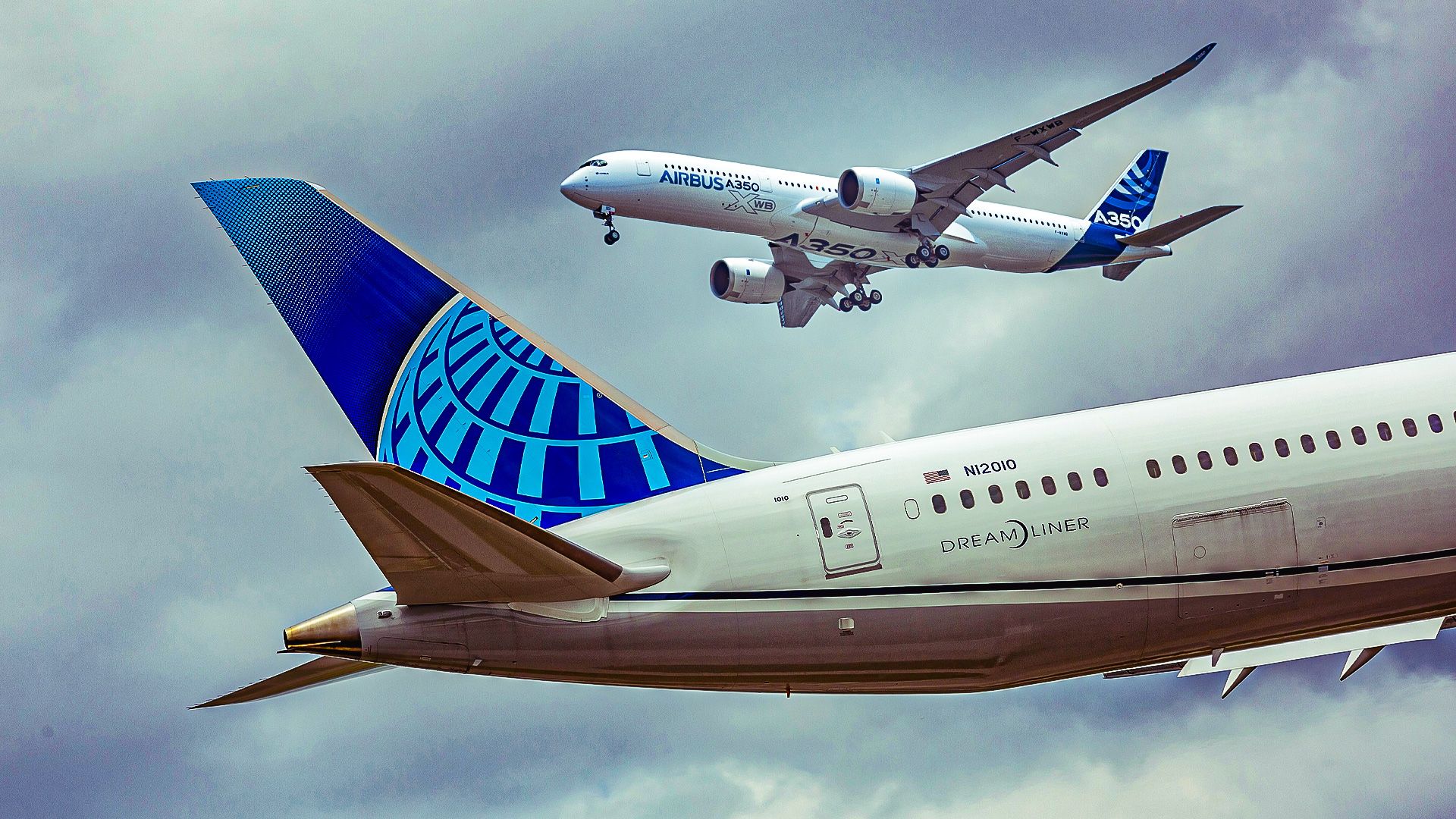
 United Airlines currently operates one of the largest commercial widebody fleets in the world, made up entirely of Boeing aircraft. However, the
  Star Alliance carrier also has a long history with Airbus’ flagship widebody aircraft – the A350. United Airlines first ordered the Airbus A350 back in 2009, but even now, some 16 years later, the aircraft is yet to join the carrier’s fleet.
In this article, we will take a look at United Airlines’ history with the Airbus A350 and consider how the aircraft may fit into the carrier’s wider fleet plans. We will also consider the aircraft and its legacy on the commercial aviation industry throughout its relatively short operational history so far.
Orders Dating Back To 2009

United placed its original order for the Airbus A350 back in 2009, ordering 25 of the aircraft’s first and smaller variant – the A350-900. Then in 2013, the carrier increased this order to 35 aircraft and converted them all to the larger A350-1000. However, just four years later, United Airlines once again reverted back to the A350-900, increasing the total number on order to 45. And that is how it has remained ever since.
The Airbus A350 was originally due to join United’s fleet in 2022, but this timeline has repeatedly been pushed back, with the latest estimates now suggesting that the aircraft will not join the carrier’s fleet until at least 2030, if at all. United Airlines is expected to make a decision soon regarding the replacement of its aging Boeing 777-200 fleet. With a substantial number of 787-9s already on order, and the A350-900 also in consideration, both aircraft stand out as strong contenders for the role.
There is also, of course, the possibility that United Airlines may once again choose to modify its existing Airbus A350 order. This could involve increasing the total number of aircraft on order or adjusting the mix of variants to better suit its long-term fleet strategy. For instance, the airline might decide to switch some or all of its current A350-900 orders to the larger A350-1000, which offers greater capacity and range. Such a move would align with evolving network demands, particularly on high-density international routes.
United Airlines & The Boeing 777-200

Given that if United Airlines decides to proceed with its order for 45 Airbus A350s, the aircraft are likely to replace the carrier’s Boeing 777-200s, let’s take a closer look at this aging widebody and its role in United Airlines’ fleet.
The latest data from ch-aviation shows that United currently has a total of 19 777-200s in its fleet, each of which is able to accommodate up to a maximum of 364 passengers in a two-class configuration – 28 in business class and 336 in economy class (including 102 extra legroom seats). The Star Alliance carrier was the launch customer for the aircraft back in June 1995 and has since gone on to become the world’s largest operator of the type. The first revenue flight to be operated by the type was from the carrier’s hub at Washington Dulles International Airport (IAD) to  London Heathrow Airport (LHR).
The Boeing 777-200 quickly became a key player in United’s long-haul fleet, praised for its range, reliability, and passenger comfort. The carrier initially deployed the 777-200 on transatlantic and transpacific routes, and later expanded its use to high-demand domestic and Latin American markets. Over the years, United Airlines has operated a fleet of over 50 777-200s, including both Pratt & Whitney- and General Electric-powered variants, and some of these aircraft were later retrofitted with updated interiors, extending their operational life. However, in recent years, the aging fleet has faced increasing maintenance costs and efficiency limitations compared to newer widebody models.
Following an uncontained engine failure on a Boeing 777-200 powered by Pratt & Whitney PW4000 engines in 2021, United Airlines temporarily grounded a portion of its fleet. While many of those aircraft have since returned to service, the aircraft’s time with the carrier is inevitably coming to an end.
The Airbus A350 – An Anomaly In United Airlines’ Widebody Fleet

United Airlines has, historically, relied heavily on Boeing for its widebody aircraft. Even today, the entirety of the carrier’s widebody fleet is built by Boeing, with more still to come, as shown in the table below:
|
Aircraft |
Number In Fleet |
Number On Order |
|---|---|---|
|
Boeing 767-300ER |
37 |
– |
|
Boeing 767-400ER |
16 |
– |
|
Boeing 777-200 |
19 |
– |
|
Boeing 777-200ER |
53 |
– |
|
Boeing 777-300ER |
22 |
– |
|
Boeing 787-8 |
12 |
– |
|
Boeing 787-9 |
46 |
142 |
|
Boeing 787-10 |
21 |
– |
|
Total |
226 |
142 |
With such a reliance on  Boeing aircraft, United’s order for the Airbus A350 always stood out as a bit of an anomaly. After all, it makes sense both operationally and financially for an airline to standardize its fleet – helping to simplify and reduce training and maintenance needs.
It is therefore difficult to see how the Airbus A350 would fit into the carrier’s fleet plans, which has led many to wonder whether or not United Airlines will actually take delivery of its A350s after all. That said, with the upcoming retirement of United Airlines’ aging Boeing 757s and 767s, the carrier’s pilots will need retraining at some point – could that be the ideal time to introduce the Airbus A350?
About The Airbus A350

The Airbus A350 is a state-of-the-art, long-range, wide-body aircraft developed by Airbus to compete with Boeing’s 787 and 777 aircraft. Launched in 2006 and entering service in 2015 with  Qatar Airways, the A350 has become one of the most advanced and efficient commercial jets in operation today. It was designed with fuel efficiency, passenger comfort, and operational flexibility in mind, making it ideal for medium to ultra-long-haul routes.
The Airbus A350 family of aircraft consists primarily of two passenger variants – the A350-900 and the A350-1000. The A350-900 typically seats between 300 and 350 passengers and has a range of around 9,600 miles, while the larger A350-1000 can accommodate up to 410 passengers in a typical three-class layout and has a range of approximately 9,200 miles. Airbus is also developing a dedicated cargo version, the A350F, to compete in the long-haul freighter market.
Over 50% of the Airbus A350’s fuselage is made from carbon-fiber-reinforced polymer, which reduces weight while increasing strength and resistance to corrosion. Together with the latest Rolls-Royce Trent XWB engines, the A350 is about 25% more fuel-efficient than the older widebodies it replaces. This efficiency has made the A350 a key element of many airlines’ efforts to reduce carbon emissions and operating costs.
The World’s Largest Operators Of The Airbus A350

 Singapore Airlines is currently the world’s largest operator of the Airbus A350, with a total of 65 in its fleet – 58 A350-900s and seven A350-900ULRs, followed by Qatar Airways with 58. The largest North American operator of the aircraft (and, in fact, the type’s North American operator) is
  Delta Air Lines, with 37 in its fleet. If United Airlines were to take delivery of its outstanding A350s, it would surpass its rival in fleet size. The largest operators of the A350 are listed in the table below:
|
Ranking |
Airline |
Airbus A350-900 |
Airbus A350-900ULR |
Airbus A350-1000 |
Total |
|---|---|---|---|---|---|
|
1 |
Singapore Airlines |
58 |
7 |
– |
65 |
|
2 |
Qatar Airways |
34 |
– |
24 |
58 |
|
3 |
Cathay Pacific |
30 |
– |
18 |
48 |
|
4 |
Air France |
38 |
– |
– |
38 |
|
5 |
Delta Air Lines |
37 |
– |
– |
37 |
|
6 |
Air China |
30 |
– |
– |
30 |
|
7 |
Lufthansa |
30 |
– |
– |
30 |
|
8 |
Japan Airlines |
15 |
– |
10 |
25 |
|
9 |
Turkish Airlines |
25 |
– |
– |
25 |
|
10 |
Thai Airways |
23 |
– |
– |
23 |
An Impeccable Safety Record

One thing is certain – the Airbus A350 has an impeccable safety record, and its impressive operational history is likely to be appealing to United Airlines. The A350 has proven itself as an extremely reliable aircraft, having suffered no fatal accidents and only one hull loss in its ten-year operating history.
This hull loss occurred on January 2, 2024, when a Japan Airlines Airbus A350-900, operating Flight 516 from Sapporo New Chitose Airport (CTS) to  Tokyo Haneda Airport (HND), was involved in a runway collision upon landing. As the aircraft touched down, it struck a Japan Coast Guard De Havilland Dash 8 that had entered the runway.
The Airbus A350 subsequently burst into flames, but all 367 passengers and 12 crew members on board were safely evacuated in what has been praised as an incredibly effective emergency response. Despite the intense fire that engulfed the aircraft, there were no fatalities among those onboard the A350, although several people sustained minor injuries. Tragically, five of the six crew members aboard the Coast Guard aircraft were killed. The only survivor, the captain, was seriously injured.
It is still unclear whether United Airlines will ultimately take delivery of the 45 Airbus A350-900s currently on order. However, with a decision expected imminently on which aircraft will replace the carrier’s Boeing 777-200s, we will likely know more soon, so stay tuned for updates.
