



The destruction of a U.S. Air Force E-3G Sentry AWACS in Saudi Arabia has reignited debate about the procurement of the E-7A Wedgetail.
The loss of a U.S. Air Force E-3G Sentry AWACS (Airborne Warning and Control System) following the drone and missile attack at Prince Sultan Air Base, Saudi Arabia, on Mar. 27, 2026, has reignited debate about the aging fleet, putting the spotlight on its replacement. As it has often been reported, the E-3 fleet continues to age and is becoming increasingly difficult to sustain and operate, while the E-7A Wedgetail is still far from being fielded.
In fact, the Wedgetail has encountered lots of skepticism from the Air Force and the Pentagon. Secretary of Defense Pete Hegseth called the E-7 “expensive and ‘gold plated,’” cancelling the program in favor of a gap-filler based on the E-2D Hawkeye while setting up a space-based capability.
This plan was met by critics, including by 16 retired senior Air Force offices, and was later pushed back by the Congress with the National Defense Authorization Act (NDAA). Meanwhile, work is continuing on the two prototypes, with the first airframe arrived this month in the UK for the conversion.
Second angle. pic.twitter.com/NUupdRkdm9
— OSINTtechnical (@Osinttechnical) March 29, 2026
The E-7A Rapid Prototype Beginnings
The Department of the Air Force first selected the E-7 Wedgetail as the replacement for the E-3 Sentry in 2022. A year later, in March 2023, the Department awarded a not-to-exceed $1.2 billion contract to Boeing to start development activities for the E-7A Rapid Prototype program.
The goal was to use this rapid prototyping acquisition pathway to procure the first two aircraft. “The E-7A will be the department’s principal airborne sensor for detecting, identifying, tracking, and reporting all airborne activity to Joint Force commanders,” said Andrew Hunter, then assistant secretary of the Air Force for Acquisition, Technology and Logistics.
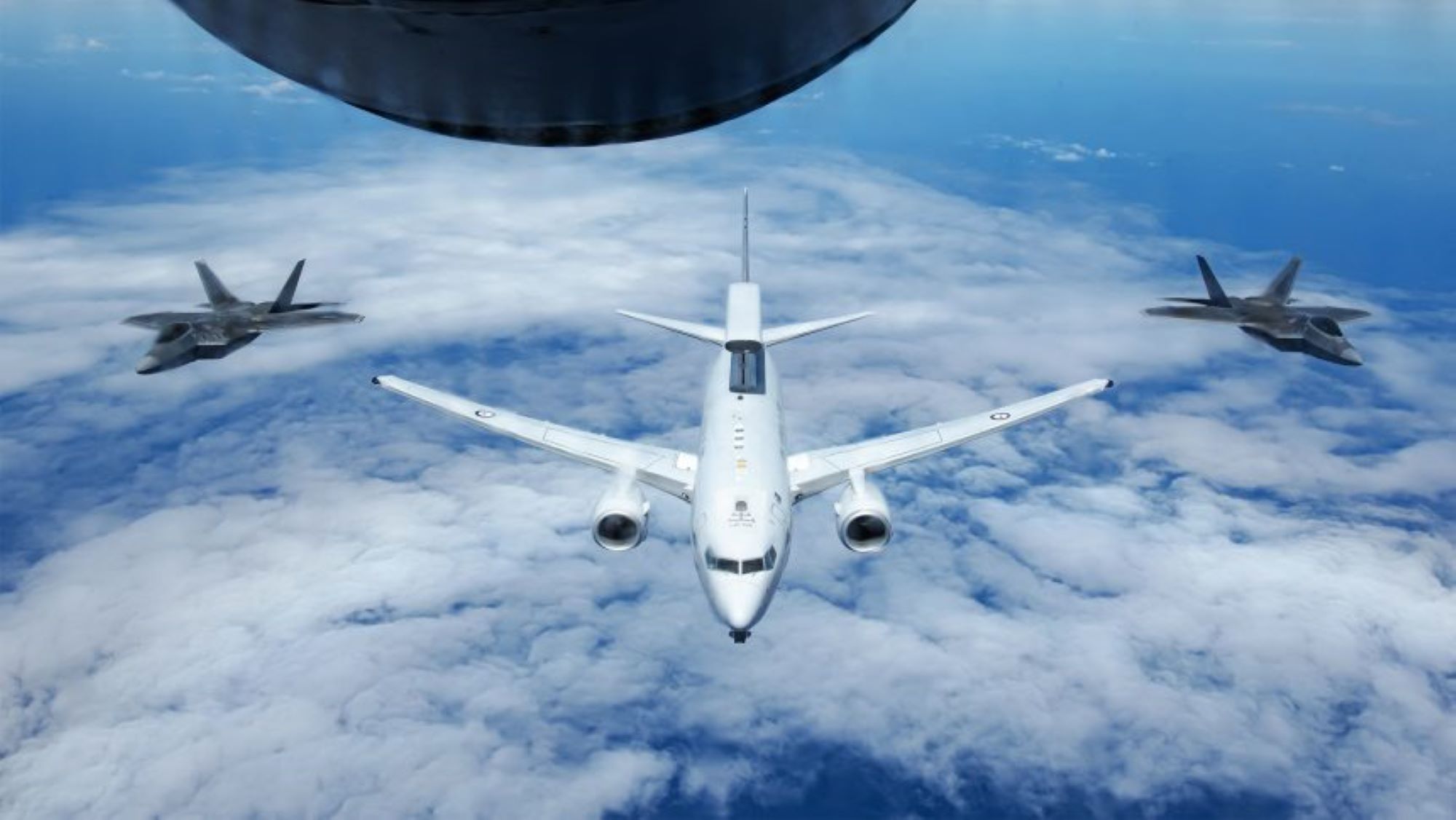
At the time, the development work was expected to be complete by August 2024, with plans to begin production in Fiscal Year 2025 and field the first E-7A by FY2027. The projected aircraft inventory was set to 26 aircraft, to be procured by FY2032.
In August 2024, the U.S. Air Force awarded Boeing a $2.56 billion contract for the production of two rapid prototype E-7A Wedgetail AEW&C (Airborne Early Warning & Control) aircraft, continuing the effort launched a year earlier. Price and negotiations were influenced by the number of modifications requested by the Air Force, which required more engineering work than anticipated.
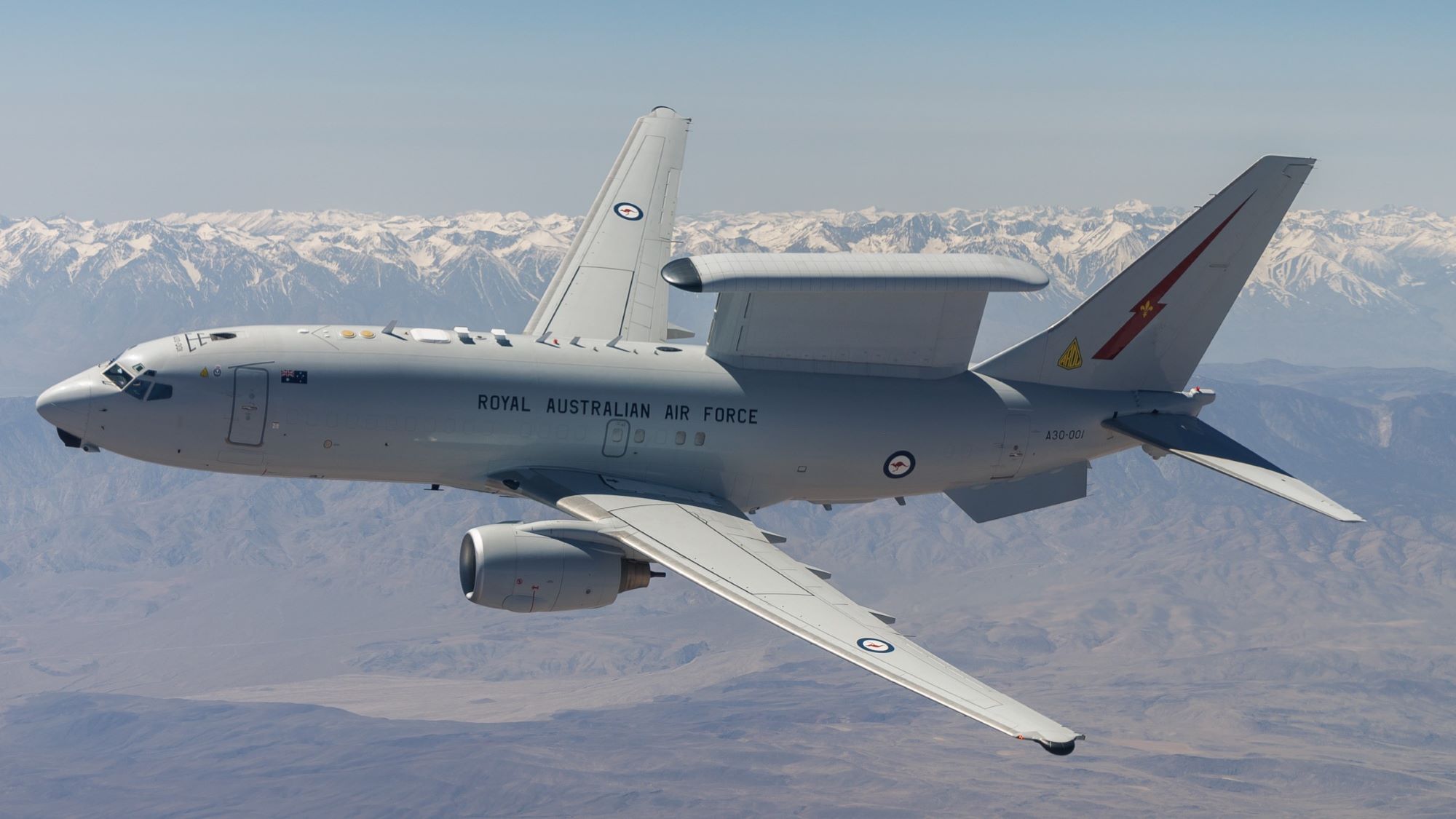
At the time, it was also reported that the service evaluated the possibility of procuring a modified variant of the Wedgetail already in service with the Royal Australian Air Force (RAAF), the type’s first operator. In the Rapid Prototype contract, Boeing later said that two variants of the E-7 would be developed.
Production Begins
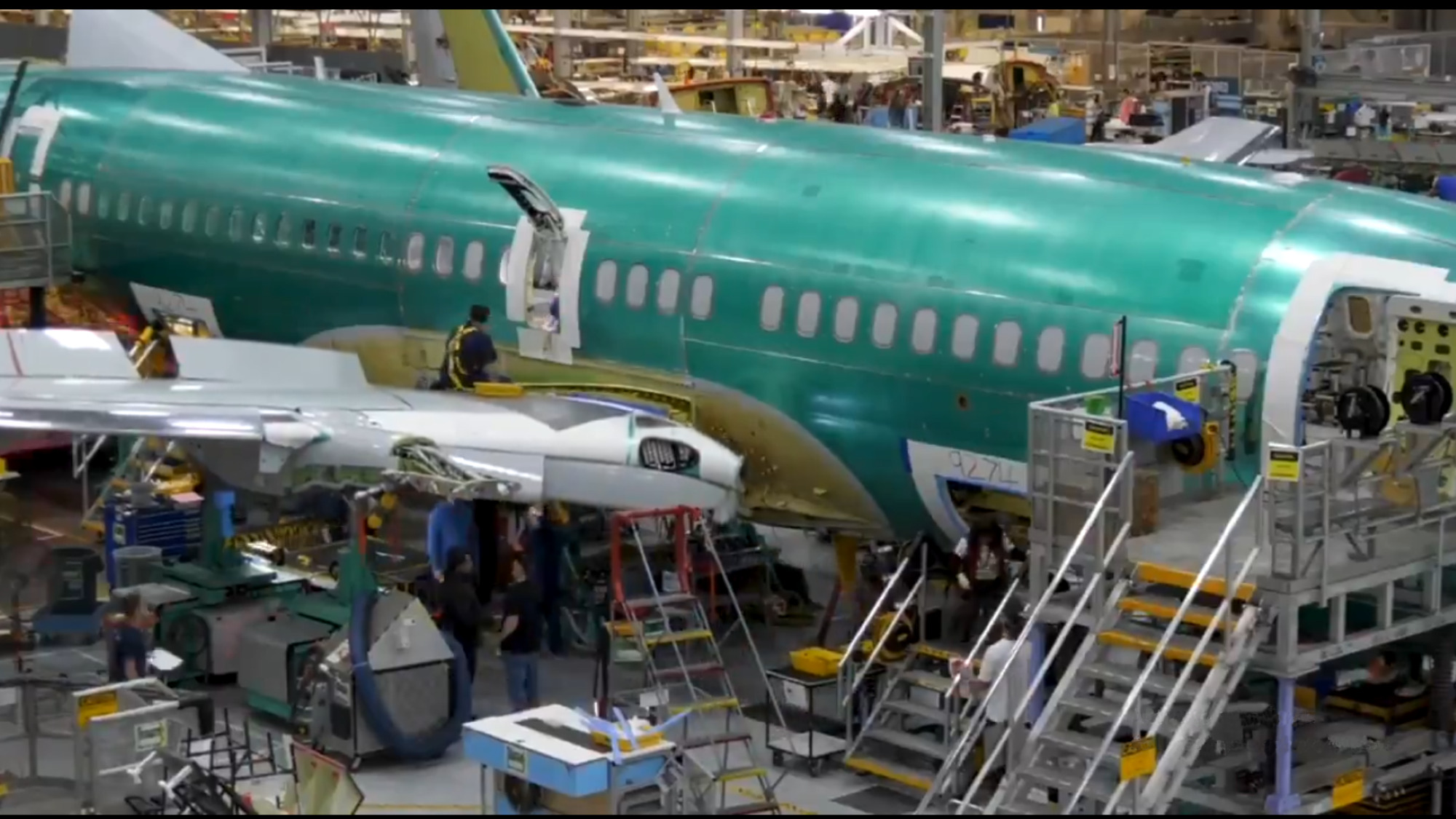
In January 2025, Boeing announced that the fuselage of the U.S. Air Force’s first E-7A was delivered to Boeing’s factory in Renton, Washington. As previously reported, the E-7’s production would use a Boeing 737-700 NG airframe as base, which would be modified to include the specialized equipment.
In April 2025, three months later, Boeing provided an update on the production’s progress with a video showing the fuselage being mated with the wings. Nose, tail cone, stabilizer’s root and other components were also installed, with Boeing saying the tails vertical and horizontal stabilizers were next.
Meanwhile, the Air Force was already eyeing potential upgrades for the platform, which in its original form was a 20 years old design. Along with updates to the platform’s electronic warfare, communications, and datalinking capabilities, the service was also investigating the integration of an infrared sensor and a replacement for the Northrop Grumman Multi-role Electronically Scanned Array (MESA) radar.
A Request for Information (RFI) about the possible upgrades mentioned that an Engineering and Manufacturing Development (EMD) contract was expected to follow in FY2027. Among the options being considered by the service were the retrofit of the new technologies onto existing E-7 airframes, integration of them only onto newbuild airframes, or a combination of these two options.
First Threats
In May 2025, the first reports emerged about the U.S. Department of Defense favoring a shift from aircraft to satellites for the replacement of the AWACS platform. With the U.S. Space Force planning to field satellite-based ground moving target indicator (GMTI) systems in the 2030s, the Department was also investigating the possibility of integrating airborne moving target indicator (AMTI) radar capabilities.
Immediately, critics argued that having operators interpreting data in real time on an aircraft such as the E-3 and the E-7 is unique and currently irreplaceable capability for command and control. The U.S. Air Force’s then Chief of Staff David Allvin similarly said that, although satellite capabilities are likely to be the solution in the future, they are not mature enough to rely on for current requirements.
During a House Appropriations Committee hearing in July 2025, Secretary Hegseth drew further doubts about the program’s future. He pointed to the lessons from the war in Ukraine as the reason, adding that the E-2D Hawkeye was being considered as stop-gap measure.
“If we have systems and platforms that are ‘not survivable in the modern battlefield’, or they don’t give us an advantage in a future fight, we have to make the tough decisions right now,” Hegseth said. “The E-7 is an example of that.”
Meanwhile, a group of retired senior USAF officers, including former Chiefs of Staff of the U.S. Air Force and NATO Supreme Allied Commanders, argued in a letter that the decision to cut the E-7 would “severely and unnecessarily undermine our service members’ ability to deter, and if necessary, prevail in future conflicts.” They further said the proposed E-2D Hawkeye-based gap-filler is unable to properly fulfill the requirements of theater-wide command and control.
Conversion Moved to the UK
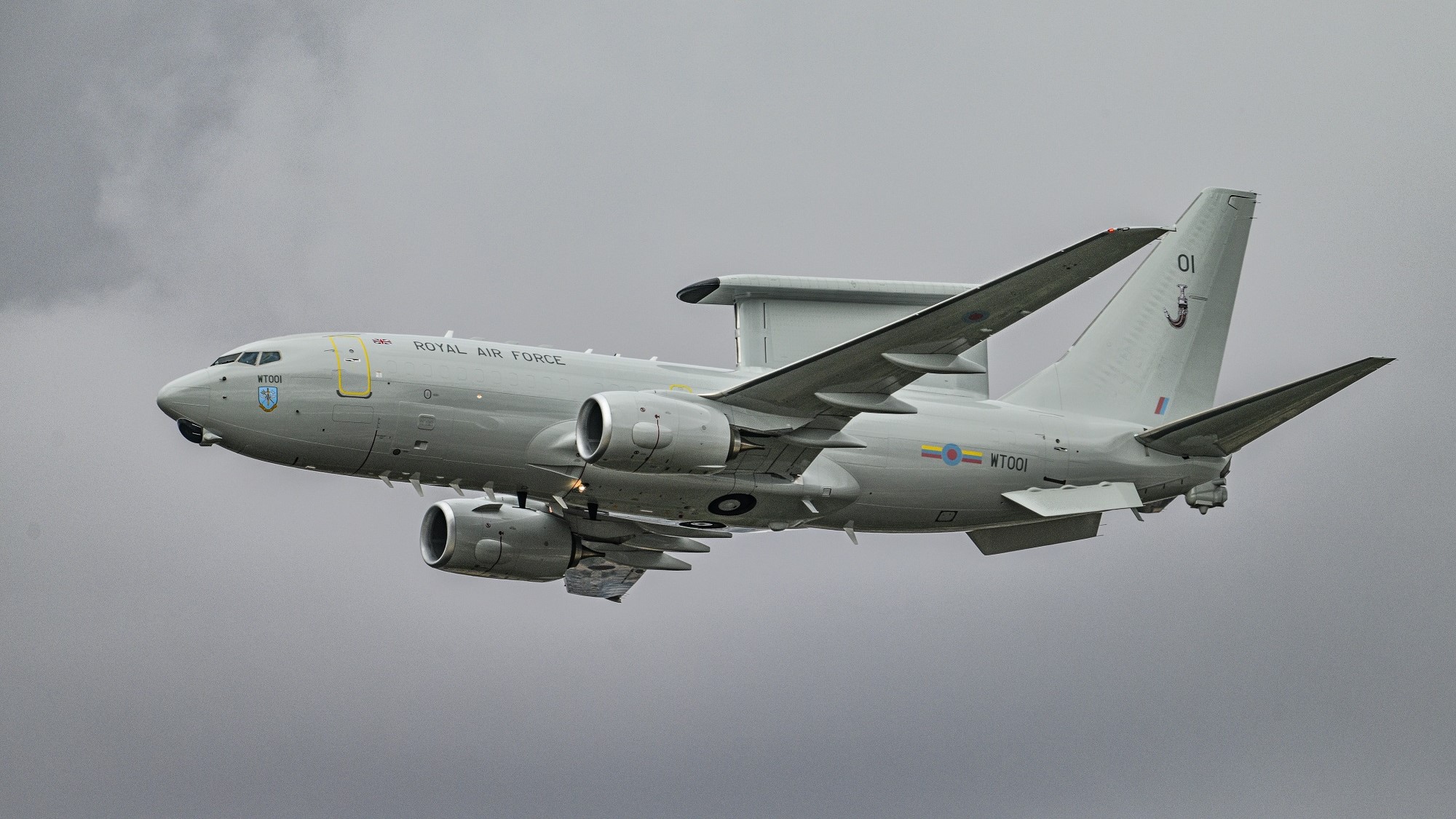
In September 2025, Boeing disclosed the two E-7 prototypes would be converted in the United Kingdom, marking a rare instance of U.S. Air Force aircraft work being performed on British soil. The work will use STS Aviation’s existing conversion line in Birmingham – currently the only facility worldwide set up for E-7 conversions – to transform the Boeing 737-700 commercial airframes into Wedgetails.
STS has already converted one 737-700 to the E-7 configuration for the RAF and has two more in varying states of assembly, providing a ready industrial base to support the U.S. prototypes. The first of the two U.S. Air Force’s airframes to be converted to the Wedgetail configuration arrived in the UK in March 2026.
FY2026 NDAA Pushes Back
The Fiscal Year 2026 U.S. National Defense Authorization Act (NDAA) includes provisions aimed at ensuring continuity in the Air Force’s Airborne Early Warning and Control (AEW&C) mission. The goal is to prevent a capability gap as the E-3 fleet continues to age and becomes increasingly difficult to sustain and operate.
Notably, the bill prohibits the Air Force from retiring or placing into storage any E-3 aircraft that would reduce the active fleet below 16 aircraft. However, two possible exceptions are also mentioned, either a submission of a readiness and mission-continuity plan or the procurement of a sufficient number of E-7 aircraft to cover required mission needs.
The legislative intent is to maintain minimum airborne early warning capacity until replacement capability is assured. Congress has historically used fleet-retirement restrictions to preserve capacity during transitions.
At the same time, the NDAA also forbids the use of FY2026 funds to terminate the mid-tier acquisition rapid prototype contract for the E–7A and the operations of the E-7A’s production line. This further affirms the intent of Congress that the Air Force maintain momentum on replacing the E-3 and continue work on the E-7 program.
2026 Developments
In March 2026, the U.S. Air Force has awarded contracts to Boeing to continue development of the E-7. According to an Air Force spokesperson quoted by Breaking Defense, the contract are a consequence of the FY2026 NDAA.
“In accordance with the Fiscal Year 2026 Consolidated Appropriations Act, the Department of the Air Force (DAF) has approved an updated acquisition strategy for the E-7A Wedgetail program. This strategy executes Congressional direction to continue development and transition to an Engineering and Manufacturing Development (EMD) phase,” the spokesperson said.
“This strategy continues the prototyping and development effort through the execution of two sole-source contract actions with Boeing, which include exercising one pre-priced option and awarding one new modification,” further added the statement. “The aircraft acquired for the EMD phase will allow the Air Force to mature the system design, conduct risk reduction, and perform comprehensive test and verification activities in accordance with Congressional intent.”
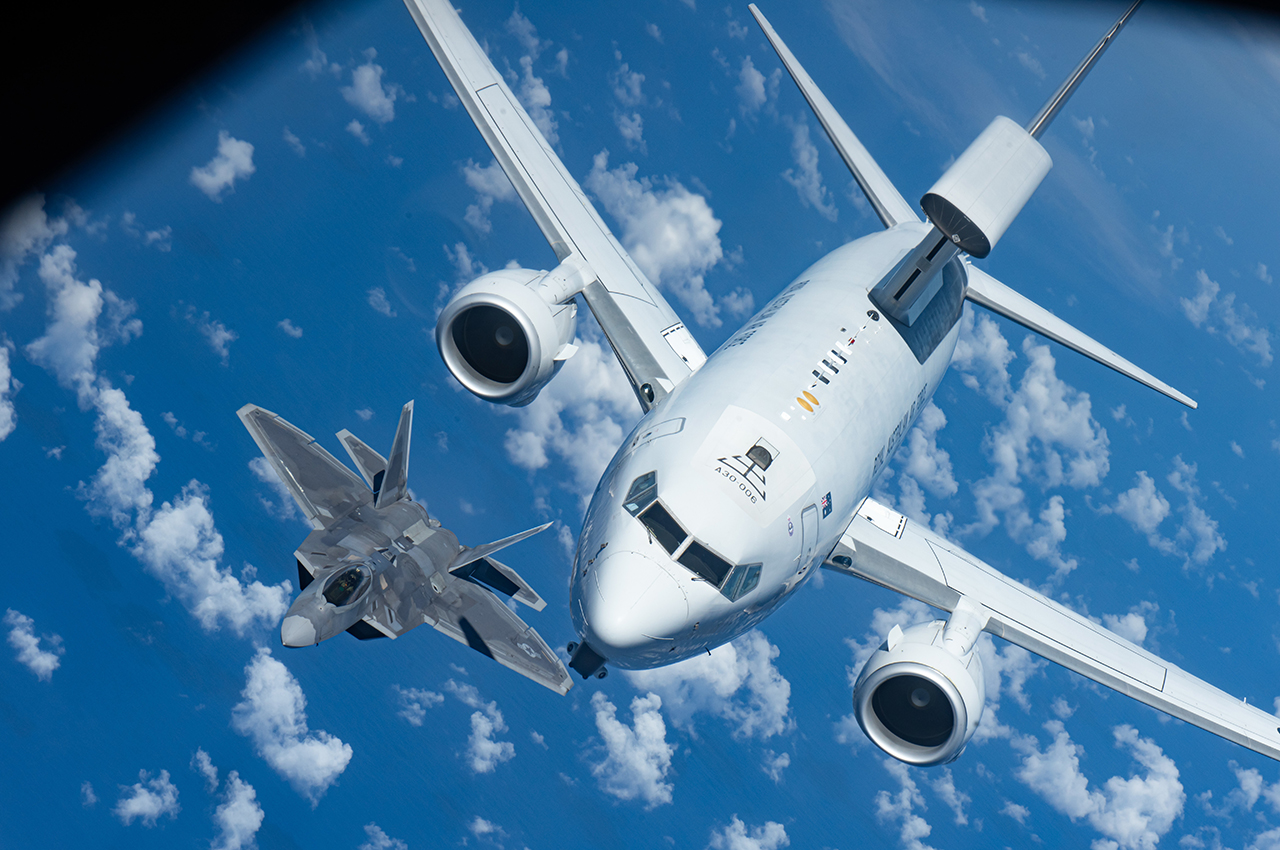
Also in March, the E-7A Program Office released a Request for Information (RFI) for a comprehensive Product Support Business Case Analysis (BCA) for the E-7A aircraft fleet. The attachment documents mention that the service is still looking to procure “at least two but possibly up to twenty-six aircraft,” while also mentioning “the E-7A aircraft to replace a portion of the E-3 Sentry Airborne Warning and Control System (AWACS) fleet.”
Meanwhile, the first airframe to be modified arrived in the UK. According to FlightGlobal, the unpainted Boeing 737-700, registered as N471DS and with callsign BOE151, arrived at STS Aviation Services’ facilities in Birmingham after a stop at Bangor International airport, in Maine.
