


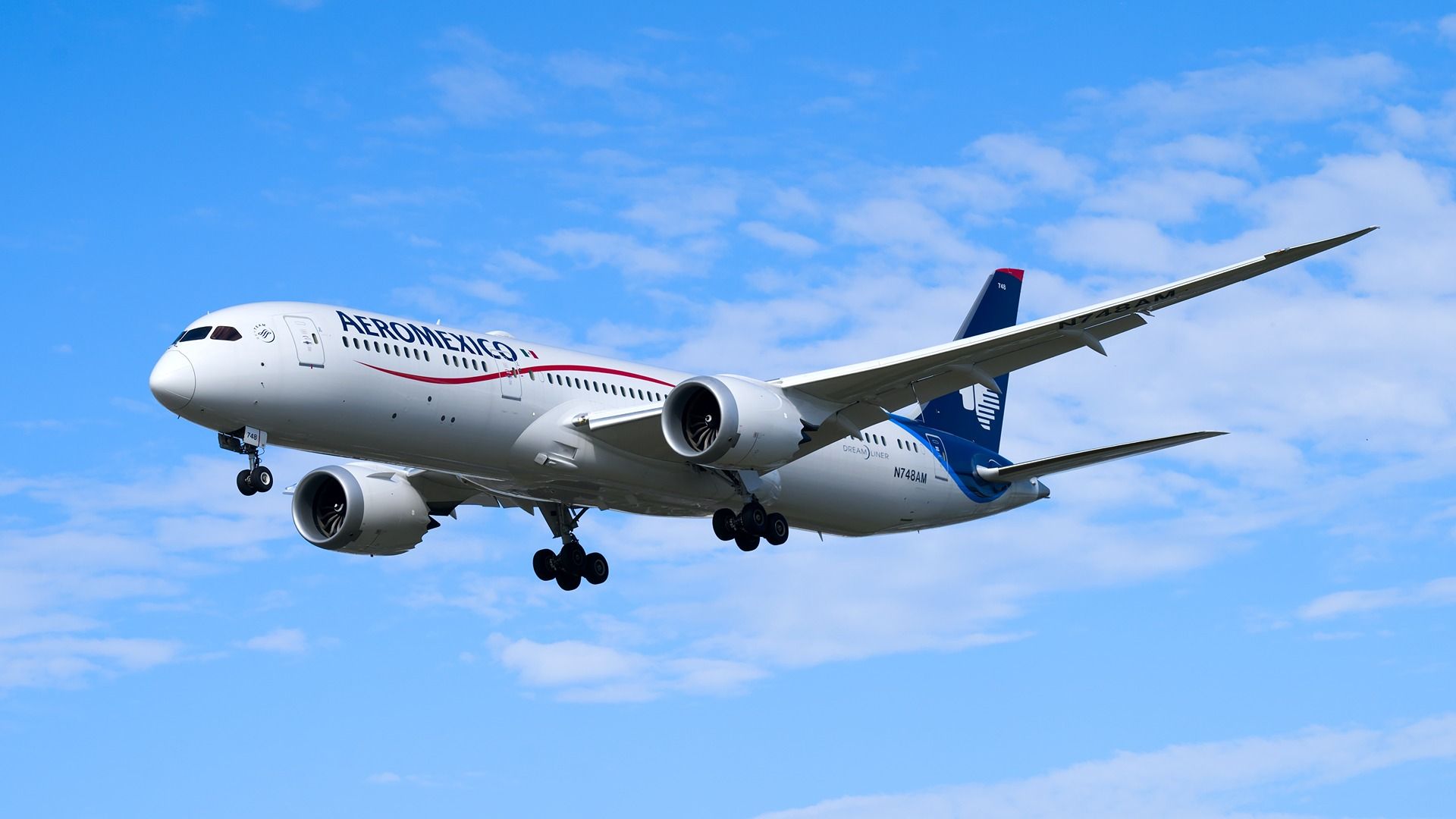
The United States has revoked the approval of Mexican carriers to operate on 13 routes into the US, citing unfair competitive advantages for airlines in Mexico. This move by the US affects the operations of three Mexican operators – Aeromexico, Volaris, and Viva Aerobus.
While the Mexican President disagrees with the United States’ decision to revoke operational rights and plans to investigate the reason behind this, the US has been clear that this is a retaliation for the events of 2022, when Mexico seized slots from US carriers, did not return them in a timely manner, and forced cargo operators into another airport with minimal warning.
Revoking Approvals On 13 Routes

The United States, earlier in the week, revoked operational approvals for 13 routes operated by three Mexican carriers in the US, with Reuters also reporting that the US canceled all passenger and cargo combined services to the US from Mexico’s Felipe Angeles Airport. The impacted Mexican carriers include  Aeromexico, Volaris, and Viva Aerobus.
Routes that have had their rights rescinded include services from  Mexico City International Airport (MEX) and Felipe Angeles International Airport (NLU):
|
Route |
Operator |
Route |
Operator |
|---|---|---|---|
|
NLU – Austin |
Viva Aerobus |
NLU – Orlando |
Viva Aerobus |
|
NLU – Los Angeles |
NLU – Miami |
||
|
NLU – New York |
MEX – San Juan |
Aeromexico |
|
|
NLU – Chicago |
NLU – Houston |
||
|
NLU – Denver |
NLU – McAllen |
||
|
NLU – Houston |
MEX – Newark |
Volaris |
|
|
NLU – Los Angeles |
The reason for taking these measures against Mexico was cited as unfair competition and the events of 2022, when Mexico breached the bilateral agreement with the US. Reuters reported the following statement from the US Transportation Secretary, Sean Duffy:
“Until Mexico stops the games and honors its commitments, we will continue to hold them accountable. No country should be able to take advantage of our carriers, our market, and our flyers without repercussions.”
So What Happened Three Years Ago?

While the US and Mexico have had an Air Transport Agreement since 2015, the US accuses Mexico of unlawfully revoking slots at MEX from US carriers, including  United Airlines,
  Delta Air Lines, and
  American Airlines.
At the time, this was cited as a temporary measure for construction. However, no significant construction ever took place in the subsequent years, and the slots were not returned to the carriers (until recently). Furthermore, a year later, in 2023, all US-based cargo operators were forced to relocate their operations from MEX to NLU.
In response, prior to rescinding approvals on these 13 routes, Mexican carriers were asked to submit schedules and obtain prior approvals on US flights. Shortly after that, the US Department of Transportation (US DoT) revoked the antitrust immunity between Delta and Aeromexico in their Joint Venture (JV).
The JV between the two carriers essentially enables them to have coordinated pricing, capacity deployment, and revenue sharing in the markets in which they are cooperating. The DoT stated that the JV gave Delta and Aeromexico an unfair advantage as the two carriers combined had a market share of around 60% on flights between the US and Mexico City.
Also Looking Across The Atlantic

Earlier this year, the US also reported that it was closely monitoring the conduct of other countries too, particularly nations in Europe that have recently been moving towards slashing capacities and reducing market access, citing reasons such as sustainability, noise abatement, and more.
While many European countries have been proactively taking measures to reduce carbon emissions by restricting certain operations, aircraft types, and more, some nations have tried to take a step too far.  Amsterdam Schiphol Airport (AMS), for one, in the fall of 2023, tried to further reduce capacity by reducing the number of flight movements in 2024, which resulted in airlines such as JetBlue in the US launching complaints as the carrier lost its slots for Summer 2024 at AMS.
While ultimately, AMS was forced not to reduce capacity, and JetBlue got the slots for operating flights into Schiphol, it was only possible after the involvement of the US DoT and the European Union. Apart from other US carriers, Schiphol also faced opposition from its home airline, KLM.
