



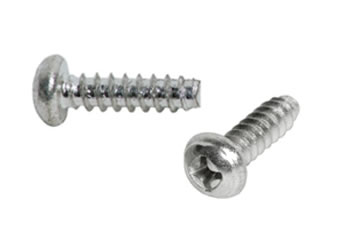
You don’t always have to tap internal threads when installing machine screws. Some screws are designed to tap their own threads when driven into objects. Known as self-tapping screws, they save time and energy by eliminating the need for tapping. You’ll still need to drill a pilot hole, especially when working with hard materials, but you won’t have to tap internal threads.
While all self-tapping screws tap their own threads, they are available in different styles, such as thread-cutting and thread-rolling. What’s the difference between thread-cutting and thread-rolling screws exactly?
What Are Thread-Cutting Screws?
Thread-cutting screws are self-tapping screws that create their own threads by cutting and removing material. They feature sharp helical ridges and flutes. When driven into objects, they will move material from inside the hole to outside the hole via these parts. The displaced material typically looks like chips or dust.
What Are Thread-Rolling Screws?
Thread-rolling screws are self-tapping screws that create their own threads by compressing and deforming material. They feature external threads just like thread-cutting screws, and they are used for the same purpose of fastening two or more objects together. Thread-rolling screws, though, don’t displace material; they compress and deform it.
Differences Between Thread-Cutting and Thread-Rolling Screws
They may tap their own internal threads, but thread-cutting and thread-rolling screws work in different ways. Thread-cutting screws work by removing material, whereas thread-rolling screws work by pushing material outward. With thread-rolling screws, the base material is pushed around the threads.
Only thread-cutting screws have flutes. Flutes are used to move material to outside the hole. Since thread-rolling screws compress and deform material, they don’t have flutes. Instead, they feature a lobed design. Some thread-rolling screws have three lobes, whereas others have five lobes. These lobes are designed to press threads into the material.
In terms of strength, thread-rolling screws typically come out on top. They offer greater holding strength by creating dense, highly compacted material. In light-duty fastening applications, the difference is minimal. For heavy-duty fastening applications, however, thread-rolling screws offer a notable increase in holding strength.
Thread-cutting screws are usually easier to install. They require less torque than their thread-rolling counterparts. Thread-cutting screws have sharp edges that reduce resistance during the threads’ formation. This translates into less required torque.
In Conclusion
Two of the most common styles of self-tapping screws are thread-cutting and thread-rolling. The former create their own threads by displacing material, whereas the latter create their own threads by compressing and deforming material. You should weigh the pros and cons of both types to determine which one is right for your next project.
