


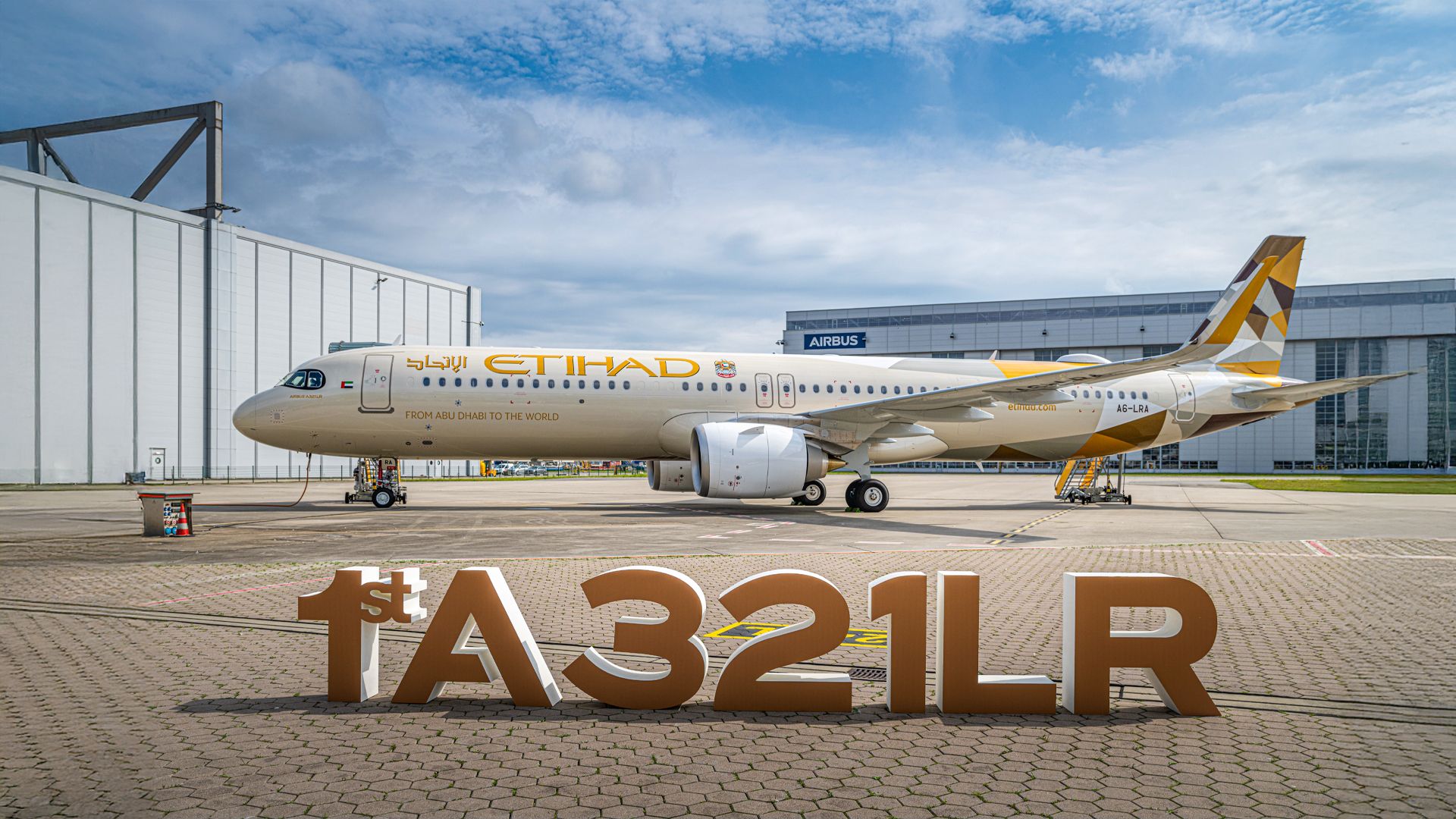
Etihad Airways has spent the last several decades becoming one of the most prominent carriers in the Middle East. Although the airline was founded in 2003, Etihad Airways has expanded from a small regional airline to a global carrier that connects Abu Dhabi to major destinations in Europe, Asia, Africa, and the Americas. Over the years, the airline has become known as a forward-thinking carrier. After a brief period of financial restructuring in the late 2010s,  Etihad Airways has grown to be more agile, sustainable, and with improved operational efficiency.
One of the airline’s most important fleet strategies came with the introduction of the Airbus A321LR. This popular narrowbody aircraft is designed for longer routes with lower capacity or high-performance regional flights. The A321LR allows Etihad Airways to take advantage of markets that do not require the capacity of a widebody aircraft, but still offer the range and comfort expected of modern passengers. Let’s take a closer look at the fleet of A321LRs that Etihad Airways currently flies, as well as where these aircraft have operated in recent months.
The Airbus A321LR Fleet Of Etihad Airways

Etihad Airways took delivery of its first Airbus A321LR. This new narrowbody aircraft allowed the airline to open new routes, but also take advantage of improving the efficiency of many existing operations. During the World Travel Market in London, Jeremy Pollock, General Manager UK & Ireland at Etihad, told Simple Flying:
“The Airbus A321LR opens up a whole host of new destinations, which we’ve seen launching throughout the last quarter. It launched its first flight on 1st August. Then recently, Chiang Mai launched with the A321LR operating on it. We’ve also had Krabi, as well, launched last month with the A321LR. So all destinations which can feed very strongly for the UK.”
According to ch-aviation, Etihad currently flies a total of six active A321LRs. These aircraft provide a total of 4,800 seats. Additionally, these aircraft are part of the airline’s order for 30 total types, meaning that Etihad expects to receive an additional 24 A321LRs to improve and modernize its fleet.
The first A321LR that Etihad took delivery of is registered as A6-LRA and has a manufacturing serial number of 12471. All of these aircraft are powered by CFM International LEAP engines. Additionally, all the airline’s A321LRs have the same configuration. This includes two first-class seats, 14 business class seats, 36 economy plus seats, and 108 economy seats, which brings the aircraft’s total capacity to 160 passengers.
Asian And Pacific Destinations

Currently, Etihad Airways flies its Airbus A321LR fleet to a considerable number of Asian destinations. The most frequent destination that Etihad Airways flies this aircraft to in Asia is Kempegowda International Airport (BLR) in Bengaluru, India. According to Cirium, in November this year, the airline has 49 round-trip flights scheduled from its base at Zayed International Airport (AUH) in Abu Dhabi, United Arab Emirates (UAE).
The airline is also flying to several other Indian destinations with the A321LR. According to Cirium, Etihad Airways will fly the A321LR to the following destinations from Abu Dhabi in November 2025:
|
Airport |
Destination |
Scheduled Flights (Nov. 2025) |
|---|---|---|
|
Cochin International Airport (COK) |
Kochi, India |
17 |
|
Rajiv Gandhi International Airport (HYD) |
Hyderabad, India |
17 |
|
New Delhi, India |
16 |
|
|
Netaji Subhas Chandra Bose International Airport (CCU) |
Kolkata, India |
11 |
|
Chennai International Airport (MAA) |
Chennai, India |
1 |
Beyond India, Etihad is flying its A321LRs to several other destinations in the Asia-Pacific region. This includes connecting Abu Dhabi to Techo International Airport (KTI) in Phnom Penh, Cambodia, Kualanamu International Airport (KNO) in Medan, Indonesia, and Bandaranaike International Airport (CMB) in Colombo, Sri Lanka. The airline also has two operations to Thailand. According to Cirium, in November, the airline will conduct 33 flights to Krabi Airport (KBV) in Krabi and 16 flights to Chiang Mai International Airport (CNX).

Unprecedented: Etihad Inaugurates 4 New Routes In A Week
The Abu Dhabi-based airline will also be initiating six new routes next month.
European And African Destinations

Etihad Airways is also flying to a significant number of European destinations with its new fleet of Airbus A321LRs. The airline’s most popular European destination is Zurich Airport (ZRH) in Switzerland. According to Cirium, the airline will fly a total of 37 flights to this destination from Abu Dhabi, which will transport 5,920 passengers over the 2,972-mile flight.
Another popular destination that Etihad Airways flies its A321LRs to is Copenhagen Airport (CPH) in Denmark. The airline will operate 28 flights on this route, flying nearly 4,500 total passengers. Several other European routes have begun being operated by its new Airbus A321LR fleet. According to Cirium, the other European destinations that Etihad Airways will fly to in November include:
|
Airport |
Destination |
Scheduled Flights (Nov. 2025) |
|---|---|---|
|
Düsseldorf International Airport (DUS) |
Düsseldorf, Germany |
25 |
|
Milan Malpensa Airport (MXP) |
Milan, Italy |
11 |
|
Athens International Airport (ATH) |
Athens, Greece |
5 |
Beyond Europe, Etihad Airways has an extensive route network in place in Africa. Currently, the airline only flies its Airbus A321LRs to three African destinations. According to Cirium, in November, Etihad will fly from Abu Dhabi to Cairo International Airport (CAI) in Egypt 20 times, Houari Boumediene Airport (ALG) in Algiers, Algeria, 14 times, and Tunis-Carthage International Airport (TUN) in Tunis, Tunisia, 13 times.
Middle Eastern Destinations

As Etihad Airways is headquartered at Zayed International Airport (AUH) in Abu Dhabi, UAE, it makes sense that the airline also flies to many prominent Middle Eastern destinations. The airline’s most popular route in November this year is connecting Abu Dhabi to Ben Gurion Airport (TLV) in Tel Aviv, Israel.
According to Cirium, Etihad will fly this route 74 times this month. However, Etihad also flies to several other destinations at a much lower frequency. In November 2025, Etihad will fly to the following Middle Eastern destinations:
|
Airport |
Destination |
Scheduled Flights (Nov. 2025) |
|---|---|---|
|
Istanbul Airport (IST) |
Istanbul, Turkey |
34 |
|
Bahrain International Airport (BAH) |
Manama, Bahrain |
9 |
|
Doha, Qatar |
9 |
|
|
Muscat International Airport (MCT) |
Muscat, Oman |
7 |
|
Kuwait International Airport (KWI) |
Kuwait City, Kuwait |
1 |
Some of the airline’s other popular routes connect the UAE to Saudi Arabia. In November, this includes 59 flights to King Abdulaziz International Airport (JED) in Jeddah, Saudi Arabia. It also includes 39 flights to King Khalid International Airport (RUH) in Riyadh and 25 flights to King Fahd International Airport (DMM) in Dammam.

Wow: Etihad Airways Has Already Announced 29 New Cities This Year
They are in Africa, Asia, Europe, the Middle East, and North America.
About The Airbus A321LR

The Airbus A321 is a member of one of the most popular narrowbody families of aircraft in the world, the A320 series. The Airbus A320 was first introduced in the 1980s, and, since then, Airbus has produced over 12,000 aircraft. However, after receiving feedback from several airlines in the 1980s and 1990s, Airbus began to develop a stretched variant of the A320, later designated the Airbus A321.
The first A321 rolled off the production line in 1993, with the first flight coming on March 11, 1993. The A321 saw a significant number of orders, including the first customers, Lufthansa and Alitalia, which each ordered 20 and 40 aircraft, respectively. The first A321 was delivered to Lufthansa in January 1994, and it officially entered commercial service later that month, when Lufthansa flew the first A321 from Hamburg Airport (HAM) to Frankfurt Airport (FRA) in Germany.
However, as the A321 was first introduced in the early 1990s, Airbus has since introduced several upgraded variants of the type. The newest generation of the series includes the A321neo family, which offers upgraded engine options and other improvements. Airbus introduced the first A321neo aircraft in the late 2010s. Even so, Airbus found a market for a long-range narrowbody aircraft, later designated the A321LR. This aircraft featured three auxiliary fuel tanks to help extend its range.
The A321LR program was officially launched in January 2015, although it had begun marketing the aircraft several months prior. The first A321LR conducted its maiden flight in January 2018, kicking off the extensive flight test program that included a record long-distance flight of around 4,750 nautical miles. The aircraft was certified by the European Union Aviation Safety Agency (EASA) and the Federal Aviation Administration (FAA) in October 2018. Arkia Israeli Airlines took delivery of the first production A321LR in November 2018, later entering the aircraft into commercial service.
Design Features And Performance Specifications Of The Airbus A321LR

The A321LR features a similar build to earlier A321 models. This includes a narrowbody fuselage with a conventional tail that features a single vertical stabilizer and rudder. However, Airbus made several significant improvements to the aircraft, including increased wing loading and a longer fuselage. Airbus also added additional fuel tanks to extend the aircraft’s range.
Like many other airliners, the A321LR features several different engine options. Airlines can choose between either the CFM International LEAP or the Pratt & Whitney PW1100G turbofan engines. These each provide the aircraft with over 30,000 pounds of thrust. According to Airbus, the A321LR can achieve the following performance specifications:
|
Length |
146 feet |
|---|---|
|
Height |
38 feet seven inches |
|
Wingspan |
117 feet five inches |
|
Maximum takeoff weight (MTOW) |
213,800 pounds |
|
Typical cruise speed |
450 knots (518 miles per hour) |
|
Range |
4,000 nautical miles (4,600 miles) |
|
Service ceiling |
39,800 feet |
Due to the Airbus A321LR’s extended fuselage, it can carry a larger number of passengers than the standard A320 series. In a maximum high-density configuration, the A321XLR can seat up to 244 passengers. However, in a standard two-class configuration, the aircraft can seat between 190 and 206 passengers. Many airlines opt for additional seating classes, including Etihad Airways, which offers four classes of seats.
