


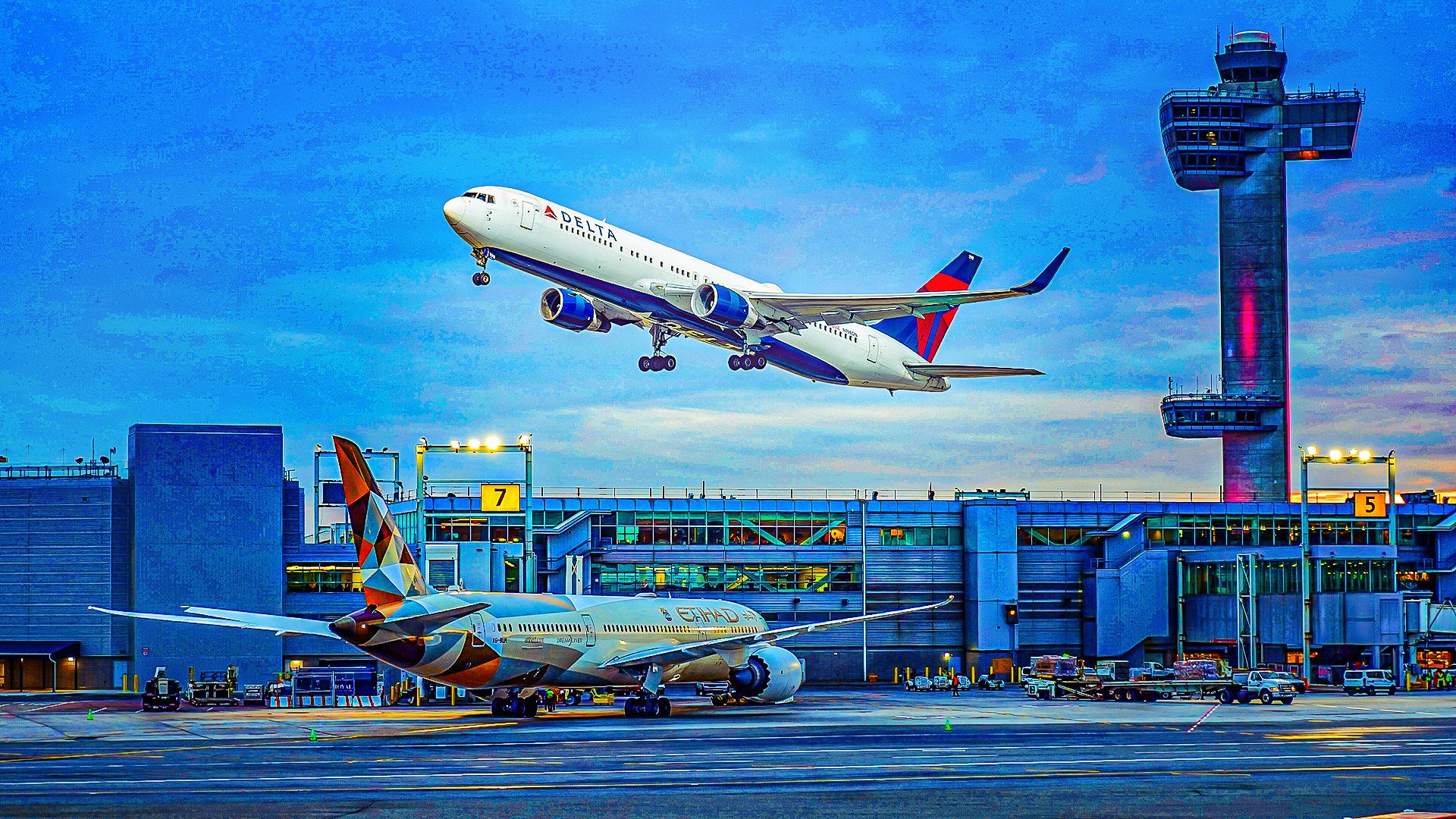
As one of the largest metropolitan areas in the world, the New York City area is home to some of the busiest airports on Earth.  John F. Kennedy International Airport (JFK) is number one.
  Newark Liberty International Airport (EWR) comes in second, and
  LaGuardia Airport (LGA) is the third-busiest airfield that serves NYC.
JFK serves over 60 million flyers per year, while EWR sees nearly 50 million travelers pass through its doors every year, and more than 30 million people visited LGA in 2024. JFK was also named the best airport in North America, according to the Port Authority of New York and New Jersey. The other two in the trio have also received numerous upgrades and overhauls to elevate the standard of service.
2024 was the busiest year on record in terms of air traffic in and out of NYC. Including the number of flyers that went through New York Stewart International (SWF), the total was just under 146 million. The trend aligns with a worldwide resurgence in air travel demand in the post-COVID era. Let’s break down the stunning amounts of flying traffic to the “Big Apple” with data provided by Cirium.
JFK Leading The Way

 Delta Air Lines leads the way in 2025 with nearly 150,000 scheduled flights until the end of the year. JetBlue Airways has over 110,000 scheduled flights this year, and
  American Airlines has more than 60,000 in 2025 as well. The long list of other airlines, including domestic and international operations, brings the total to over 430,000 departures on the boards at JFK this year.
These three airlines will together generate 50 million seats of flying capacity. Delta’s aircraft will carry over 22 million travelers this year. JetBlue will accommodate more than 18 million passengers, and American will accommodate almost 10 million flyers on its jets departing JFK. The total seat capacity for all airlines operating at JFK will exceed 77 million in 2025.
JFK is currently undertaking a $19 billion modernization and expansion program that will transform the sites of five existing terminals into two giant terminals. Virtually every aspect of the airport will be upgraded, including publicly managed infrastructure like roads and transit, as well as retail, dining, and airline services. The project is currently at peak construction, but is expected to begin opening the new spaces in 2026.
Newark On The Charts

Newark Liberty has an impressive 371,000 flights scheduled for the year. Of those,  United Airlines takes the lion’s share, operating over 260,000 of the year’s total. Spirit Airlines comes in second with a paltry 18,000, and Delta ranks third with a couple of hundred less than Spirit.
The combined total seat capacity of all flights scheduled at Newark this year will reach 60 million. Of the total, United will provide the aircraft on which nearly 40 million flyers ride. Spirit will transport almost 3.5 million passengers, and Delta will ferry more than 2 million passengers on their journey from EWR.
The EWR Vision Plan will modernize Newark Airport with an all-new Terminal A and sweeping upgrades across the entire airfield and all facilities. There will also be a new automated rail system expected to open by 2030. The new train will connect parking, rental car services, and terminals and integrate with the Northeast Corridor Rail Link Station.
LaGuardia’s Slice Of The Pie

LaGuardia Airport will see 356,000 flights this year across its runways. The learning carrier will be Delta, which has about half of the schedule board to its credit, racking up 170,000 flights in 2025. Behind Delta is American, which will fly 100,000 times out of LGA. The third-busiest airline at LaGuardia is  Southwest Airlines, which claims a little over 23,000 of the scheduled departures.
Over 41 million travelers will pass through LGA in 2025. Over 13 million of those passengers will ride on Delta jets. American will take over 10 million flyers to their destinations, and Southwest will have room for almost four million onboard their fleet. Despite some severe hardships earlier this year related to ATC issues, the airport remains one of the most popular in NYC.
LaGuardia invested $8 billion in an upgrade program that was the first complete rebuild of a US airport in 25 years. The project received over half its financing from the NY/NJ Port Authority and included the brand-new Terminal C, which opened in 2022. The modernization consists of everything from increased parking and faster security lanes to art installations and a unique water feature unlike any airport in the world.
Record Flying Demand

The post-COVID-19 era of air travel has seen a powerful resurgence in demand for air travel and air cargo. Flyers have come flocking back to airports to make up for the lost opportunities of the Coronavirus air travel halt. These flyers are also increasingly willing to pay additional fees for more amenities and premium services, as well as higher-quality cabin products.
Travel Agent Central reported that September 2025 saw the all-time high in airfare sales by travel agencies, with the nationwide cumulative total exceeding $8.7 billion. That was a dramatic eight percent jump over 2024 in the same month. The third quarter saw a four percent increase over the previous year. Steve Solomon, Chief Commercial Officer at Airlines Reporting Corporation, commented on the passenger growth.
“Strength in pricing and passenger demand helped ARC-accredited agencies close out the third quarter at record levels. This trend underscores sustained traveler confidence as well as the expanding vacation travel window into the fall as the industry prepares for the busy holiday travel season.”
That bounce back is helping recover the losses that air carriers, airports, and manufacturers suffered during the pandemic’s grinding stoppage of flight operations. In 2025, record numbers of flights, travelers, and aircraft sales have been set. The current aviation boom is seeing demand soar while capacity remains constrained worldwide.
The Recovering Industry

The high demand for air travel after the two years of virtually zero activity due to COVID-19 has forced airports to scramble and meet the needs of carriers and flyers alike. Meanwhile, airlines have rushed to bring their capacity up to pre-COVID levels as they steadily expand fleets and destination networks, year over year. Likewise, manufacturers are still struggling to ramp up supply chain capacity and production output to meet the rising demand.
The effects of the COVID-19 pandemic are still being felt in the supply chains of all aviation-related businesses today. The flow of raw materials and components is yet to reach the scale it was at before the pandemic. Meanwhile, the invasion of Ukraine by Russia has also restricted the flow of some raw materials like high-grade alloys and oil, which are blocked from the market by political sanctions.
Boeing has especially struggled in the 2020s with the 737 MAX assembly line shut down after fatal mishaps and the capacity limited due to quality concerns. The Federal Aviation Administration (FAA) just recently agreed to raise the monthly output cap from 38 to 42. Still, only two of the four planned variants have cleared certification, and the next-generation widebody, the 777X, is still languishing in testing before it can enter production.
Airbus has also had issues, primarily with powerplant deliveries, that have left many nearly-finished planes sitting on back lots until their engines arrive. The A350-1000 is also still in development, whereas the A350F cargo model is one to two years behind schedule. Then there’s the effect of US President Donald Trump’s tariffs on makers like Airbus, Embraer, and Bombardier. While not stopping the flow of components and aircraft deliveries, they have disrupted the steadiness and cast doubt on reliability.
This at least gives airports in dire need of infrastructure upgrades and modernization some breathing room. The NYC area’s airports have experienced a number of operational issues, especially at Newark and LaGuardia, caused by outdated and unreliable air traffic control (ATC) equipment, as well as runway improvements that are behind schedule.
The Future Ahead

The future of commercial flying is bright, with significant growth predicted by all the major planemakers: Boeing, Airbus, Embraer, and Bombardier. The executive jet market is also growing alongside the commercial industry, with Honeywell projected to increase demand in that niche steadily over the coming years.
Boeing and Airbus have both worked to rebuild production and sustainment capacity across their global operations. Boeing has brought its aerostructures maker, Spirit Aerosystems, back into the fold as it works to ensure no more quality issues disrupt output. Airbus has invested in expanding its A220 and A320 plants in the US. Embraer also successfully navigated political channels to secure the future of its customer base in the US.
Airports in the US have also begun to ramp up modernization projects, with locations like Los Angeles International Airport (LAX) overhauling virtually the entire airfield and terminal areas. Pittsburgh International Airport (PIT) created one of the most robust energy microgrids in the world to keep its operations uninterrupted after seeing other airports, like Newark, struggle under harsh conditions.
