


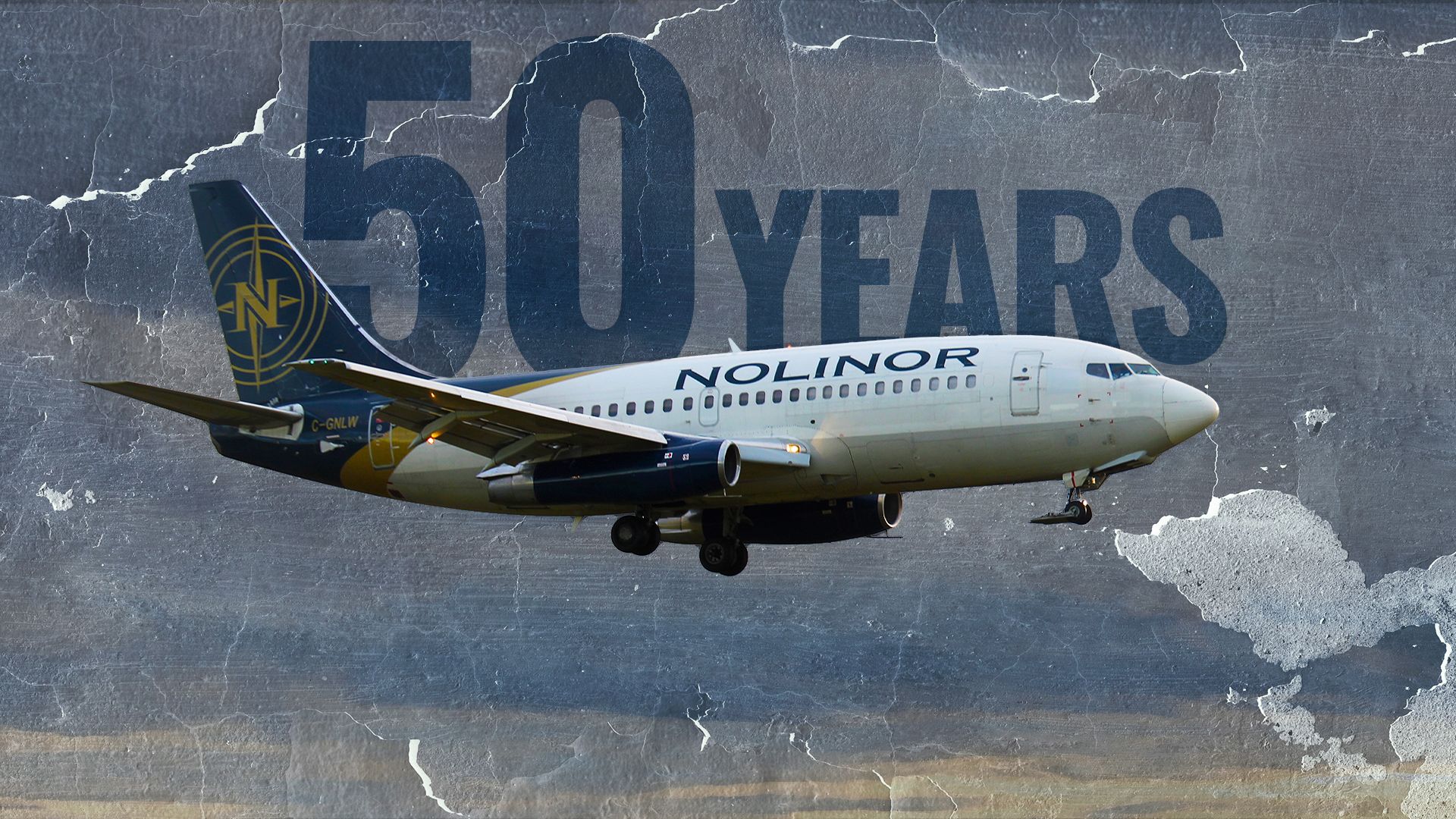
Canada’s Nolinor Aviation is notable for having the oldest active commercial passenger jet in the world, or at least the oldest regular passenger fleet in a Western country. There may be small passenger airlines in Africa or Russia with older regional aircraft, e.g., the Angara Airlines Flight 2311 An-24 that crashed in 2025 was 49 years old. That said, Nolinor has the oldest Western-built airliner in regular passenger service. Even in sanctioned Iran, the oldest fleets are typically between 30 and 35 years old on average.
The typical retirement age for a narrowbody airliner is 20 to 25 years, although they typically live longer if they are converted to freighters. Most Western and reputable airlines fly modern aircraft, generally preferring to keep narrowbody aircraft under 25 years. Internationally, the passenger airlines operating older aircraft are typically unable to access financing to purchase modern aircraft. These are particularly found in certain developing or sanctioned countries. Another reason why airliners may last much longer than other airliners is that they are specialized and difficult to replace, like the Boeing 737-200C Combi.
Canada’s Nolinor Aviation

Nolinor Aviation (legally Les Investissements Nolinoc Inc.) is a Canadian charter airline based in Montreal-Mirabel International Airport. The airline operates passenger charter and cargo services to remote places in northern Canada and the United States. Established in 1992, the airline operates a fleet of 11 older-generation Boeing 737 aircraft. These aircraft often have to land on runways consisting of packed gravel or even ice.
In 2007, Nolinor acquired two former Royal Air Marco Boeing 737-200 combis, and it has continued to acquire Boeing 737 Original as well as Boeing 737 Classic aircraft. In August 2025, Nolinor acquired its eighth Boeing 737-200, which was already almost 45 years old, registered C-FTWW. The aircraft was previously operated by Chrono Aviation, a Quebec City charter airline. The aircraft first flew in 1981, but it’s not even the oldest in Nolinor’s fleet.
This may also not be the last of Nolinor’s 737–200 acquisitions as it plans to purchase a ninth example in 2026. Notably, Nolinor operates the world’s last remaining active 737-200 flight simulator in Miami. Other examples of Canadian airlines operating the 737-200 include Buffalo Airways and Inuit Air. Nolinor is the world’s largest operator of the Boeing 737-200, of which fewer than 40 remain in service worldwide.
The World’s Oldest Active Passenger Aircraft

The oldest aircraft in Nolinor service is a Boeing 737-200C combi listed by Planespotters.net as 51.5 years old. The aircraft was built at Renton and was first delivered to Transavia in 1974. In Transavia service, the aircraft was known as Richard Gordon. Transavia continued to own the aircraft, leasing it out to various other airlines until 1990. In 2001, the aircraft was acquired by Europe Airpost and leased it to airlines in Europe and Peru.
The already-aging aircraft was stored at Budapest’s international airport in 2010 but reemerged in 2014 when it was sold to Norlinor Aviation. Norlinor has operated the jet ever since. Nolinor plans to operate its 737-200 fleet well into the 2030s. Currently, there are no direct replacement options for the 737-200 combi. Turboprop Dash 8s and ATR 42s or 72s come close, but they are slower and smaller than Boeing’s 737s. Norlinor markets itself around its rugged old 7-37-200s, saying it flies “where others can’t.”
|
Oldest Norlinor active aircraft |
|
|---|---|
|
Type |
Boeing 737-200C |
|
Age |
51.5 years old |
|
First delivered |
1974 |
|
Purchased by Norlinor |
2014 |
|
Powerplant |
2x Pratt & Whitney JT8D-17A engines |
According to ch-aviation, the aircraft is powered by Pratt & Whitney JT8D-17A engines. The JT8D is a low-bypass turbofan engine developed for the Boeing 727-100. It is a modification of the P&W J52 turbojet, which is the engine that powered the US Navy A-6 Intruder as well as the A-4 Skyhawk. Variants of the engine powered the original series (-100/-200) of the Boeing 737 and the Douglas DC-9.
Nolinor’s Market Segment

As Nolinor operates specialized aircraft designed to haul both cargo and passengers into remote and austere environments, its requirements differ from those of most conventional airlines. For Nolinor, jet fuel efficiency is not the top concern it is for most airlines. Its customers include Native Canadian villages, mining companies, and provincial governments.
Modern jets like the Boeing 737-800 with large engines can’t safely land in some of the austere environments of Northern Canada. By contrast, the Boeing 737-200 was built at a time when airport infrastructure was often rudimentary, with unpaved runways and with no ground support. The airlines’ charter model also operates fewer flights per week, which increases the benefit of having older, cheaper, paid-off aircraft, even if they are less fuel-efficient and require more maintenance.
It is common for airlines operating in remote locations to use older aircraft, as Russian regional airlines do. Russia’s position is aggravated by the Western sanctions in 2022 that cut it off from purchasing new aircraft and the components it needs to build domestic aircraft.
Nolinor’s Aging Fleet Of Boeing 737s

According to Planespotters.net, Nolinor operates a fleet of 11 aircraft, of which ten are active and one is parked. Its fleet consists of eight Boeing 737-200s (expected to grow to nine), one Boeing 737-300, and two Boeing 737-400 aircraft. The overall fleet age is 42.8 years, with the -200s being 45.7 years old, the -300s being 34.4 years old, and the -400s averaging 35.7 years. As these are charter aircraft, they will typically age more slowly than regular passenger aircraft that have much more intense flight cycles. Flight cycles increase airframe fatigue, while age factors for corrosion, obsolescence, and other factors.
Nolinor says its Boeing 737-200s can be configured to carry up to 119 passengers (with 23 kg of baggage per passenger), cargo, or a combination of both. The aircraft has a payload capacity of up to 30,000 lbs. They can also be used as tankers carrying up to 15,900 liters or 4,200 gallons of petroleum. These aircraft offer 100+ seat capacity, the ability to operate on gravel, and the ability to convert into mixed cargo/passenger layouts. This is something for which there is no modern replacement.
|
Nolinor aircraft |
Max passengers carried |
Combi? |
Cargo carried |
|---|---|---|---|
|
Boeing 737-200 |
119 |
Yes |
23,940 lbs or 4,200 gallons of petroleum |
|
Boeing 737-300 |
130 (44 executive) |
No |
Normal |
|
Boeing 737-400 |
159 |
No |
Normal |
The 737-300 comes in multiple configurations, including one with 130 economy-class passengers. Another passenger configuration is the executive version with 44 seats. A mixed option has both VIP and economy seats (e.g., 24 VIP and 66 economy seats). The Boeing 737-400 comes with a longer fuselage than the 737-300. Both are configured to carry 159 economy class seats.
Nolinor To Purchase Next-Gen BWB Freighters

It is perhaps ironic that the airline operating some of the world’s oldest aircraft is also looking to operate the next generation of futuristic aircraft. Natilus is developing a blended-wing-body (BWB) aircraft that will operate in remote, rugged regions of northern Canada and Alaska. In 2025, Nolinor announced a collaboration with Natilus to become one of the first operators of the type. The company purchased an unspecified number of production slots.
The California-based company JetZero is not the only start-up developing BWB aircraft. JetZero’s Z4 is being developed with Northrop Grumman for the US Air Force and as a mid-sized commercial airliner. Meanwhile, San Diego-based start-up Natilus is developing its own BWB cargo aircraft. Natilus claims this new aircraft will “revolutionize” commercial air cargo, carrying a payload of 3.8 metric tons (8,400 lbs) and a range of 900 nautical miles.
Natilus says the aircraft will offer greater cargo capacity, 50% lower operating costs, and 30% less fuel use. Nolinor says that its plans to acquire the aircraft demonstrate its “commitment to bringing innovative and sustainable solutions to address regional freight challenges.” It is unclear when KONA is expected to be operational, although Natilus says it is also developing another BWB aircraft called Horizon to carry over 200 passengers.
Limited New Combi Options To Select From

Nolinor’s status as the operator of the oldest Boeing 737 passenger aircraft is more out of necessity than anything else. The Boeing 737-200C is a specialized aircraft well-suited to Nolinor’s specific requirements, operating in remote conditions, with limited passenger and freight demand. Combi aircraft were relatively popular in the 1960s and 1970s, but they declined due to the rise of more efficient single-purpose aircraft, the growth of passenger and cargo volumes while also negatively affected by increased safety regulations.
Almost all combi aircraft are old aircraft. Boeing mostly built combi variants of its Boeing 707-300, Boeing 737 Original and Classic, and older Boeing 747 variants. Douglas built combi DC-7, DC-8, DC-9, DC-10, and MD-11 aircraft. Combi aircraft based on the Lockheed L-188 Electra, Convair CV-240, BAC One-Eleven, ATR 42-300, and DHC-7/-8 have also existed.
But there are very few modern options for combi aircraft (especially jet-powered); the demand for them is too small. The most modern Boeing option may be the Boeing 737-700C, although Boeing lists 17 of the 22 new-build 700Cs as being purchased by the US Navy. While Nolionor appears to plan to continue operating the Boeing 737-200C for as long as possible, it can’t operate them forever and is betting on the upcoming Natilus KONA.
