


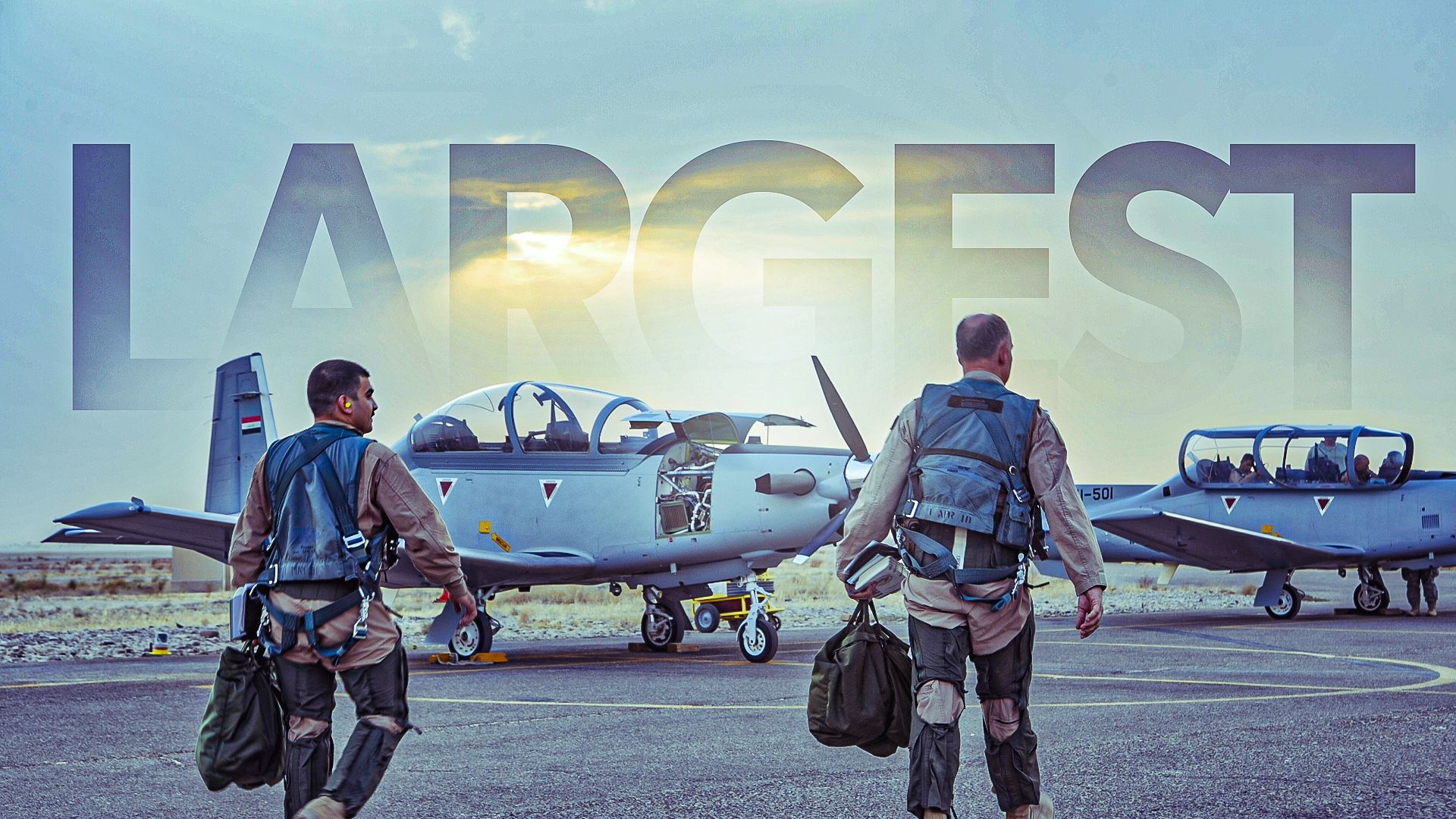
American air dominance remains at the top of the stack 30 years after the curtain fell during the Cold War. As countries deal with declining birth rates, changing finances, and the introduction of pilot-optional aircraft, fighter cockpits around the world are always changing. Washington and Moscow struggle with recruitment shortages that result in understaffed squadrons, while Beijing has invested heavily in expansion.
The number of pilots in the air forces around the world fluctuates regularly as fleets shrink and grow. Some nations have expanded greatly in recent years, like the People’s Liberation Army Air Force (PLAAF). Meanwhile, recruiting shortages see others shrinking, like the United States and Russia. Below is the list of the top five air force rankings by national fleet size:
|
Ranking |
Airframe Count |
Pilot Count |
|---|---|---|
|
1. USA |
14,486 |
37,000 |
|
2. Russia |
4,211 |
4,000-5,000 |
|
3. China |
3,304 |
4,000 +/- |
|
4. India |
2,296 |
3,834 |
|
5. Japan |
1,459 |
2,000 +/- |
The manpower of these forces is generally a bit more than the number of aircraft in their fleets. Some have deeper rosters of aircrew than others relative to airframes. This ranking will not go in-depth on the qualitative aspect of the forces that sources like World Directory of Modern Military Aircraft (WDMMA) attempt to provide with ratings.
Japan’s Aerial Shield

At the heart of Japan’s air-power equation are roughly 2,000 men and women qualified to fly for the Japan Air Self-Defense Force. They represent a small fraction of the JASDF’s nearly 50,000 uniformed and civilian workforce. Every one of the service’s 1,459 aircraft, from trainers and tankers to the newest stealth fighters, depends on their skill and dedication.

A typical JASDF aviator begins the journey at Hamamatsu with basic instruction in the sub-sonic T-7, graduates to the Kawasaki T-4 for advanced maneuvering, and spends a year in an operational conversion unit. Those who earn a fighter slot are ready to strap into a Boeing-licensed Mitsubishi F-15J Eagle or Lockheed Martin-derived F-2 Viper, also made by Mitsubishi.
A growing percentage will transition straight to the F-35A going forward. Mastering the fifth-generation cockpit means learning to manage fused sensor data, coordinate with joint forces through Link-16 and others, while also conducting hot-pit refueling drills on dispersed runways.
The small community of tanker crews that keep those fighters aloft trains on  Boeing KC-767s and the new KC-46 Pegasus, platforms that demand long-duration proficiency at night and over water. Meanwhile, JGSDF helicopter pilots fly the UH-60J Black Hawk in support of rescue alerts that can happen within minutes of warning.

Japan’s naval aviators add another layer to the manpower equation. The Maritime Self-Defense Force (JMSDF) helicopter carrier Izumo is a light carrier capable of launching F-35B vertical-takeoff stealth fighters. By the time Izumo reaches full operational tempo later this decade, Tokyo will need more than 100 qualified F-35B pilots in addition to its land-based fighter force.
India’s Evolving Air Power

India’s pilot corps was already stretched before the war in Ukraine upended global supply chains. The Air Force is authorized for 4,239 cockpit billets yet can fill only about 3,834, according to the Hindustan Times. Roughly half of its fighters and almost all of its trainers trace their lineage to Russian design bureaus.
About 650 pilots are needed to keep the carrier INS Vikramaditya’s ski-jump deck busy with MiG-29Ks and a mixed bag of Kamov and Western helicopters. Wartime demand inside Russia has delayed engine overhauls and radar upgrades for those carrier fighters, leaving fewer jets available for carrier qualifications. Every canceled deck cycle means another naval pilot risks falling behind the night-trap curve, a problem Western carrier air wings have faced as well.

Squadron Leader Mohana Singh became the first woman fighter pilot to fly India’s Tejas fighter jet. She took flight last September in a historic achievement for gender equality in the IAF, as Financial Express reported.
Negotiations for an “F-21” variant of the F-16 or a possible Sukhoi Su-57 export deal hinge on whether India believes future conflicts will resemble the current drone-saturated fight in Ukraine or the high-end stealth contests envisioned by the US. No decision has been made public yet, although President Donald Trump reportedly offered to sell F-35 Lightning II fighters to India and the head of the Air Force was given a tour of an F-35A.

Cadets progress from the Pilatus PC-7 Mk-II to Kiran jets and then the Hawk Mk-132. The leap into a frontline Sukhoi has grown riskier because simulator parts sourced from Russia arrive late, if at all. Grounding even a handful of Sukhoi Su-30MKIs or MiG-29s forces squadron commanders to rotate pilots through fewer flyable jets, which erodes currency hours and accelerates burnout.
The Rise Of The People’s Liberation Army

The People’s Liberation Army Air Force (PLAAF) likely has around 4,000 active-duty pilots, who form the core of a service that is expanding rapidly. Young cadets begin at the Air Force Aviation University in Changchun before moving to operational conversion units. To meet the Navy’s demand, the Naval Aviation University in Yantai has ramped up, and sought assistance from every available source, including former American aviators.

The ex-US Marine pilot Daniel Duggan is set to be extradited from Australia on charges of assisting the Chinese Military in pilot training. He has denied claims of aiding the PLA in developing carrier takeoff and landing training despite his arrest and detention at a maximum security prison in Australia, according to CNN. He was arrested in 2022 for allegedly providing air force training between 2008 and 2012 in China, violating existing arms embargoes.
Naval aviation is catching up despite an alarming pilot death toll since its beginning, with over 2,00 pilots killed according to the Eurasian Times. The ski-jump carriers Liaoning and Shandong likely carry around 300 deck-qualified pilots between them, and the new Fujian will need at least another 200 once it finishes trials.

The fighter force constitutes about half of the total combat airframes available for the PLAAF and PLAN. The stealth J-20 Mighty Dragon fighter has increasingly taken a larger share of the inventory and production doesn’t show any signs of slowing down, as the PLAAF invests in new engines and missiles for the fifth-generation fighter.

The PLAAF is enhancing recruiting and training. In the transport and special-mission world, pilots are trained for Y-20 airlifters, KJ-500 early-warning platforms, and a fast-growing tanker fleet built around the KC-20.
The Russian Federation’s Struggle

The Russian Aerospace Forces (VVS) relies on a force of 4,000 aviators to meet normal readiness quotas for its 4,211 aircraft. These aviators are spread across various squadrons, with the fighter community being the VVS’s most elite tier. Maintaining this pipeline has become increasingly difficult since combat operations in Ukraine began in 2022. Aircraft losses, combat fatigue, and the death of many experienced officers have created gaps in the roster.

Russia has shifted to a much more cautious use of its manned aircraft and instead invested in drones or long-range munitions for strike fighters and heavy bombers to fire from stand-off, beyond visual range (BVR) in efforts to mitigate losses of men and machines. Strategic priorities are shifting, with fixed-wing naval aviators being brought into VVS land-based squadrons.
Training starts at the Krasnodar Military Aviation School and Syzran Helicopter School, where cadets log their first flight hours before earning wings. The VVS has shortened some training courses and pushed instructors back to the line, but replacement rates still lag behind attrition. Pilots’ availability, proficiency, and adaptability will determine whether Russia can translate its aerospace ambitions into sustained combat capability in the years ahead.
America’s Unrivaled Lead

There are currently 37,000 men and women in the US military, but that still doesn’t satisfy the manning requirements of the armed forces. With more than 5,200 Air Force combat aircraft waiting on the ramp and units frequently staffed under authorized levels, the fighter community is especially under pressure, as Air & Space Forces Magazine reported.

The Air Force Times recounted this passage from a Mitchell Institute for Aerospace Studies report regarding the need for pilots, which has become more critical than even next-generation platforms like the F-47 sixth-gen fighter:
“Experienced pilots have better survivability rates and mission outcomes in combat and confer those benefits to their less experienced wingmen. The Air Force’s combat pilot experience levels continue to drop as the service suffers from ongoing budget-driven force cuts and reduces opportunities that are essential to pilot career progression.”

The Air Force’s 13,000 pilots are stretched thin, as are the approximately 10,000 naval flying officers and aviators serving between US Navy and US Marines squadrons on the maritime side. Over 200 deck-qualified flyers are required for each of the Navy’s supercarriers in order to sustain an air wing. Over 4,000 helicopters are mission-ready to fly approximately 14,000 helicopter pilots in the arsenal of Army Aviation.
