


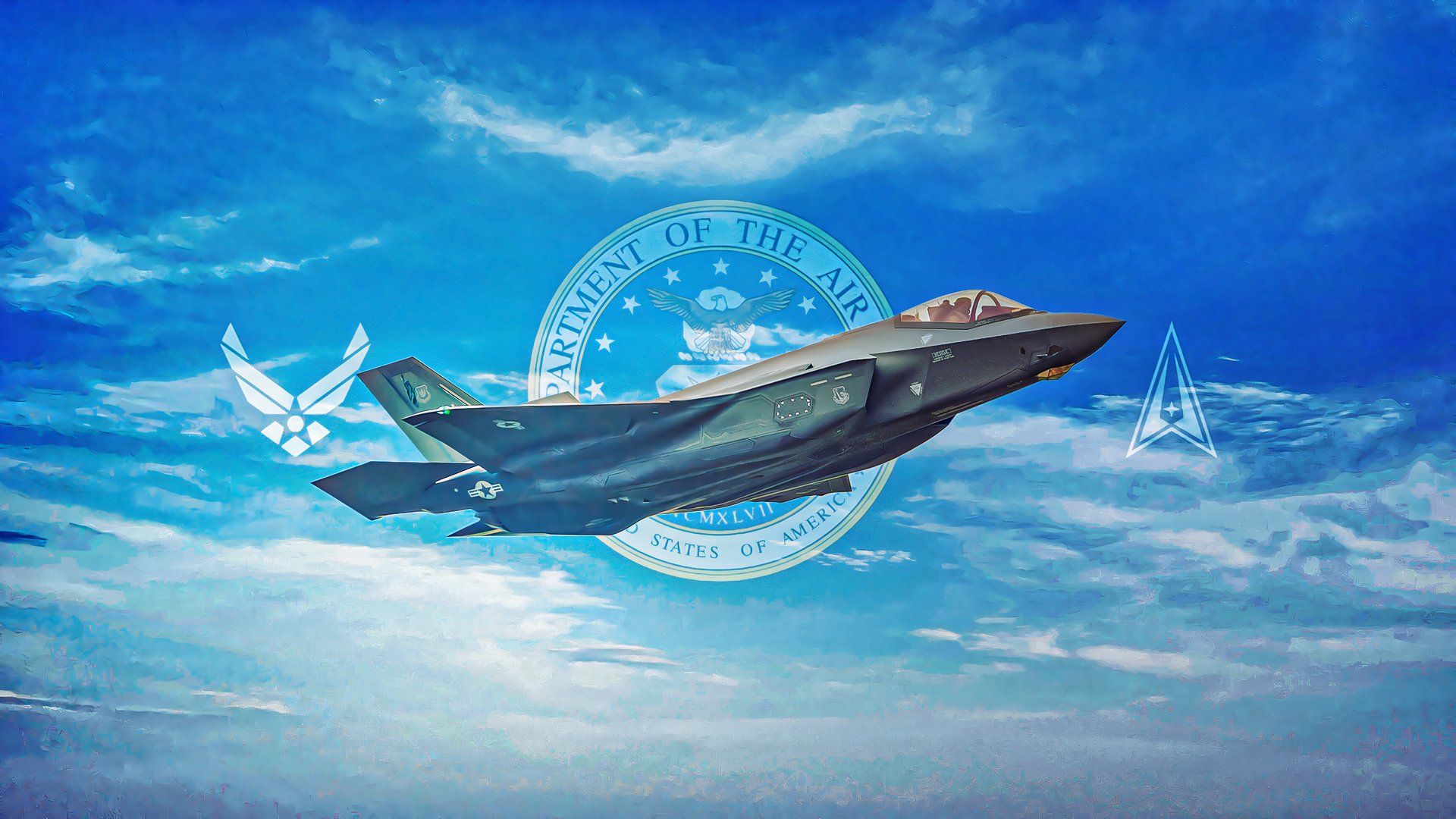
The US Air Force’s newest jets represent the cutting edge of aerial combat, blending stealth, sensors, and networked warfare in previously unthinkable ways just a few decades ago. At the heart of this modern fleet is the F-35 Lightning II, a fifth-generation workhorse already serving across multiple services and allies. Yet, as threats evolve and budgets tighten, the question lingers: how long can the F-35 remain relevant? In this article, we examine the F-35’s development and service, the case for sustaining it through the 2070s, and the aircraft and drones that may eventually replace or complement it.
In the era of peer competitors, advanced air defense systems, and rapid technological advancements, the US Air Force must continually evolve to stay ahead. The F-35 is already central to its force structure. However, with concepts like NGAD (Next Generation Air Dominance), manned-unmanned teaming, and the introduction of new sixth-generation jets on the horizon, the Air Force is balancing the risk of obsolescence with the practicalities of sustaining a massive fleet. This guide will walk through the F-35’s journey, its likely longevity, and what might come next.
The F-35: From Vision To Frontline

The F-35 Lightning II is perhaps the most ambitious combat aircraft program in US history: designed to serve multiple services, to be affordable, stealthy, and networked. Its roots stretch back to the 1990s, under the Joint Strike Fighter program, and it has since matured to become the backbone of many air forces worldwide. Yet the program has faced cost pressures, technical delays, and evolving threats. Understanding where it began and how it evolved helps explain why it may remain relevant for decades to come.
The JSF (Joint Strike Fighter) program began in the mid-1990s, aiming to develop a standard airframe to replace aging aircraft across the US services and their allies. After a competition between Boeing’s X-32 and Lockheed Martin’s X-35, the latter was chosen. The X-35’s capability to perform short takeoff, supersonic flight, and vertical landing in one mission was a highlight of the design phase. The first F-35 variants flew in the mid-2000s (for example, F-35A’s first flight in December 2006). Its formal entry into service began in the 2010s, with the US Marine Corps F-35B variant entering service in July 2015. The US Air Force’s F-35A was declared operational around August 2016.
The F-35 was promoted by the USAF as a multirole stealth aircraft that combines “sensor fusion,” networked operations, and survivability. Because logistics and sustainment dominate life-cycle costs, the program invested in digital support systems (initially ALIS, later transitioned to ODIN) to monitor and maintain aircraft health. However, the program has not been without controversy: cost overruns, software delays, and sustainment challenges are well documented. Congress has flagged long-term sustainment of the fleet through 2088 as a significant cost (estimated at over $1.5 trillion).
The F-35 In Service: Role, Popularity, And Longevity

The F-35 became the primary fighter for the USAF, USMC, and USN (in its C variant), as well as numerous allies. Its role is not limited to air-to-air combat but encompasses strike, electronic warfare, ISR (intelligence, surveillance, reconnaissance), and command & control support. Over time, its flexibility and adaptability have made it indispensable.
The USAF fields the F-35A as its primary stealth strike/fighter platform, intended to replace aging F-16s and A-10 Warthogs, and complement the F-22 Raptors. The F-35’s sensor fusion and data sharing capabilities make it a valuable node in modern networked warfare, as it can gather information and share it with other aircraft, surface units, and command centers. Internationally, the F-35 has been adopted by numerous US allies and partners, thereby enhancing interoperability and burden-sharing.
The key factors that might contribute to the F-35’s longevity are the following:
• Stealth & low observability: Shaped design, internal weapons bays, and radar-absorbent materials keep the F-35 survivable against advanced defenses.
• Sensor fusion & networking: Fuses data from multiple sensors and shares it with the network, ensuring relevance as a battlefield information hub.
• Modular upgrades: Block improvements (e.g., Block 4, TR-3, Tech Refresh) allow continuous modernization over decades.
• Wide fleet base: Large US and allied fleets provide economies of scale and political durability.
• Sustainment architecture: Digital maintenance and logistics systems help control long-term support and cost growth.
These strengths explain why many observer analysts believe the F-35 could remain in service into the 2070s. Its large fleet, continuous upgrade path, and the flexibility to integrate new systems offer a path to evolutionary growth rather than wholesale replacement. At the same time, future adversary air defense systems and hypersonic threats will require upgrades that exceed the current designs’ expectations. The F-35’s ability to absorb those upgrades, or be supplemented by other platforms, will determine whether it truly endures for half a century or more.
Why The US Might Keep The F-35 Until 2070

To envision the F-35 flying in the 2070s, one must understand both practical constraints and the strategic advantages that drive its retention. The cost and risk of entirely new aircraft, as well as industrial base considerations, and incremental modernization all militate in favor of extending the life of a proven design.
The acquisition of a new combat aircraft is a budgetary and programmatic gamble. Developing new airframes, engines, sensors, software, and sustainment systems costs billions of dollars and spans decades. In contrast, the F-35 already has supply chains, operational experience, infrastructure, and global partnerships in place. Upgrading an existing fleet is often safer and more cost-effective than starting from scratch. In recent years, the US Department of Defense has approved full-rate production of the F-35, emphasizing continued procurement.
|
Factor |
New Clean-Sheet Fighter |
Upgrading the F-35 |
|---|---|---|
|
Development Cost |
$50–100+ billion over 20–30 years (R&D, testing, certification) |
Incremental billions per Block upgrade; far cheaper than new development |
|
Timeline to Field |
15–25 years before full-rate production |
3–7 years per major upgrade cycle; continuous capability injection |
|
Risk |
High – new technologies may face delays, overruns, or cancellation |
Lower – mature design, established logistics, and training |
|
Industrial Base Impact |
Risk of gaps if next-gen fighter stalls; workforce retraining needed |
Maintains existing supply chains, jobs, and multinational production |
|
Capability Growth |
Potential for radical advances (propulsion, stealth, weapons) |
Evolutionary improvements (sensors, computing, weapons integration) |
|
Global Partnerships |
Would need fresh coalition buy-in; uncertain export viability |
Strong international user base (17+ nations already invested) |
|
Political Feasibility |
Hard sell in Congress given cost/uncertainty |
Easier sell: proven jet, sunk costs, existing commitments |
Each new software and hardware block is intended to inject fresh capabilities, ideally keeping the platform competitive. However, sustaining the F-35 through 2070 presents challenges. The maintenance, sustainment, and upgrade costs scale over time; that is why GAO and Congressional assessments warn of steep growth in costs through 2088.
Technological leaps like new propulsion systems, directed energy weapons, or radically new stealth methods, may outpace the F-35’s ability to absorb them. The battle is whether incremental upgrades can keep it relevant in an era where adversaries could field networked sensors, hypersonic missiles, and counter-stealth systems. Still, political, industrial, and alliance commitments may tip the balance toward retention, at least as part of a mixed fleet.
What Might Replace Or Complement The F-35: NGAD, F-47, And Beyond

The F-35 is likely to remain central to US airpower for decades, but the Air Force is already preparing for what comes next. That future now has a name: the F-47, the centerpiece of the service’s Next Generation Air Dominance (NGAD) program. NGAD began as an umbrella concept for advanced air superiority, but as of 2025, it has crystallized into a tangible platform, the F-47 sixth-generation fighter, backed by a family of supporting systems.
In March 2025, the US Air Force selected Boeing to develop the manned element of NGAD, officially designated the F-47. This sixth-generation jet will form the sharp edge of America’s future air dominance strategy. While precise details remain classified, reports suggest the F-47 will combine extreme stealth, advanced sensor integration, and extended range, potentially over 1,000 nautical miles (1,852 kilometers) with supersonic performance above Mach 2.
Initial procurement goals are estimated at around 185 aircraft, making it a specialized fleet compared to the thousands of F-35s expected worldwide. Importantly, the F-47 won’t operate alone: it’s designed to work in tandem with drones known as Collaborative Combat Aircraft (CCAs), which will act as loyal wingmen to multiply the jet’s effectiveness while reducing risk to human pilots.
Alongside the Air Force’s F-47, the US Navy is pressing forward with its F/A-XX program, a carrier-capable stealth fighter expected to fly in the 2030s to replace the F/A-18 Super Hornet. The bigger picture reveals a clear trend: the next era of US air dominance will center on manned-unmanned teaming. Congressional briefings indicate the Air Force is planning for roughly 1,000 CCAs, with each F-47 or F-35 likely to command two or more of these drones.
These unmanned aircraft could conduct electronic warfare, suppress enemy defenses, extend sensor reach, or even fight alongside their manned counterparts. This “family of systems” approach points toward a future where the F-35 is not entirely replaced but instead works alongside new platforms in a hybrid fleet.
Could The F-35 Be The Last Manned Fighter?

A question that has fascinated defense analysts and aviation enthusiasts alike is whether the F-35 will mark the beginning of the end for manned combat aircraft. With artificial intelligence and drone technology advancing rapidly, some argue that the days of pilots dogfighting in the cockpit may be numbered.
Despite these arguments, most experts believe human pilots will remain indispensable for decades. Manned aircraft still bring unique advantages: on-the-spot decision-making, moral accountability, and flexibility in unpredictable combat situations.
A 2025 Belfer Center paper highlighted that drones are most effective when they operate as “loyal wingmen,” rather than full replacements. Similarly, the US Air Force continues to view manned fighters, such as the F-47 under the NGAD program, as central, with unmanned platforms serving in support roles.
While debates about the “last manned fighter” are philosophical, the Air Force’s investments in unmanned systems are very concrete. For the first time, it has designated prototype drones, such as the YFQ-42A and YFQ-44A, as fighter aircraft, signaling a significant shift in how uncrewed combat platforms are viewed.
|
Drone / UAV Project |
Purpose / Role |
Status |
|---|---|---|
|
XQ-67A → YFQ-42A |
Loyal wingman, combat support (air-to-air focus) |
Prototype first flight achieved (August 27, 2025); designated as first CCA fighter |
|
Anduril’s Fury prototype → YFQ-44A |
Drone support & combat missions (semi-autonomous CCA) |
Designated YFQ-44A for CCA Increment 1; first flight expected mid-October 2025 |
|
Lockheed’s Vectis concept |
Stealth drone “wingman” design (CCA-like with low-observable survivability) |
Recently revealed publicly (September 21, 2025); first flight targeted for 2027 |
The real challenge is not whether machines can fly or fight, but whether they can match a pilot’s ability to make rapid, intuitive decisions in unpredictable combat. Most likely, the near future will be hybrid, with F-35s and eventually F-47s leading swarms of drones that undertake the riskiest missions. If autonomy continues to improve and budgets demand cheaper options, manned aircraft could slowly give way. In that sense, the F-35 may not be the last manned fighter, but it could represent the beginning of the end for an era in which humans alone dominate the skies.
Conclusion: The F-35’s Place In A Changing Sky

The F-35 entered service in 2015 as the most ambitious fighter program in history, and a decade later, it remains a key player in shaping the future of aerial warfare. With more than a dozen allied air forces flying it, and US plans to keep it in service through the 2070s, the jet has become far more than a stopgap; it is the backbone of Western air power.
At the same time, the US Air Force is not standing still. Programs like NGAD and the F-47 demonstrate that the next era of manned fighters is already under construction, while drone initiatives such as the CCA program are redefining what it means to command the skies. Together, these systems point to a future where manned and unmanned platforms work in tandem.
Whether the F-35 is remembered as the last of its kind or the bridge to a new generation, its legacy will be undeniable. For now, it remains the central figure in the Air Force’s evolving fleet, symbolizing both continuity and change. As drones take on greater roles and sixth-generation fighters emerge, the F-35 stands as proof that modern air combat is never static; it’s a constant evolution.
