


The Boeing 737 MAX family comes in four variants, or four and a half if the MAX 8-200 is included. The MAX 8 replaces the popular Boeing 737-800 and is one of the best-selling aircraft on the market today. To meet the requirements of Europe’s ultra-low-cost carrier, Ryanair, Boeing modified the MAX 8 to give it extra seating. Ryanair wanted the aircraft to be extra-high-density, as it seeks to bring down the price per seat as much as possible.
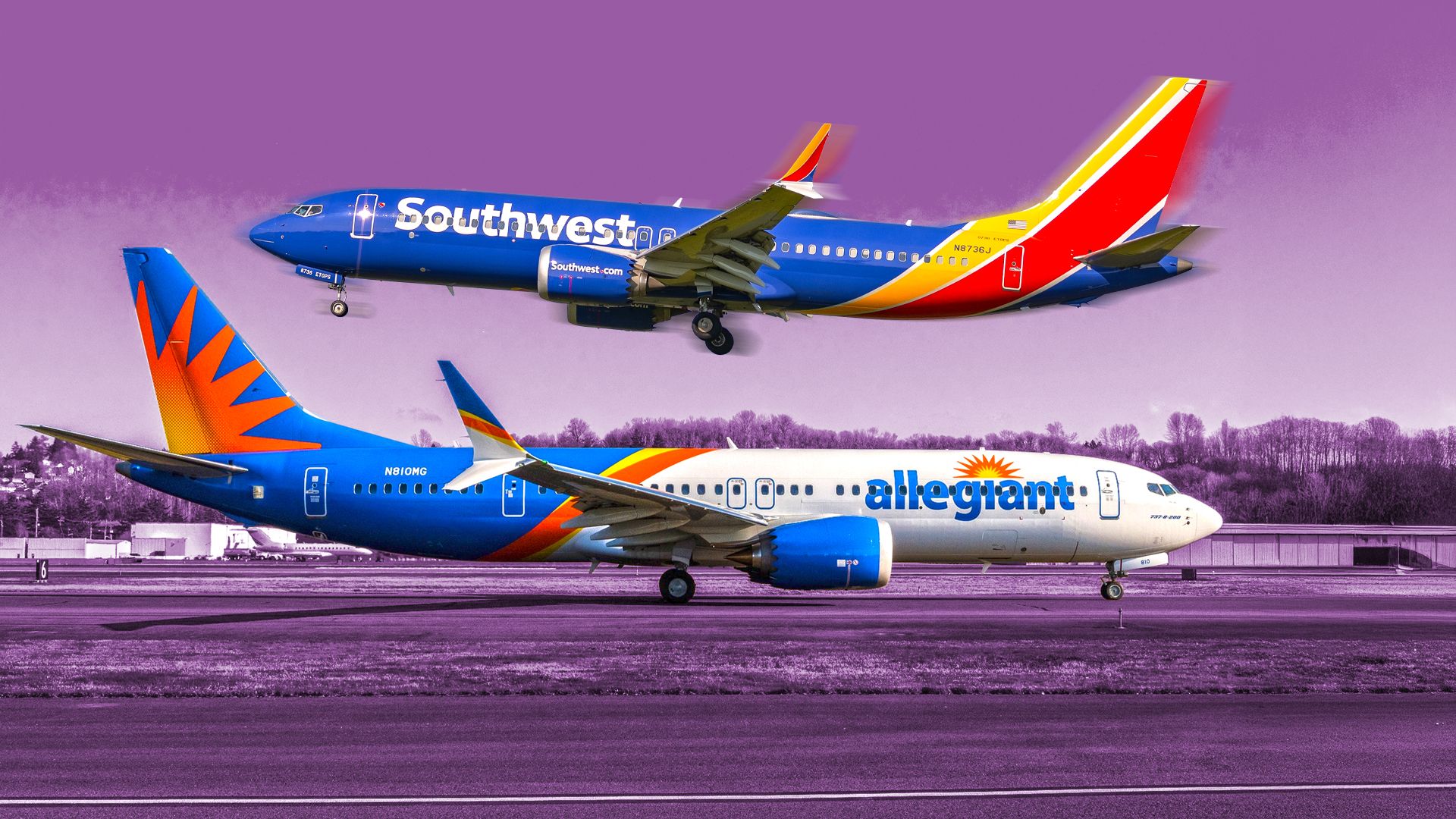
The type is mostly operated by Ryanair and its subsidiaries (including Buzz, and Malta Air), although it has since been ordered by other low-cost carriers like Allegiant, VietJet, and Akasa Air. The MAX 8-200 offers low-cost airlines the ability to further reduce fares, and it represents a divergent trend seen happening with Boeing’s upcoming flagship, the Boeing 777X.
Boosting Passenger Capacity

The Boeing 737 MAX 8-200 is developed from the baseline MAX 8 model. It was launched in 2014 and received its certification in 2021, with the driving factor for the subvariant being the desire of Ryanair to have a higher-capacity version of the MAX 8. The aircraft is listed by Boeing as being able to carry 210 seats compared with the standard MAX 8’s maximum certified capacity of 189. However, the number 210 is more of an aspirational figure that can’t be obtained in reality.
For example, EASA limits the aircraft to 202 passengers and five crew for a total of 207. The subvariant does not meaningfully change the MAX 8 in other ways typically done by variants. For example, both the MAX 8 and MAX 8-200 have the same fuselage length (102 feet and eight inches), the same engines (CFM LEAP-1B), the same performance characteristics, the same maximum takeoff weight (181,200 lbs), and the same range (around 3,550 nautical miles).
The number of passengers an aircraft is permitted to carry is not so much determined by space available for seating as it is by how much calculated time it takes for passengers to exit in the event of an emergency. Aircraft need to be able to evacuate all passengers in 90 seconds or less, a rule that has been in place since the 1960s. The assessed time needed for evacuation is influenced by factors like the number of exits and the size of the exit doors.
The Boeing MAX 8-200’s Modified Doors

Type I doors are large, floor-level main exits that come with escape slides. Type II and III doors are smaller overwing or mid-cabin doors designed for emergency exit. Both the baseline MAX 8 and the subvariant 8-200 have four main doors with two located forward and two set aft, and they have four overwing exits. This gives the MAX 8 a total of eight exits.
Where the 8-200 differs is that it has two mid-cabin exits dividing the cabin, giving the MAX 8-200 a total of ten exits. These are Type II or de-rated Type III mid-exits with one door on each side and are equipped with escape slides and meet CS-25.811 standards. They are located 82 feet and eight inches aft of the aircraft’s nose. The extra doors are plug-type in design that open inward for pressurization.
|
MAX 8 doors (per Boeing) |
MAX 8 exits |
MAX 8-200 exits |
|---|---|---|
|
Forward doors |
2 (Type I) |
2 (Type I) |
|
Mid-cabin doors |
None |
2 (Type II) |
|
Aft doors |
2 (Type I) |
2 (Type I) |
|
Overwing exits |
4 (Type III) |
4 (Type III) |
|
Crew exits (pilots) |
2 cockpit sliding windows |
2 cockpit sliding windows |
|
Total cabin exits |
8 |
10 |
The addition of the two extra mid-section emergency exits allows the aircraft’s cabin to be segmented into three zones (forward, mid, and aft). They allow for faster evacuations, allowing the FAA and EASA to give the aircraft a higher certified seating capacity. Ryanair called the 8-200 the ‘Gamechanger’, although that is hyperbole.
Other Impacts Of The MAX 8-200’s Design

As expected, passengers can expect the trade-off for flying in MAX 8-200 aircraft with lower fares to be a lack of legroom. The MAX 8-200’s slimline seats come with 28 inches of seat pitch, while the MAX 8’s standard seats have up to 32 inches in a two-class configuration. The seats allow airlines to fit in around 16 more seats, although this necessitates reinforcing the floors to bear the higher weight.
One trade-off is that the denser configuration increases the aircraft’s turnaround time as it takes longer for passengers to board the aircraft and then deplane after the flight. The modification also only requires some minor tweaks to the aircraft’s software, particularly the software related to the mid doors. Otherwise, the changes to the aircraft are insignificant or non-existent.
It is worth noting that Boeing has designed four main variants of the MAX family. Only two of these, the MAX 8 and MAX 9, received their type certificates before the twin MAX crashes in 2018 and 2019. Boeing has not yet recovered from the fallout of these crashes. It has not recovered in profitability, in trust with the FAA, and in airplane production. As of October 2025, the FAA is still refusing to issue the type certificates for the MAX 7 and MAX 10.
Ryanair’s Fleet & Seating Configuration

While Ryanair is not the only customer for the 8-200, it is the main customer. It also operates the world’s second-largest Boeing 737 fleet after Southwest Airlines. Like Southwest, Ryanair strives for standardization among its aircraft and, so, its core brand only operates the Boeing 737-800 and MAX 8-200. Ryanair gets close to reaching the 202-EASA-passenger limit, but falls short by five seats with its aircraft configured for 197 passengers.
These aircraft are all-economy class and fitted with Zodiac Z110 slimline seats, which have a width of 17 inches and a typical seat pitch of 28 inches, while exit row seats have a seat pitch of 35 inches. Ryanair’s 737-800s are configured with 189 seats with the same seat width and exit row pitch, and the standard seat pitch is 29 inches.
|
Boeing 737 MAX variants/subvariants |
Maximum seating capacity (per Boeing) |
|---|---|
|
Boeing 737 MAX 7 |
172 |
|
Boeing 737 MAX 8 |
189 |
|
Boeing 737 MAX 8-200 |
210 (limited to 202 passengers + 5 crew by EASA) |
|
Boeing 737 MAX 9 |
220 |
|
Boeing 737 MAX 10 |
230 |
According to Planespotters.net, the Ryanair group has a total of 640 passenger aircraft made up of 614 Boeing 737 family aircraft and 26 Airbus A320 aircraft. The A320 aircraft are operated by the Lauda Europe subsidiary. Ryanair currently has the largest fleet size of any airline in Europe, although its smaller than the fleet sizes of Delta, United, American, and Southwest.
The Reverse Case Of The Boeing 777X

While the Boeing 737 MAX family is a core aircraft of low-cost and ultra-low-cost airlines, the upcoming (but delayed) Boeing 777X is designed for full-service flag carriers on long-haul routes. The Boeing 777-9 is seven feet longer than the older Boeing 777-300ER, but will be certified to carry far fewer passengers. In fact, it will be certified to carry fewer passengers than the considerably smaller rival Airbus A350-1000.
The Boeing 777X is designed with fewer doors than the shorter 777-300ER to save on weight and costs. The aircraft is designed with the doors it needs to meet the modern evacuation standards in its typical multi-class seating configuration. With more airlines tending to configure their long-haul aircraft with premium seating options (particularly premium economy), Boeing has decided there is no need to design the aircraft to meet a high-density standard.
The Boeing 777-300ER has a maximum certified seating capacity of 550 passengers and new production standard Airbus A350-1000s are certified for 480 passengers, but the Boeing 777-9 will only be certified for 475 passengers. It’s worth noting that some airlines (like ANA) have configured 777-300s in high densities for domestic routes to carry over 500 passengers, but this will not be an option for the 777-9.
A Niche For Ultra-Low-Cost Carriers

The Boeing 737 MAX 8-200 is quite similar to the MAX 8, with its difference mostly confined to having a pair of mid-section exit doors installed and being a little more densely configured. For passengers, this means slightly lower fares and a little less legroom. The aircraft type has a niche with ultra-low-cost carriers like Ryanair, but is not wanted by full-service, hybrid, or even many low-cost carriers. For example, Southwest is a hybrid carrier, and it configures its MAX 8s with 175 seats.
Meanwhile,  Alaska Airlines configures its MAX 8 aircraft in a two-class setup. One configuration has 12 premium seats and 147 economy seats for a total of 159 seats, while the other has 16 premium seats and 145 economy seats. United’s MAX 8s have 16 premium and 150 economy seats. Overall, the stories of the Boeing 737 MAX 8-200 and the upcoming Boeing 777-9 tell the tales of two divergent trends in the aviation industry.
Indeed, one trend is that of low-cost and ultra-low-cost carriers claiming a larger and larger share of the market at the expense of legacy airline market share. It is a trend towards bare-bones comfort. The other trend is the collapse of first-class seating and the rise of premium economy. More passengers are unwilling to pay the huge expense of first class, while also being willing to fork out more for seating options better than economy.
