


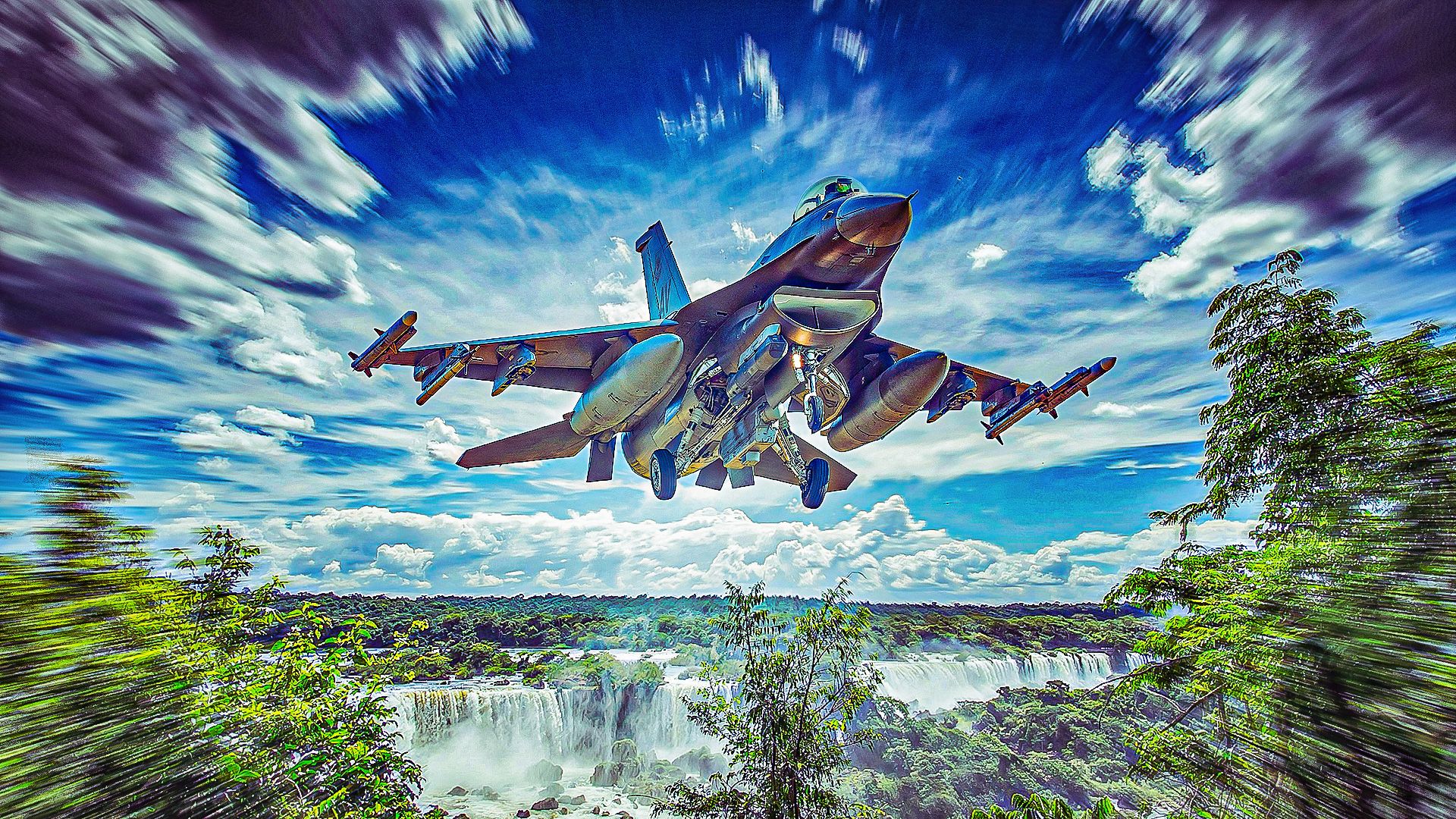
The F-16 is the modern era’s indisputably best mass-produced, multirole fighter. The Viper was conceived as nothing more than a daytime interceptor with high agility, but it was transformed into the most combat-effective fighter in the jet era. Nearly 5,000 have been made for 25 operators around the world, and it continues to evolve five decades after it debuted. The F-16 has proven to be endlessly adaptable and timelessly capable in the face of everything thrown at it.
That is the lesson offered by the iconic F-16, an effective fighter jet doesn’t need every imaginable feature onboard. The F-16s’ carefully calculated, balanced handling and performance empower their pilots with the tools to outwit, outmaneuver, and out-fly their opponents even if the enemy outclasses them by every standard.
Similarly, applied on a strategic level. The Viper’s lower cost and lower maintenance requirements make it far simpler to deploy to the frontline and much more attainable in large numbers than higher-spec jets like the F-15 Eagle. The USAF has the largest share of the world’s largest defense budget, yet the F-16 remains the tip of the spear in air defense.
The United States Air Force doesn’t have to give the Viper white-glove treatment for every aspect of its operation, but it doesn’t demand a massive sum of money and Herculean logistical effort to keep it in fighting condition even when the going gets rough. Reputed as the “Swiss army knife” of fighter jets, the F-16 can still go toe-to-toe with the latest fighters on the block and, with a little luck and the right pilot on the stick, claim victory against all odds.
The F-16 On The Battlefield Of Tomorrow

Fifth-generation fighters like the Viper’s successor, the F-35 Lightning II have capabilities that the F-16 can’t match. Still, at roughly half the cost and with none of the special needs of the F-35, the Viper can mount a credible air defense for operators that lack the budget for stealth fighters. The latest iteration by Lockheed Martin incorporates upgrades to avionics, sensors, and weapons compatibility that keep the Viper lethal against all but the most exquisite adversaries.
The large number of existing aircraft, robust global supply chain, and balanced cost-to-performance value make the F-16 the best platform for a wide variety of missions: air interception, suppression of enemy air defenses (SEAD), close air support (CAS), and supporting more advanced fighters.

The F-22 Raptor remains the apex predator of the skies, but as the small fleet of less than 200 jets is diminishing under the strain of time and cost, the F-16 is blazing new trails with artificial intelligence (AI) in the cockpit, and even a potential joint-manufacturing venture with India to make what has been dubbed the F-21 for the Indian Air Force.
The Russian Air Force may have a handful of Su-57 Felon stealth fighters, and the People’s Liberation Army Air Force (PLAAF) has a steadily growing fleet of J-20 Might Dragon fifth-gen fighters, but these are a small sliver of potential threats. Against legacy fighters made by Soviet or Western manufacturers, or in a drone-saturated airspace, the F-16 delivers the performance and firepower most air forces need at a price they can afford.
Bringing A Knife To A Dogfight

The world of aerospace defense focuses heavily on the shiniest toys on the flightline with the highest performance and newest technology, but these “exquisite” systems represent a small fraction of any modern air force. The United States Air Force is an excellent example of the complementary roles that decked-out, state-of-the-art air superiority fighters and lightweight, affordable fighter jets have in any strategic force.
While the USAF has had the high-powered, blisteringly fast, and brutally hard-hitting F-15 Eagle for just as long as the F-16 Fighting Falcon, the F-16 has achieved a prolific level of success that the expensive, complex, and heavy F-15 has not. The F-15 may outclass the F-16 in almost any comparison of performance or weapons capability. Still, if the Eagle driver slips up and loses track of his energy management at the wrong moment, that little Viper is ready to strike.
The combat pilots of the USAF have an exceptional record of combat success at the controls of the F-16, as do many of the allied air forces that fly it. The Israeli Air Force (IAF) is the second-largest operator of the Viper and boasts the first air-to-air victories at the helm of an F-16. The second recorded kill was, prophetically, none other than a MiG-21.
The IAF has pushed the limit of the F-16 on daring raids over Iraq, destroying nuclear facilities deep behind enemy lines and defending its airspace from massive onslaughts of higher-performance Soviet airframes piloted by adversaries in the Middle East. Fast-forward to the present, and retired F-16s from the Netherlands were transferred to Ukraine’s Air Force to support its defense against the invasion of Russia, where it has once again proven their exceptional battlefield effectiveness.
The Fighter Mafia

The F-16 is the epitome of a lesson written in blood, as the American military’s aviator community refers to modern flying doctrine. The Vietnam War saw US combat aircrews going up against Soviet-made MiGs made to dogfight and, most importantly, armed with internally-mounted guns. The Americans, on the other hand, were hamstrung by a recent shift in strategic doctrine that dropped guns off the armament list and prioritized speed over handling.
The fighter jet most commonly flown by the USAF, US Navy, and US Marines during that conflict was the McDonnell Douglas F-4 Phantom. Its two high-powered engines propelled it over Mach 2 and bellowed black smoke, leaving a perfect trail for hostiles to follow. Its short, speed-optimized wings and high weight made it a horrible dogfighter. While it eventually got an externally mounted gun pod, that wasn’t the fix-all solution, and it wasn’t always equipped.
The North Vietnamese MiGs claimed many kills against US forces, piling up a human toll in casualties and prisoners of war (POWs). When the US eventually withdrew from Vietnam, the fighter community of the USAF was hell-bent on ensuring that the next conflict would not be the same. Led by Colonel John Boyd and mathematician Thomas Christie, the “Fighter Mafia” was thus assembled.

A group of USAF officers, civilian defense engineers, and analysts deviated from the mainstream thinking of the 1960s aerospace community to push forward a drastically different design. Inspired by the work of John Boyd and Thomas P. Christie’s energy-maneuverability (E-M) theory, which would win the Advanced Day Fighter concept and eventually become the F-16 Fighting Falcon.
General Dynamics YF-16 Lightweight Fighter (LWF) maximized the design features that the veteran aviators and industry experts demanded to create a true dogfighter. That prototype would win the Air Combat Fighter (ACF) over the Northrop prototype. When it entered service, it almost immediately earned the new nickname, Viper, for its resemblance to the Battlestar Galactica show’s spacecraft. The rest, as they say, is history.
Viper By The Numbers

The secret to the success of the F-16 is less the technology and engineering that went into performance or weapons, both of which are still excellent by any metric, than the way the plane maximizes its best system: the pilot. The Viper is a pilot’s fighter; it will go as far as you can take it and keep coming back for more.
Every upgrade has only made it even better, enabling its “fighter jockeys” to achieve even greater success with better avionics and systems, while the baseline characteristics that make it great remain unchanged over the decades. Below is a snapshot of the key specifications of the F-16, according to the USAF.
|
Specification |
F-16C/D |
|---|---|
|
Primary function |
Multirole fighter |
|
Thrust |
27,000 pounds |
|
Wingspan |
32 feet, 8 inches (9.8 meters) |
|
Length |
49 feet, 5 inches (14.8 meters) |
|
Height |
16 feet (4.8 meters) |
|
Weight |
19,700 pounds without fuel (8,936 kilograms) |
|
Maximum takeoff weight |
37,500 pounds (16,875 kilograms) |
|
Fuel capacity |
7,000 pounds internal (3,175 kilograms); typical capacity, 12,000 pounds with two external tanks (5443 kilograms) |
|
Payload |
Two 2,000-pound bombs, two AIM-9, two AIM-120 and two 2400-pound external fuel tanks |
|
Speed |
1,500 mph (Mach 2 at altitude) |
|
Range |
More than 2,002 miles ferry range (1,740 nautical miles) |
|
Ceiling |
Above 50,000 feet (15 kilometers) |
|
Armament |
One M-61A1 20mm multibarrel cannon with 500 rounds; external stations can carry up to six air-to-air missiles, conventional air-to-air and air-to-surface munitions and electronic countermeasure pods |
|
Crew |
F-16C, one; F-16D, one or two |
|
Unit cost |
F-16A/B , $14.6 million (fiscal 98 constant dollars); F-16C/D,$18.8 million (fiscal 98 constant dollars) |
|
Initial operating capability |
F-16A, January 1979; F-16C/D Block 25-32, 1981; F-16C/D Block 40-42, 1989; and F-16C/D Block 50-52, 1994 |
Joseph Stalin may be attributed with coining the phrase, “quantity has a quality all its own,” but the F-16 has shown how that concept can be applied to air power like no aircraft the Soviet Union ever created. The Viper was made in response to the MiG-21. While it may not have achieved the epic production numbers of the “Fishbed,” it did far surpass its arch-nemesis in terms of combat effectiveness and continued service in the 21st century.
The F-16 has been the backbone of frontline air force squadrons from the US National Guard to the North Atlantic Treaty Alliance (NATO) air forces of Europe until the introduction of Lockheed Martin’s F-35. The Japanese Air Self-Defense Force (JASDF) even flies a specially made, licensed variant that Mitsubishi builds, with larger surface areas, greater fuel capacity, and a higher weapons payload.
