


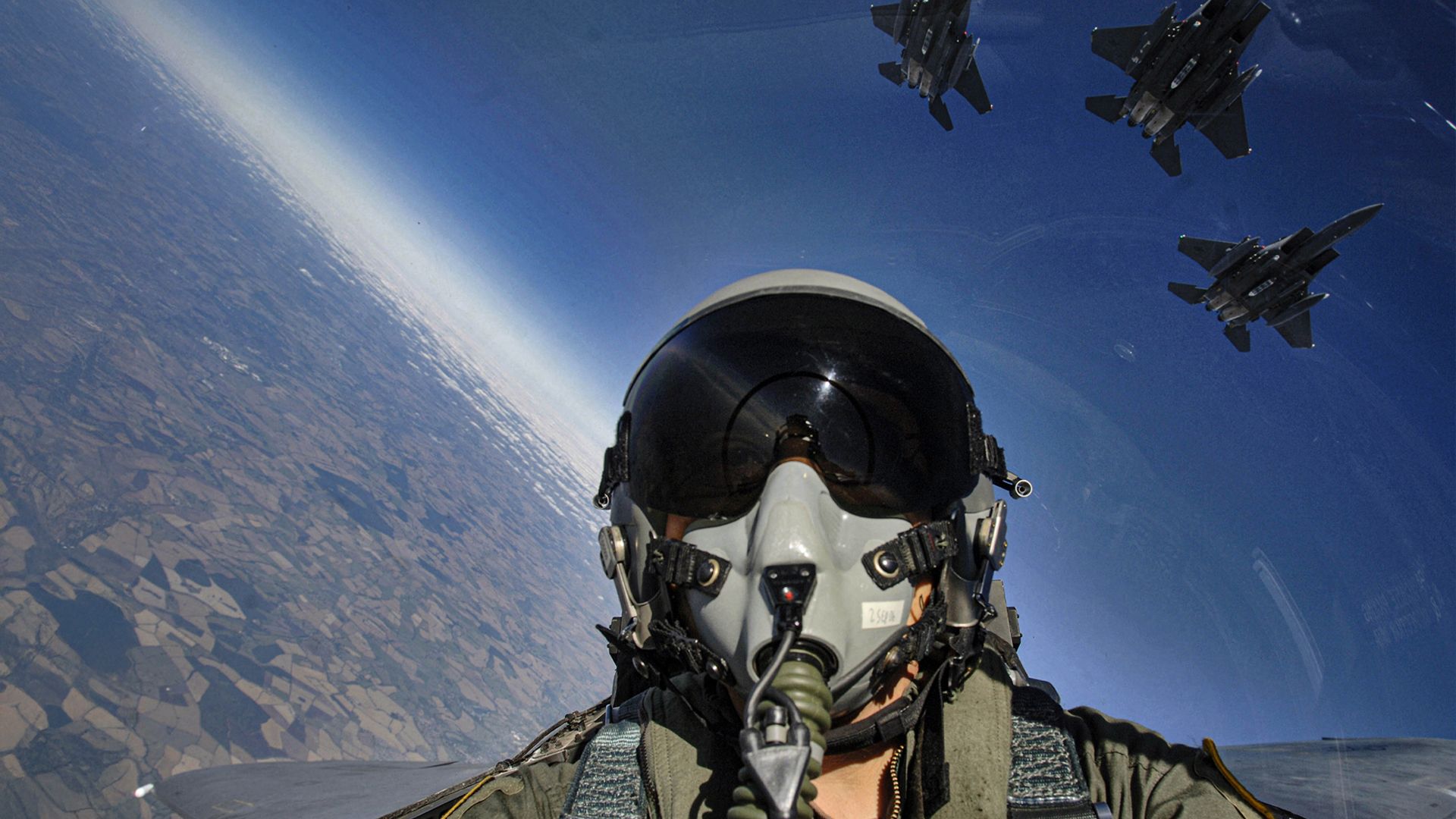
Skimming the highlights of any forum, or most popular social media platforms, will paint a picture of US air power that reads like a tale of Western decline. The sensationalism around emerging technology and new platforms produced by others like the People’s Republic of China (PRC) sounds as if the United States Air Force is on the verge of being eclipsed as the top military air power in the world.
That’s just not true. It’s so far from the reality of the modern balance of power that it is easy to see how PRC efforts to saturate social media with disinformation and propaganda have influenced mainstream channels. Are there potentially greater threats to the air dominance of the USAF than ever before? Yes. Is the USAF already making moves to stay one step ahead (or two)? Absolutely.
The familiar concept of air power as the 20th century shaped it is no longer the standard. Raw performance, huge payloads, and massive numbers of aircraft do not guarantee victory on today’s battlefield, or more importantly, on tomorrow’s. The key to victory in the air now, and in the future, is a combination of manned, sixth-generation stealth platforms and attritable drones coordinating complex tactics in a data-networked battlespace.
That means that the days of ultra-fast fighters swooping in to strike and huge bombers lumbering overhead with tons and tons of ordnance are now obsolete. The USAF is in the midst of one of its greatest transformations since 1947, when it became its own service at the dawn of the Cold War.
21st Century Tactics And Beyond

In order to dominate the current battlespace against near-peer adversaries like China and Russia, the Air Force is undergoing a paradigm shift from 20th-century tactics centered on mass, individual aircraft performance, and brute force to 21st-century tactics centered on information dominance, stealth, integrated systems, and autonomous technology. This move signifies a significant shift from strategies like “trolling for targets” and visual engagements to beyond-visual-range domination, where survival and victory depend on targeting the enemy first while staying hidden.
Key airframes from the 20th century are being retired, including the E-3 Sentry AWACS, being replaced by the networked Boeing E-7 Wedgetail, and the B-1 Lancer and B-2 Spirit bombers being consolidated and superseded by the deep-penetrating B-21 Raider stealth bomber. Older fighters like the legacy F-15s and F-16s are giving way to a “system of systems” approach that pairs fifth-generation F-35s and sixth-generation F-47s (NGAD fighter) with swarms of uncrewed Collaborative Combat Aircraft (CCAs).
The logistical tail is also evolving, with more resilient KC-46 Pegasus tankers replacing susceptible KC-135 tankers and the upcoming Next Generation Air Refueling System (NGAS) to provide deep-strike capabilities. In the end, this new doctrine turns the USAF from a fighter-focused organization into an integrated, highly networked, and stealthy force that can overwhelm enemies with swarming tactics and superior information.
Supersonic Cannon Fodder

Fourth-generation plus (4+) fighters face significant disadvantages against sixth-generation (6th gen) fighters due to key technological differences in stealth, sensor integration, artificial intelligence (AI), and unmanned systems control. The 6th-gen jets are equipped with advanced all-aspect stealth designs that reduce their radar visibility, unlike the larger radar cross-section of 4+ gen fighters, which often exhibit lower stealth due to external weapon carriage.
The vast majority of modern air combat takes place at Beyond Visual Range, where engagements are decided by sensors and missiles, not close-in dogfighting. Sixth-gen platforms utilize advanced sensor fusion and AI, functioning as command centers that synthesize data from networks of satellites and drones. Manned-unmanned teaming (MUM-T) in 6th-gen jets enables them to command swarms of drones, enhancing operational effectiveness without endangering pilots.
Sixth-generation fighters are anticipated to possess advanced electronic warfare (EW) capabilities and may integrate directed energy weapons, improving their performance in contested airspace. In engagements between these two generations, the 6th-gen fighter can detect and destroy the 4+ gen aircraft from a distance, rendering traditional dogfights obsolete.
A stealth aircraft can detect and fire upon a non-stealthy aircraft from a distance that the non-stealthy aircraft cannot even perceive a threat, effectively allowing the stealth jet to destroy its opponent before the opponent knows it is in a fight. Performance metrics like top speed and tight turning circles are largely “party tricks” if the enemy can see you coming from 200 miles away.
Radar Cross Section: Size Matters

Modern surface-to-air missiles (SAMs) and air-to-air missiles are extremely fast and accurate. If a radar can track a non-stealthy aircraft, a missile can likely hit it, regardless of how fast or maneuverable the aircraft is. Stealth reduces an aircraft’s radar cross-section (RCS) to such an extent that it makes the aircraft very difficult to track with targeting radar, rendering these advanced missile systems less effective.
Stealth provides the critical element of surprise, allowing a pilot to choose when and how to engage, or to avoid engagement altogether. This dramatically increases the aircraft’s survivability and mission success rate, as avoiding detection is the best form of self-defense against modern threats.
Without a complicated and risky support operation involving jamming aircraft and defense suppression assets, stealth aircraft can penetrate complex, integrated air defense systems to strike high-value, heavily defended targets that non-stealth aircraft cannot reach.
Although speed and maneuverability are still important, they are primarily important in a close-quarters “dogfight” situation, which is what modern air doctrine aims to prevent. A stealth aircraft’s built-in stealth characteristics, such as a diminished infrared signature, can still make it more difficult for heat-seeking missiles to lock on in the unlikely event that it is discovered and forced into a close-range encounter.
Because stealth aircraft are built with sophisticated sensor fusion, the pilot has unmatched situational awareness. They have an unbeatable information advantage because they can network with other platforms (such as devoted wingman drones in the future) to create a complete picture of the battlefield without sending out powerful radar signals themselves.
Sixth-Gen Strike: The Raider

The Air Force is restructuring its bomber fleet to counter China and Russia by creating a two-type fleet of B-21 Raiders and upgraded B-52 Stratofortresses, while retiring the B-1 and B-2 bombers. The strategy emphasizes the B-21’s ability to penetrate highly contested airspace using superior stealth, range, and advanced networking to hold any target at risk globally, thus bypassing advanced anti-access/area-denial (A2/AD) defenses.
By retiring the B-1 Lancer and the B-2 Spirit in the 2030s, the USAF will reduce its fleet from four types to just two. Designed to operate in high-threat environments where other aircraft cannot survive, the B-21 Raider will be the main deep-strike, penetrating stealth bomber. It is a dual-capable platform, which is essential for credible deterrence because it can deliver both conventional and nuclear weapons.
In order to meet the demands of concurrent operations in the Indo-Pacific and European regions, the Air Force intends to purchase at least 100 B-21s, with plans to grow the fleet from 145 to over 200. This is a substantial increase in stealth bombers. By enabling decentralized maintenance and operations from many locations, Agile Combat Employment (ACE) will increase fleet survivability against possible enemy strikes.
The technological advantages of the B-21 include next-gen stealth, an open-systems architecture for quick upgrades, enhanced networking, and compatibility with unmanned collaborative combat aircraft, significantly augmenting intelligence, surveillance, reconnaissance, and strike capabilities against advanced Russian and Chinese air defenses.
The USAF’s Exquisite Fighters

The F-35 and, more extensively, the F-47 will serve as “quarterbacks” or command-and-control centers for a number of unmanned, less expensive Collaborative Combat Aircraft (CCAs), also known as “loyal wingmen” drones. A swarm of CCAs led by a single F-47 or F-35 can carry out high-risk operations like scouting, engaging targets, electronic warfare, or serving as decoys or sensor extenders, thereby increasing the power of the manned jet and lowering pilot risk.
The F-35 and the new F-47 will fundamentally change the USAF tactical operations and force structure by shifting from a traditional one-manned jet per mission approach to a highly integrated system of systems centered around manned-unmanned teaming (MUM-T) and network-centric warfare.
Sensor fusion is already a strong suit for the F-35, providing pilots with a comprehensive view of the battlefield. With AI-assisted processing and sophisticated networking, the F-47 will advance this and enable quick decision-making throughout the entire integrated force (satellites, drones, and other jets). In complex environments, this results in a much shorter kill chain and less work for pilots.
The High Low Fleet

The USAF structure is evolving into a mixed fleet. The F-35 will form the bulk of the advanced fighter force, serving as a versatile, multirole fighter for global interoperability. The F-47 will be a smaller, specialized fleet. The objective is a structure that guarantees life in a contemporary, high-threat environment where the ability to stay undetected is more crucial than a specific quantity of airframes.
The open-systems architecture and built-to-adapt nature of the new aircraft enable quick hardware and software upgrades (such as the F-35’s Block 4) to address changing threats more quickly than earlier models. The F-47 is designed to be more sustainable and require less workforce and infrastructure to deploy than previous generations (like the F-22), which could lead to a more flexible and agile logistics structure, consistent with the USAF’s Agile Combat Employment (ACE) strategy.
The F-15EX and the B-52 Stratofortress are examples of upgraded legacy aircraft that fit into the larger low-end strategy differently. They complement the penetrating missions of the high-end by operating in less contested airspace and utilizing their large payload capacities to launch standoff munitions (such as the LRSO missile for the B-52) from safe distances.
The formal integration of a large fleet (over 1,000 planned) of CCAs creates a new force element that must be structured, trained, and sustained, alongside the manned platforms. CCAs are intended to be significantly less expensive than manned fighters, allowing the USAF to procure them in large volumes to achieve mass and replace expected combat losses without the immense cost of losing a fifth or sixth-generation fighter and its pilot.
Next-Gen Linebackers

The Air Force’s new era is focused on the ability to operate deep within contested airspace. The KC-46 extends the range and endurance of the F-47, F-35, and B-21, allowing them to penetrate deeper into enemy territory and stay on station longer. The Next Generation Air Refueling System (NGAS), with its own low-observability features, would be able to fly into contested airspace (areas where the enemy has advanced air defenses), refuel the stealth aircraft, and return safely.
The concept for NGAS is an entire “system,” which may include a mix of large, possibly optionally-crewed, stealthy tanker aircraft and potentially even smaller, autonomous refueling drones that shuttle fuel between a large tanker and combat jets deeper in enemy territory.
The KC-46’s modernized features and higher survivability, along with its ability to carry more passengers and cargo, as well as serve an aeromedical evacuation role, make it crucial for the dispersed and austere operations under ACE doctrine.
The E-7 wedge tail features a Multirole Electronically Scanned Array (MESA) radar that provides superior air and surface tracking that is a generational leap (or two) above the E-3 Sentry it replaces. It processes and relays real-time data to and from virtually any asset, including the F-35, F-47, CCA, space-based sensors, and more. This enables high-end fighters and low-end drones to operate as a cohesive, coordinated force.
