


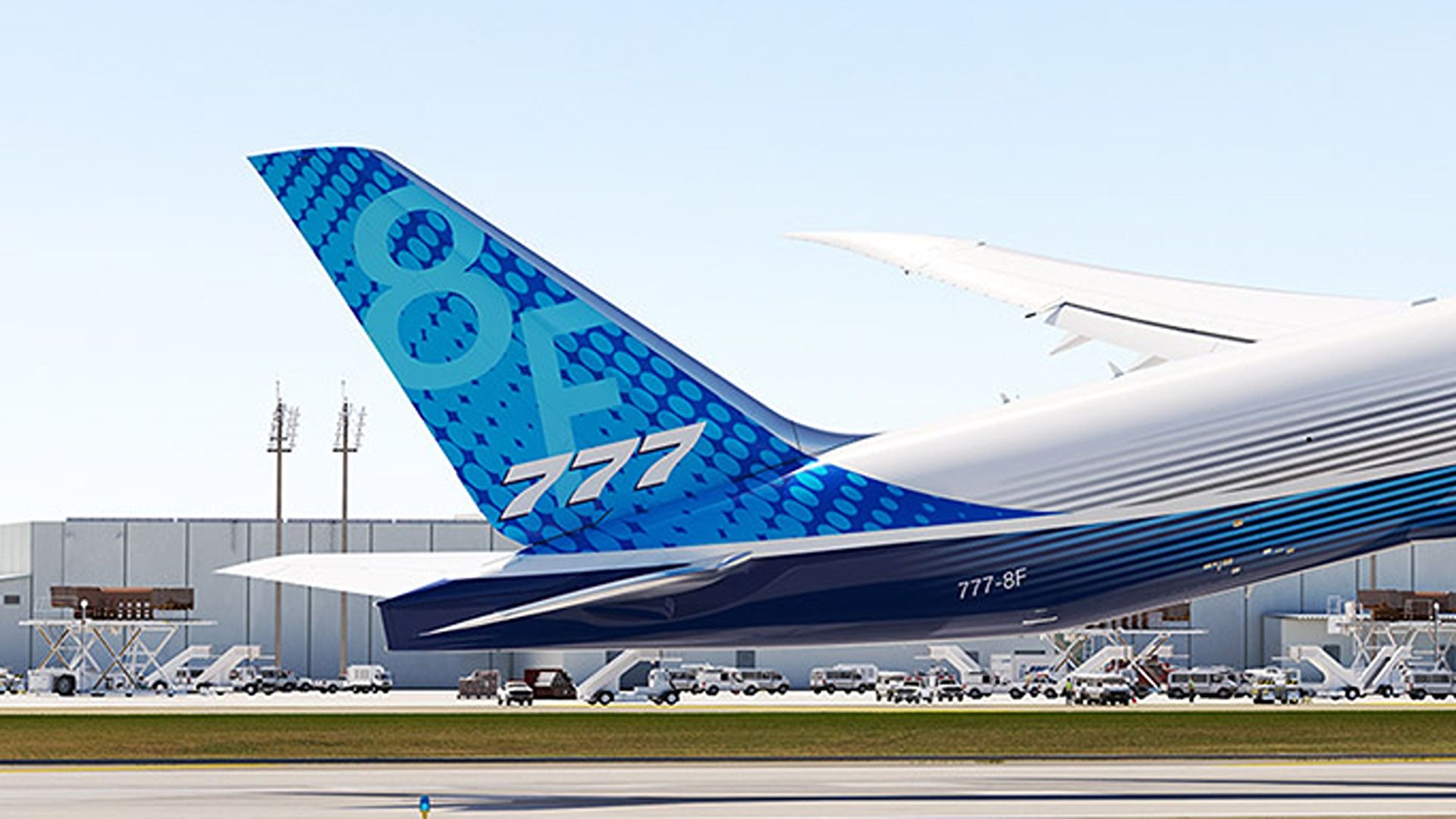
The Boeing 777-8F is the next generation cargo aircraft to be produced by the US manufacturer, combining the advanced technology of the 777X program and building on the success of the popular 777F. As a result, the 777-8F has been billed as the future of long-haul cargo transport.
In this article, we will take a closer look at the Boeing 777-8F, examining its origins, specifications, and the cargo carriers that are set to operate the aircraft when it enters service in 2028.
How Did The Boeing 777-8F Come To Be?

 Qatar Airways was looking to replace its aging Boeing 777Fs, and urged the US manufacturer to develop a freighter variant of its upcoming Boeing 777X series. As a result, Boeing developed the 777-8F, and the Doha-based carrier subsequently placed a firm order for 34 of the aircraft, with options for an additional 16. The deal was valued at more than $20 billion, making it Boeing’s largest-ever cargo aircraft order.
Qatar Airways’ CEO at the time, Akbar Al Baker, spoke about the anticipated aircraft.
“Boeing has a long history of building market-leading freighter aircraft and Qatar Airways is honored to have the opportunity to be the launch customer for the 777-8 Freighter, an aircraft which will not only allow us to further enhance our product offering for our customers, but also help us meet our objectives to deliver a sustainable future for our business. Today marks a great day in the ever-building and strong relationship between Qatar Airways and Boeing. We certainly push Boeing hard to deliver upon our expectations, and the team at Boeing consistently strives to meet and exceed our expectations, giving the opportunity for us to be here today to launch the most significant new freighter aircraft for a generation.”
Several other major worldwide cargo carriers have since ordered the Boeing 777-8F, with the aircraft proving to be a commercially successful venture for Boeing, capitalizing on the rapid growth in air cargo demand during and after the COVID-19 pandemic. The first 777-8F is expected to be delivered in 2028.
About The Boeing 777-8F

The Boeing 777-8F is based on the 777X series and incorporates the same advanced GE9X engines, composite wings with folding wingtips, and modern flight deck technology inspired by the Boeing 787.
The Boeing 777-8F can accommodate up to 31 pallets on its main deck and 13 on its lower deck, representing a 17% increase in volume over its predecessor – the 777F, and bringing its maximum payload more in line with the 747-400F. With a range of more than 5,000 miles at maximum payload, the 777-8F offers flexibility for global cargo carriers, enabling them to operate long-haul routes with fewer technical stops. The aircraft also offers superior fuel efficiency, supporting the aviation industry’s wider sustainability targets and ensuring lower operating costs for airlines.
The specifications of the Boeing 777-8F
|
Payload |
118 tonnes |
|
Range |
5,074 miles / 8,165 km |
|
Length |
70 m / 232 feet, 6 in |
|
Wingspan (with wingtips extended) |
71 m / 235 feet, 5 in |
|
Wingspan (with wingtips folded) |
64 m / 212 feet, 8 in |
|
Height |
19 m / 64 feet |
Production Of The Boeing 777-8F Has Already Started

 Boeing began production of its first 777-8F aircraft in July 2025. At the time, Jason Clark, the company’s Vice President and General Manager of the 777/777X, celebrated the milestone.
“It may seem small, [but] it’s that one hole…that gets everything started. All the work that goes into starting a program, the years of development, the years of engineering, the years of supply chain, procurement, and contracting, and all the other pieces—the blood, sweat, and tears—all that innovation comes together and is represented in the first in that first hole.”
The Boeing 777-8F is primarily assembled at the US manufacturer’s Everett facility, located near Paine Field. However, the different components of the 777-8F are produced globally across Boeing’s extensive supplier network, including fuselage and wing production in Japan. The first test flights are expected to take place in 2026, with the first delivery planned for two years later in 2028.
Which Carriers Have Ordered The Boeing 777-8F?

Since Boeing announced the 777-8F back in 2022, the US manufacturer has received more than 50 orders from cargo carriers around the world.
|
Airline |
Boeing 777-8F Orders |
|---|---|
|
Qatar Airways Cargo |
34 |
|
Cargolux |
10 |
|
Korean Air |
8 |
|
Lufthansa |
7 |
|
China Airlines |
4 |
|
All Nippon Airways |
2 |
|
Silk Way West Airlines |
2 |
The order for eight Boeing 777-8Fs from Korean Air forms part of a broader $50 billion agreement with Boeing, which also includes 20 777-9s, 25 787-10s, and 50 737-10s. This deal was finalized in July 2025, with all aircraft set for delivery by the end of 2030. Korean Air currently operates an extensive cargo fleet made up of four Boeing 747-400Fs, seven 747-8Fs, and 12 777Fs. These aircraft have an average age of 20 years, 11 years, and 10 years, respectively.
The carrier’s fleet strikes a balance between the capacity of the Boeing 747‑400F and 747‑8F and the fuel-efficient, long-range performance of the 777F. Korean Air’s plan to introduce the 777‑8F highlights the carrier’s strategic push toward higher efficiency and sustainability in its cargo operations, very much in line with broader industry goals and trends.
The Boeing 777 Freighter

The Boeing 777-8F will replace the 777F as Boeing’s flagship long-haul cargo aircraft. The 777F is based on the design of the 777-200LR, featuring the same fuselage, engines, and fuel capacity.
The Boeing 777F’s operational history dates back to 2009, when the first example was delivered to Air France. The latest data from ch-aviation shows that today, Fedex Express is currently the world’s largest operator of the Boeing 777F, with a total of 59 in its fleet. The aircraft’s largest operators are listed in the table below:
|
Ranking |
Airline |
Boeing 777F |
|---|---|---|
|
1 |
FedEx Express |
59 |
|
2 |
DHL |
32 |
|
3 |
Qatar Airways Cargo |
28 |
|
4 |
AeroLogic |
26 |
|
5 |
Lufthansa Cargo |
18 |
|
6 |
Emirates SkyCargo |
12 |
|
7 |
Kalitta Air |
8 |
|
8 |
Silk Way West Airlines |
5 |
|
9 |
Etihad Cargo |
5 |
|
10 |
CMA CGM Air Cargo |
2 |
The Boeing 777F has become known for its reliability, efficiency, and large cargo capacity, all of which have contributed to the aircraft becoming a cornerstone of modern air cargo transport, supporting global trade and supply chains with speed and dependability. For that reason, the 777F will likely still play a key role in many cargo carriers’ fleets, even with the arrival of the 777-8F.
FedEx Express is the world’s largest cargo airline by fleet size, with more than 650 aircraft, including the Boeing 777F, 757F, McDonnell Douglas MD-11F, and Airbus A300F. FedEx Express is followed by UPS Airlines with around 300 aircraft, and Amazon Air, with just under 100.
The Wider Boeing 777X Program

The Boeing 777-8F is based on the 777X, which will soon become Boeing’s flagship long-haul passenger aircraft. The 777X is designed to raise the bar in terms of efficiency, capacity, and range. It comes in two variants – the 777-8 and the larger 777-9, both featuring cutting-edge technologies borrowed from the 787, such as composite materials and advanced onboard technology. The 777X will be powered by two General Electric GE9X engines, which are the most powerful commercial aircraft engines ever built, each providing the aircraft with more than 105,000 lbfs of thrust. The engine is also up to 10% more fuel efficient than its predecessor, the GE90.
Another distinguishing feature of the Boeing 777X is its folding wingtips, which extend the wingspan to over 71 m during flight for improved lift and efficiency, but fold up on the ground to enable to aircraft to fit into existing airport gates. This innovation enables the aircraft to operate within current airport infrastructure, despite its increased size.
Delays have plagued the Boeing 777X. The aircraft was originally due to enter commercial service in 2020, but this has since been pushed back again and again, with the first aircraft delivery now expected in 2026.
When deliveries eventually begin, Lufthansa is set to be the launch customer of the Boeing 777X. However,  Emirates is due to become by far the largest operator of the 777X, with a staggering 205 of the aircraft on order, made up of 35 777-8s and 170 777-9s. The Dubai-based carrier is followed by Qatar Airways, based at Doha Hamad International Airport (DOH), which has a total of 94 firm orders in place for the 777X.
The airlines with the largest orders for the Boeing 777X are outlined in the table below:
|
Ranking |
Airline |
Boeing 777X Orders |
|---|---|---|
|
1 |
Emirates |
205 |
|
2 |
Qatar Airways |
94 |
|
3 |
Singapore Airlines |
31 |
|
4 |
Lufthansa |
27 |
|
5 |
Etihad Airways |
25 |
|
6 |
Cathay Pacific |
21 |
|
7 |
All Nippon Airways |
20 |
|
8 |
British Airways |
18 |
|
9 |
Air India |
10 |
|
10 |
Ethiopian Airlines |
8 |
- ICAO Code
-
B77F
- IATA Code
-
77F
- Engine Count
-
2
