


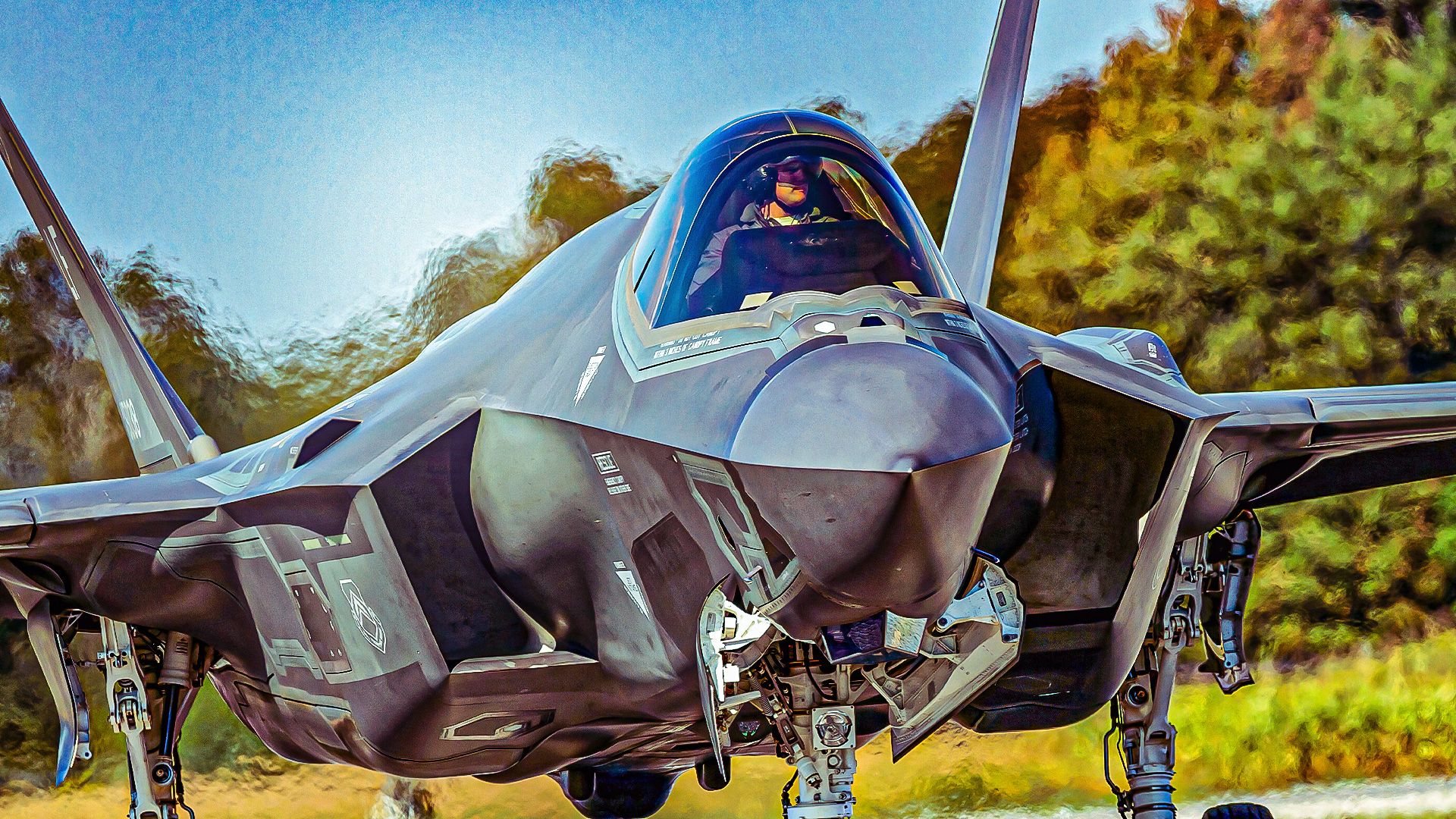
What are the largest Navy air stations, and what are their strategic roles? There are many ways to measure a base’s size, including acreage, personnel, number of aircraft stationed, and flight operations. It is difficult to provide rankings for some of these measures. For example, training aircraft may be stationed permanently, but aircraft carrier strike groups with F-35 and F/A-18 fighter jets fluctuate with deployments. It’s also worth noting that the Marine Corps is part of the Department of the Navy. Sometimes it has its own stations, and at other times it uses Navy stations.
Ranking naval air stations by number of flights is also somewhat odd, as it equates a T-6 training flight with an F-35C flight. This article will rank some of the largest naval air stations based on the reported number of aircraft stationed there. As stated, this does not necessarily imply one air station is larger than the other, and numbers fluctuate. A carrier air wing’s overseas deployment typically lasts six to seven months. In July 2024, the USS Dwight D. Eisenhower (CVN-69) finally returned home after a historic nine-month deployment. Here are six of the largest US Navy air stations in the US.
Naval Air Facility Atsugi/MCAS Futenma
Around 90 aircraft stationed

The Naval Air Facility Atsugi is one of the largest US Navy air stations overseas. It is located in Japan near Tokyo and is described as the largest US Navy air station in the Pacific outside the United States. The base is jointly used by the US Navy and the Japanese Maritime Self-Defense Force. It is a vital forward-deployed aviation hub for US Navy operations in the Western Pacific.
The base enables rapid response in the region and supports carrier strike groups, destroyers, and expeditionary aviation operations. It plays an important role in the US Navy’s operations in the South China Sea amid competition with China. Some of Atsugi’s squadrons were moved to Marine Corps Air Station Iwakuni in 2017 and 2018 in western Japan. Iwakuni is one of the largest Marine/Navy air bases in Japan.
Another major and vital air base in Japan is the Marine Corps Air Station Futenma in Japan’s southern island of Okinawa. Futenma serves both fixed and rotary-wing aircraft. It is also one of the US’s most forward-deployed air bases and would be on the front line of a major conflict in the region. The main air base in the US territory of Guam is Andersen Air Force Base and is operated by the US Air Force, although it can also be used by other services, like the Marines.
Naval Air Station Whidbey Island
Around 90 aircraft stationed

Naval Air Station Whidbey Island in the state of Washington supports the Navy’s EA-18G Growler, P-8 Poseidons, C-40 Clipper aircraft, and its MH-60S Seahawk helicopters. The base’s main portion is Ault Field, located around three miles north of Oak Harbor, but it also includes the Seaplane base. During WWII, the PBY Catalina was a common sight at the Seaplane base.
Whidbey Island is a key aviation hub in the Pacific Northwest. It is home to all the Navy’s important electronic attack squadrons flying the EA-18G Growler based on the F/A-18 Super Hornet. The Growlers are central to the US Navy’s ability to conduct SEAD (Suppression of Enemy Air Defense) and DEAD (Destruction of Enemy Air Defense) missions.
In all, there are 20 active duty US Navy squadrons with another three Navy Reserve squadrons stationed at the air station. This includes all EA-18G Growler squadrons. It is also home to four anti-submarine and maritime surveillance squadrons as well as a signals intelligence reconnaissance squadron. According to the US DoD, the air station is “the Navy’s premier naval aviation installation in the Pacific Northwest.“
Naval Air Station Jacksonville
Over 100 aircraft stationed full-time

Another of the massive Naval Air Stations is NAS Jacksonville in Florida, located around eight miles from downtown Jacksonville. The Navy says it is the largest installation in Navy Region Southeast, covering an area of over 3,800 acres. The base also includes the Navy’s only live-fire range on the East Coast. Its three bombing ranges include Pinecastle, Rodman, and Lake George, as well as Outlying Field Whitehouse.
NAS Jacksonville has seven active-duty VP squadrons that fly the P-8A Poseidon maritime patrol aircraft based on the Boeing 767 civilian airliner. It has three Reserve squadrons, five helicopter squadrons, and a single MQ-4C UAS Triton squadron. The Triton is an advanced maritime patrol drone also operated by Australia. Overall, the base has more than 100 full-time aircraft made up of P-8A Poseidons, MH-60R Romeo helicopters, C-130T Hercules tactical transports, and MQ-4C Triton drones. Aircraft include US Customs and Border Patrol and Flying Club aircraft.
The MH-60 is “the” modern naval helicopter, forming the backbone of US Navy ship-based helicopter fleets and those of many US allies and partners around the world. The air station serves as a major base for the Navy’s anti-submarine, maritime patrol, and surveillance capabilities for the Atlantic and Gulf regions. It provides a forward hub for the Atlantic theater.
Naval Air Station North Island
Over 230 aircraft stationed

The Navy’s NAS North Island should not be confused with New Zealand’s North Island. This station is based on the northern end of the Coronado Peninsula in San Diego Bay. It is part of the larger Naval Base Coronado, which forms the largest aerospace-industrial complex of the US Navy. This is the base where some of the Navy’s Pacific Coast aircraft carriers are based.
The larger Naval Base Coronado complex covers around 57,000 acres and employs more than 36,000 personnel (military and civilian). NAS North Island is home to 23 aviation squadrons and is a major embarkation point for carrier strike groups on the West Coast. The naval station is at the center of the Navy’s power projection into the Indo-Pacific region.
The North Island base is one of the oldest air stations, having been commissioned as a naval air station in 1917 during WWI. Among its aircraft are large numbers of MH-60S Seahawk and MH-60R Seahawk helicopters. Its Carrier Air Wing tenants include CVW-2, CVW-9, CVW-11, and CVW-17, whose aircraft are a mix of F/A-18 Super Hornets and F-35Cs.
Naval Air Station Oceana
Around 250 aircraft stationed

The US Navy’s Norfolk Naval Base is regarded as the most powerful naval base in the world and is an epicenter of US Navy ship construction. Predictably, it is also home to one of the largest Navy air stations. Navy Air Station Oceana is the primary home of the Navy’s Atlantic Fleet strike fighter community and houses some 17 squadrons, 16 of which are F/A-18 Super Hornets. Another squadron operates the C-40A Clipper.
The airbase supports Carrier Air Wings 1, 3, 7, and 8 and is a Master Jet Base. These deploy on the Atlantic-based aircraft carriers; Norfolk is the largest aircraft carrier base. The air station says, “The primary mission of NAS Oceana is as a Shore-Based Readiness Integrator, providing the facilities, equipment, and personnel to support shore-based readiness, total force readiness and maintain operational access of Oceana-based forces.”
Two squadrons are permanently based at Oceana, including the largest fleet replacement squadron, the Strike Fighter Squadron (VFA) 106, as well as the adversary training squadron, Fighter Squadron Composite (VFC) 12. The Navy says around two-thirds of this complement is continuously “working up” on aircraft carriers sailing off the coast or deployed at the inland Naval Air Station Fallon in Nevada. At Fallon, they conduct live air-to-ground and air-to-air weapons training.
Naval Air Station Whiting Field
Around 250 aircraft stationed
Whiting Field is one of the Navy’s two primary pilot training bases, with the second being NAS Corpus Christi in Texas. Whiting Field is located in the Florida Panhandle near Milton. The massive base has multiple airfields sharing a common support base. The Primary Flight Training students fly their T-6 Texan II trainers at North Whiting Field, while those enrolled in the Advanced Helicopter Training program operate at South Whiting Field.
The base spans around 12,000 acres, and is home to more than 250 aircraft used for training. These include 142 T-6 Texan II aircraft and 112 TH-57 helicopters, although it is currently transitioning to the new TH-37A Thrasher helicopter. Its website says it includes, “12 outlying fields with three separate and fully operational airfields.” These are called Navy Outlying Landing Fields (NOLFs), and these fields see around 120,000 to 160,000 annual flight hours. The base is home to Training Air Wing FIVE, and “together form the backbone of Naval Aviation Training.”
With around 1 million flight hours each year, the base complex accounts for 17% of the Navy’s flight hours, making it the busiest in the world. The Navy points out that this is more than Atlanta-Hartsfield International Airport, the US’s busiest civilian airport. All the Navy, Marine Corps, and Coast Guard helicopter pilots receive their initial helicopter aircraft training at Whiting Field. Over 60% of all primary flight training is performed at this naval station.
